
夸克S1

Search documents
AI眼镜专家交流-CES智能眼镜百花齐放-关注新品催化
2026-01-19 02:29
Summary of AI Glasses Industry Conference Call Industry Overview - The AI glasses industry is evolving towards independent communication and app operation capabilities, with significant advancements made by companies like Thunderbird Innovation. However, battery life remains a critical challenge, necessitating users to carry charging cases despite improvements like hot-swappable charging [1][5][6]. - Lightweight design is a growing trend, with brands like Mijia and XGIMI launching products weighing over 20 grams, enhancing user comfort. However, breakthroughs in optical display technology are still needed, particularly in cost reduction and yield improvement [1][2]. - Silicon carbide materials are viewed as a future direction due to their excellent properties, but high costs and yield issues hinder large-scale application in the short term. Resin lenses will continue to dominate due to their cost advantages [1][7]. Market Insights - Global AI glasses sales are projected to reach 5 to 8 million units by 2025, with Meta holding a 70% market share, primarily in North America, indicating a lack of consumer demand in other regions [1][6][12]. - By 2026, global AI glasses shipments are expected to reach 16 million units, driven by technological breakthroughs and low-cost products, although the presence of low-priced products may lead to a "bad money drives out good" phenomenon [3][14]. - The supply chain for AI glasses is still immature, which is a limiting factor. However, significant technological advancements are anticipated by 2027, with shipments potentially exceeding 30 million units by 2028 and reaching 100 million units by 2030 [3][16]. Key Product Strategies - AI glasses manufacturers are focusing on several key areas: optical display, computing modules, power supply systems, and ecosystems. Dual-color display technology is a significant breakthrough direction, but cost reduction and yield improvement are necessary [4]. - The integration of AI with operating systems is a crucial trend, with companies like Apple and Google collaborating to incorporate AI into their operating systems [4]. - Battery life remains a major challenge, with manufacturers striving to enhance battery performance to allow for all-day wear without frequent recharging [4][5]. Competitive Landscape - Meta is the market leader, followed by stable brands like Thunderbird and Excel, with emerging brands like Yiweng gaining traction in Europe [13]. - Smaller AI glasses manufacturers have opportunities in niche vertical markets, such as smart glasses for guiding, cycling, skiing, and fitness coaching, which have significant market potential [18]. - The entry of large players like Apple and Alibaba is expected to drive industry development, even if their products do not achieve high sales initially [15]. Future Trends and Challenges - The AI glasses industry is currently in a dormant phase, with a predicted need for 3 to 5 years before a significant market explosion occurs. Most companies are still searching for application breakthroughs [20]. - The industry faces challenges such as supply chain issues, production difficulties, and the need for material breakthroughs [19]. - By 2026, the domestic market is expected to see a significant increase in product offerings, with domestic brands potentially capturing 30% to 50% of the market share [23]. Conclusion - The AI glasses market has a promising future, but it is constrained by supply chain maturity and the integration of multiple functions into a compact wearable device. The next few years will be critical for technological advancements and market acceptance [16][20].
2025年的智能眼镜,一个能打的都没有?
投中网· 2025-12-19 04:36
Core Viewpoint - The article discusses the rapid growth and competitive landscape of the AI smart glasses market, highlighting the diverse range of products and the lack of standardization in the industry [5][6]. Group 1: Market Overview - By 2025, it is estimated that around 30-40 companies will release AI smart glasses, with some institutions reporting over a hundred [5]. - The sales of smart glasses are increasing rapidly, with a 2500% year-on-year growth in transaction volume during the 2025 Double Eleven shopping festival, making it one of the fastest-growing categories in the 3C digital industry [5]. Group 2: Product Classification - Smart glasses can be classified into five levels based on their intelligence: - L1: Non-interactive, video playback only - L2: Interactive via headphones, no object recognition - L3: Can capture video and recognize objects with AI interaction - L4: Includes AR functionality for real-time display of information - L5: Full-color display with advanced interaction capabilities [8][11]. Group 3: Current Product Landscape - Nearly half of the smart glasses from major manufacturers fall into L2 and L3 categories, priced generally under 2000 yuan, resembling smart headphones more than traditional smart glasses [11]. - Products priced above 3000 yuan typically target tech-savvy consumers, with limited offerings in the L4 category, such as the Thunderbird Innovation X3 Pro, which struggles with battery life and weight issues [12][13]. Group 4: Sales Data and Trends - In Q3 2025, the Chinese smart glasses market shipped 623,000 units, a 62.3% year-on-year increase, with audio-video capturing glasses accounting for 454,000 units and AR/VR glasses for 169,000 units [18]. - The market for consumer-grade AR/VR glasses saw a similar trend, with 169,000 units sold, but the exact sales figures for AR-enabled smart glasses remain unclear due to combined reporting with VR devices [19]. Group 5: Future Outlook - IDC predicts that by 2025, smart glasses shipments in China will exceed 2.9 million units, with a year-on-year growth rate of over 121% [22]. - Despite the optimistic projections, the industry is still maturing, and the actual demand for smart glasses has yet to be established, with many products still seen as luxury items rather than necessities [22][23]. Group 6: Target Markets and Strategies - Brands are advised to focus on specific user groups, such as car owners or content creators, to create more defined use cases for smart glasses [25]. - The current wave of smart glasses development is closely tied to the AI trend, with many companies seeking to leverage their AI capabilities through wearable technology [26].



千亿赛道爆发前夜,智能眼镜供应链暗藏机遇
Xin Lang Cai Jing· 2025-12-17 01:56
Core Insights - The launch of Quark smart glasses has sparked a wave of excitement reminiscent of the early iPhone days, indicating a significant market potential for smart AR glasses, which are expected to become a core hardware in daily life [1][7] - During the 2025 Double Eleven shopping festival, Tmall's AI glasses sales surged by 2500%, while JD's similar category saw a growth rate of 346%, highlighting the rapid adoption of this technology [1][7] Group 1: Product Development and Market Positioning - Quark S1 smart glasses have successfully addressed the challenges of "computing power, battery life, and weight," achieving a weight of only 51 grams and a design that resembles regular glasses [3][9] - The glasses incorporate advanced features such as detachable battery design for all-day use and improved display technology that resolves common issues like color dispersion and text clarity [3][9] - The integration of Alibaba's navigation, AI models, and payment functionalities has significantly enhanced the product's responsiveness and practicality, positioning it competitively against industry leaders like Meta [3][9] Group 2: Strategic Industry Dynamics - The current AI-driven industrial revolution presents a gap in hardware capabilities, prompting AI companies to develop tangible hardware products to leverage their software strengths [3][9] - Major tech firms, including Alibaba and Li Auto, are entering the smart AR glasses market, with Tencent and Baidu expected to follow, indicating an impending escalation in competition within this sector [4][10] Group 3: Supply Chain Opportunities - Despite the involvement of large companies like Alibaba and Li Auto, the production of smart AR glasses relies heavily on the technological capabilities of supply chain partners, such as Guangfeng Technology [11] - Guangfeng Technology has strategically chosen the LCoS display technology, aligning with market demands and maintaining a competitive edge in the industry [5][11] - The company's recent innovations, including the Dragonfly G1 and Rainbow C1 LCoS AR light engines, have garnered significant attention for their compact size and energy efficiency, reinforcing Guangfeng's leadership in the supply chain [12]
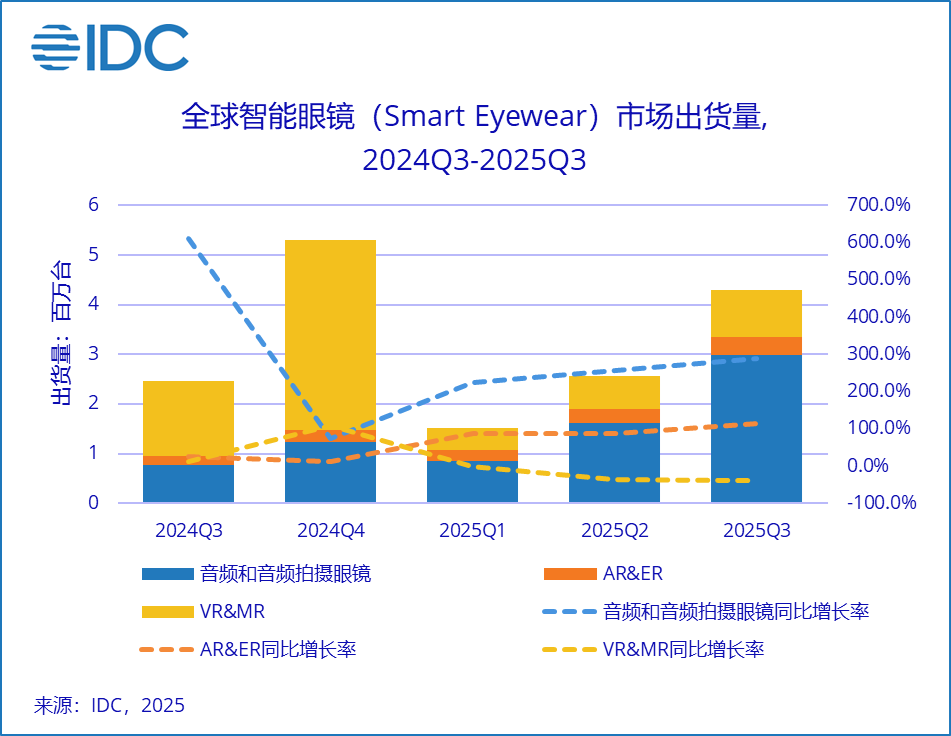
IDC:三季度全球智能眼镜出货量同比增长74.1% 音频和音频拍摄品类大增287.5%
智通财经网· 2025-12-12 06:07
Core Insights - The global smart eyewear market is projected to ship 4.296 million units in Q3 2025, representing a year-on-year growth of 74.1% [1] - The audio and audio-capturing glasses segment is expected to see a significant increase in shipments, with a year-on-year growth of 287.5%, while the AR/VR segment is experiencing a decline of 23.2% [1] - Meta has launched new products, achieving a market share of 75.7%, while Chinese manufacturers like Xiaomi, Thunder, Xreal, and Viture are also gaining traction in the market [1] Global Market Overview - The global smart eyewear market is expected to see a shipment of 4.296 million units in Q3 2025, with a year-on-year growth of 74.1% [1] - The audio and audio-capturing glasses market is projected to ship 2.994 million units, showing a remarkable growth of 287.5% [1] - The AR/VR market is expected to ship 1.302 million units, but it is facing a decline of 23.2% [1] Chinese Market Insights - The Chinese smart eyewear market is projected to ship 623,000 units in Q3 2025, reflecting a year-on-year growth of 62.3% [3] - The audio and audio-capturing glasses segment in China is expected to ship 454,000 units, with a year-on-year growth of 79.2% [5] - The AR/VR market in China is expected to ship 169,000 units, showing a year-on-year growth of 29.4% [6] Product Innovations and Trends - Major Chinese brands are launching new products, including Alibaba's Quark G1 and Baidu's AI glasses, which are expected to enhance market dynamics [5] - The proportion of products supporting large models has reached 49.5%, indicating a trend towards AI integration in smart eyewear [5] - The AR/ER category is leading growth in the AR/VR market, with a market share of 83.4% and a year-on-year growth of 142.3% [6] Future Projections - The Chinese smart eyewear market is expected to reach 4.508 million units by 2026, with a year-on-year growth of 77.7% [6] - The audio and audio-capturing glasses segment is projected to ship 3.434 million units, reflecting a growth of 68.1% [6] - The AR/VR device shipments are expected to reach 1.073 million units, with a year-on-year growth of 62.1% [6] Competitive Landscape - The smart eyewear market is entering a phase of scale growth, with major companies launching new products and driving technological innovation [8] - Competition is shifting towards ecosystem collaboration, content integration, and practical application scenarios [8] - The market is expected to see a more diverse competitive landscape, with a focus on user experience, AI functionality, and ecosystem completeness [9]


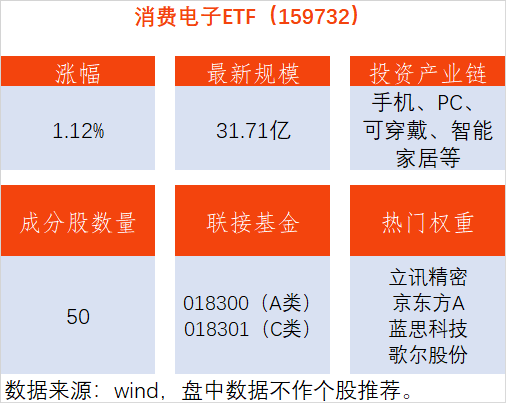
AI端侧多重利好催化!消费电子ETF(159732)上涨1.12%,东山精密涨5.12%
Sou Hu Cai Jing· 2025-12-08 02:34
Market Performance - A-shares indices collectively rose on December 8, with the Shanghai Composite Index increasing by 0.50% during intraday trading [1] - The communication equipment, brokerage, and aerospace military industries showed significant gains, while coal and energy equipment sectors experienced declines [1] - The Consumer Electronics ETF (159732) rose by 1.12%, with notable increases in constituent stocks such as Baiwei Storage (+6.91%), Dongshan Precision (+5.12%), and Shenghong Technology (+4.85%) [1] Industry Developments - AI glasses are seeing a surge in new releases, with Alibaba's self-developed AI glasses Quark S1 selling out, and Li Auto launching the AI glasses Livis focused on the "human-vehicle-home" ecosystem [3] - Google and XREAL are set to integrate Gemini with XR in their upcoming products, while Meta shifts its focus from the metaverse to AI and hardware [3] - ByteDance's Doubao has introduced a prototype with system-level AI interaction capabilities, marking a significant step in hardware-software integration [3] Investment Insights - Galaxy Securities suggests that AI applications will be a key focus for technology sector investments in the coming year, emphasizing the ongoing exploration phase of edge AI [3] - Continuous monitoring of developments in the Apple supply chain and new consumer electronics categories is recommended [3] - The Consumer Electronics ETF (159732) tracks the Guozheng Consumer Electronics Index, investing in 50 A-share listed companies involved in the consumer electronics industry, primarily in electronic manufacturing, semiconductors, and optical electronics [3]



AI端侧产品密集出新,国产算力初创公司资本化加速 | 投研报告
Zhong Guo Neng Yuan Wang· 2025-12-08 02:11
Core Insights - The electronic industry index increased by 1.17% during the week of December 1-5, 2025, driven by the emergence of AI glasses and improvements in the supply-demand dynamics of the panel industry [1][2] - The optical and optoelectronic sector led the gains with a rise of 4.28%, followed by consumer electronics at 1.32% and semiconductors at 1.02% [1][2] - In the overseas technology sector, major North American indices rose due to increasing expectations of interest rate cuts and a recovery in global risk appetite, with the Philadelphia Semiconductor Index up by 3.84% [1][2] Industry Updates - AI terminal products are being launched intensively, with notable releases including the Quark S1 AI glasses from Alibaba and the Livis AI glasses from Li Auto, which emphasize an integrated "person-vehicle-home" ecosystem [2] - Meta is shifting its focus from the metaverse to AI and hardware, indicating a strategic pivot in its business model [2] - The U.S. Secretary of Commerce has been meeting with leaders in the robotics industry, suggesting potential administrative actions in 2026 [2] Market Developments - The successful listing of Moore Threads on the STAR Market on December 5, 2025, saw its stock price surge by 468.8%, reaching a market capitalization of over 280 billion [3] - The DeepSeek-V3.2 model was released, showcasing enhanced capabilities that may further enrich the open-source model ecosystem [3] - The HBM4 supply competition is intensifying, with Samsung completing production readiness and Micron exiting the retail storage business to focus on AI storage chips [3] Investment Recommendations - The recent launches of AI products are expected to catalyze the consumer electronics sector, although challenges related to privacy and security remain [4] - The successful IPO of Moore Threads and the high subscription interest in Mu Xi shares indicate a rapid capitalization of computing chips [4] - Suggested investment opportunities include companies like SMIC, Hua Hong Semiconductor, and others involved in AI and semiconductor sectors [4]