奇瑞三体式复合翼飞行汽车

Search documents
从“四轮”到“双翼”与“双腿”,车企创新狂飙新赛道
Zhong Guo Qi Che Bao Wang· 2025-11-24 06:47
Core Insights - The emergence of humanoid robots, flying cars, and the integration of these technologies into the automotive industry is a significant trend, with companies like XPeng and Tesla leading the charge [2][4][10] - XPeng's new humanoid robot, IRON, has garnered attention for its advanced capabilities, including a lifelike appearance and improved interaction systems, reflecting the company's commitment to innovation [3][8] - The automotive industry is witnessing a shift towards a multi-dimensional business model that includes robotics and aerial vehicles, indicating a broader transformation in transportation [2][11] Group 1: XPeng's Developments - XPeng's IRON robot features upgrades in bionic structure, intelligent systems, and energy architecture, making it more human-like [3] - The company has successfully trialed its flying car production line, marking a milestone in the mass production of flying vehicles [3][8] - XPeng plans to launch three Robotaxi models by 2026, utilizing a vision-based system for navigation without relying on Lidar [3][12] Group 2: Industry Trends - Tesla has been a pioneer in the integration of automotive and robotics, launching its Cybercab Robotaxi and expanding its humanoid robot production [4][10] - Other automakers, such as GAC and Chery, are also advancing in the fields of autonomous driving and flying vehicles, indicating a competitive landscape [5][6] - The collaboration between companies and research institutions is becoming a common strategy to enhance capabilities in these emerging sectors [9][10] Group 3: Market Dynamics - The integration of automotive, robotics, and flying vehicles is seen as a necessary evolution in response to changing transportation needs and technological advancements [11][12] - Experts suggest that while the current focus is on innovation, traditional automotive manufacturing remains crucial for sustaining competitive advantages [15] - The development of a cohesive ecosystem for these technologies is still in its early stages, with challenges in achieving a self-sustaining business model [14][15]


上海车展上的空天争夺战
Zhong Guo Qi Che Bao Wang· 2025-05-07 08:16
Core Insights - The 2025 Shanghai Auto Show showcased a variety of flying cars, marking a significant shift in the automotive industry towards vertical takeoff and landing (eVTOL) vehicles [2][3] - Companies such as GAC, Xpeng, Chery, and others are entering the flying car market, indicating a growing interest and investment in this new transportation sector [2][3] - The future of transportation is expected to evolve into a three-dimensional model, integrating land, water, and air travel [2][6] Company Developments - Xpeng's flying car, the "Land Carrier," is in the critical phase of commercialization, with pre-sales expected to start in Q3 2023 and first deliveries anticipated in 2026 [3] - Chery has developed a modular flying car that can transform between flying and driving modes, having already completed its maiden flight [3][4] - GAC's flying car brand, GOVY, introduced the GOVY AirCar, which features L4 autonomous driving technology and is designed for versatile applications [4] Industry Trends - The flying car sector is seen as a key component of the emerging low-altitude economy, with applications in intercity travel, medical rescue, and logistics [5][10] - The integration of automotive and aviation technologies is leading to a shared supply chain, with a commonality rate of 60%-70% between electric vehicles and flying cars [7][8] - The development of solid-state batteries is a priority for many companies, with several planning to launch these technologies between 2026 and 2027 [7][8] Market Outlook - Morgan Stanley predicts that the global flying car market could reach $9 trillion by 2050, with China expected to account for over 20% of this market [10] - The Chinese government is actively promoting the low-altitude economy, with various provinces including low-altitude initiatives in their development plans [10][11] - The transition from traditional automotive manufacturing to becoming comprehensive mobility solution providers is underway, as companies adapt to the evolving landscape of transportation [11][12]

车展观察|飞行汽车“飞入”车展,打“飞的”出行将成现实
Bei Ke Cai Jing· 2025-04-24 00:51
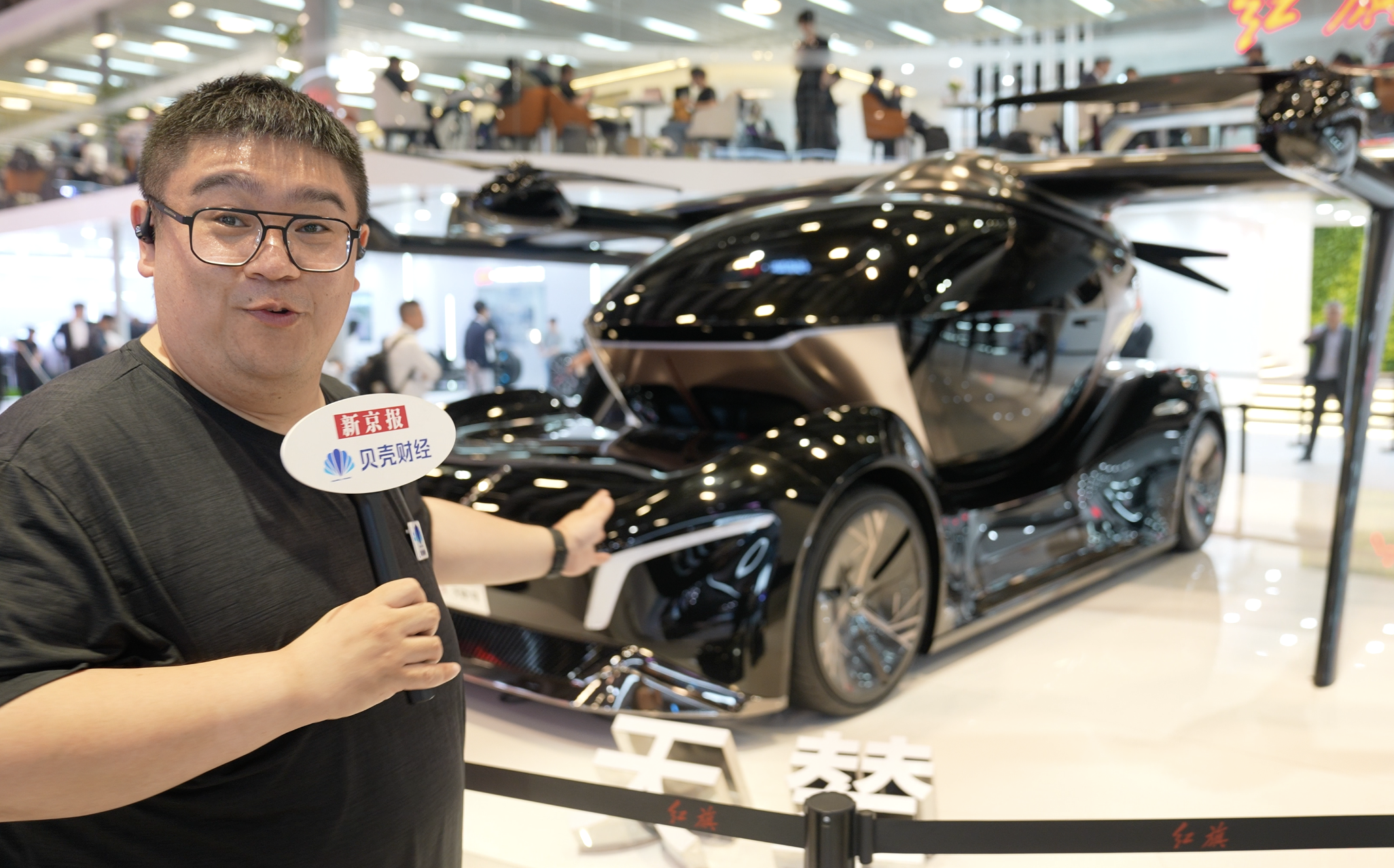
一辆辆飞行汽车"飞入"了2025上海车展的展台。 新京报贝壳财经记者在现场看到,造型前卫的飞行汽车以悬停姿态展示,可以清晰地看到内部简约的驾驶舱布局,有的甚至完全取消了传统方向盘。大家驻 足围观,似乎置身于"地面堵车就起飞"的未来出行时代。 相比于低空经济的管理规范、商业化落地等话题,公众更关注飞行汽车多少钱、何时能乘坐、驾驶难不难等实际问题。或许在不久的将来,人们就能享受到 打"飞的"出行服务。 黄金平衡。 2025上海车展,红旗首款豪华飞行汽车"天辇1 号"。新京报贝壳财经记者李学浩 摄 【现场】 飞行汽车亮相车展 奇瑞今年车展上展示了自己的飞行汽车。2024年10月18日,这款飞行汽车第一次被展示出来,目前已成功试飞,试飞距离大约80公里。 "飞行模块与座舱结合形成飞机形态,行驶模块与座舱结合形成汽车形态",奇瑞飞行汽车实验室主任李涛向新京报贝壳财经记者介绍,这款三体式复合翼飞 行汽车引入了三体对接结构,由飞行模块(螺旋桨和机翼)、座舱模块和行驶模块组成,通过开发超紧凑对接结构系统可完成上、中、下三模块自主结合、 分离,实现陆空无人驾驶模式无缝切换,以构建城市三维立体交通。 模块化分体式设计,不仅能让汽 ...