飞行汽车

Search documents
东莞产业研究之低空经济产业报告:政策促进落地生花
Dongguan Securities· 2026-03-31 11:29
Investment Rating - The report indicates a positive investment outlook for the low-altitude economy industry, highlighting its potential for significant growth driven by policy support and technological advancements [4]. Core Insights - The low-altitude economy in China is projected to expand rapidly, with market size estimates reaching approximately 670.25 billion yuan in 2024, a year-on-year growth of 32.5%, and expected to reach 1.5 trillion yuan by 2025, representing a 123.8% increase [4][18]. - The central government has been actively promoting the low-altitude economy through a series of policies and regulations, establishing a comprehensive regulatory framework and recognizing it as a strategic emerging industry [4][22]. - Local governments are also implementing supportive policies, with 31 provinces incorporating low-altitude economy initiatives into their development plans, focusing on various aspects such as infrastructure, application scenarios, and technological innovation [4][24]. Summary by Sections 1. Low-Altitude Economy Development Prospects - The low-altitude economy is defined as a new economic form driven by low-altitude flight activities, encompassing various industries and characterized by a long industrial chain and strong growth potential [11][14]. - The industry is segmented into four main categories: low-altitude manufacturing, low-altitude operations, low-altitude infrastructure and information services, and supporting industries [14][16]. - The market is expected to grow significantly, with forecasts indicating a market size of 3.5 trillion yuan by 2035 [18]. 2. Dongguan's Low-Altitude Economy Implementation - Dongguan aims to become a model for high-quality development in the low-altitude economy, leveraging its manufacturing strengths and establishing multiple industrial clusters [4][32]. - The city has introduced comprehensive policies to support the low-altitude economy, focusing on infrastructure, application scenarios, and industry collaboration [32][33]. 3. Creating Low-Altitude Economy Industrial Cluster Effects - Dongguan is prioritizing the development of the low-altitude economy as part of its strategic emerging industries, with a focus on technologies such as drones and eVTOL aircraft [39]. - The city is actively promoting the establishment of industrial clusters and bases to enhance the low-altitude economy's growth and integration with other sectors [39].
3月中上旬新能源乘用车零售同比-17%
Dong Zheng Qi Huo· 2026-03-29 13:43
1. Report Industry Investment Rating There is no information provided in the content about the report industry investment rating. 2. Core Viewpoints of the Report - The automotive market is showing a seasonal recovery. The recovery of the fuel - vehicle market is hindered by reduced terminal discounts and oil - price fluctuations, while the new - energy vehicle penetration rate has recovered to over 50%. The vehicle market may not recover growth until the second half of the year. Domestic sales will decline year - on - year, exports will increase year - on - year, and the annual wholesale sales of the vehicle market will remain flat year - on - year [1][114]. - High oil prices stimulate the demand for alternative energy, which is beneficial to the recovery of the domestic market and the increase in overseas exports of Chinese new - energy vehicles. Emerging fields such as low - altitude economy are brewing new opportunities, and the energy - using scenarios are undergoing a systematic reconstruction [1][114]. - The penetration rate of the Chinese new - energy vehicle market has rapidly increased in the past few years, reaching over 50% in 2025. Since the second half of 2025, exports have gradually become a new growth point. The trade environment in Europe and the United States is challenging, while countries along the Belt and Road and the Middle East have good development prospects. Non - American regions' new - energy vehicle markets have good development potential, and self - owned brands' market share continues to expand [2][115]. 3. Summaries According to Relevant Catalogs 3.1 Financial Market Tracking - The report presents the weekly price - change percentages of relevant sectors and listed companies. For example, BYD's weekly price - change percentage is 2.20%, and Seres' is - 4.35% [10][14]. 3.2产业链数据跟踪 3.2.1 China New - Energy Vehicle Market Tracking - **Sales**: In the first 22 days of March, the retail sales of new - energy passenger vehicles were 495,000, a year - on - year decrease of 17%. Since the beginning of the year, the cumulative retail sales of new - energy passenger vehicles were 1.556 million, a year - on - year decrease of 23%. The report also shows data on China's new - energy vehicle sales, including internal sales, exports, and sales of EVs and PHVs [109][15]. - **Inventory Changes**: The report provides data on the monthly new additions to the channel inventory and manufacturer inventory of new - energy passenger vehicles [25][26]. - **Delivery Volumes of Chinese New - Energy Vehicle Manufacturers**: It shows the monthly delivery volumes of manufacturers such as Leapmotor, Li Auto, XPeng, NIO, Zeekr, Aion, Voyah, and Deepal [28][29]. 3.2.2 Global and Overseas New - Energy Vehicle Market Tracking - **Global Market**: The report shows data on global new - energy vehicle sales, penetration rate, and sales of EVs and PHVs [37][38]. - **European Market**: It presents data on European new - energy vehicle sales, penetration rate, and sales of EVs and PHVs in countries like the UK, Germany, and France [44][45]. - **North American Market**: Data on North American new - energy vehicle sales, penetration rate, and sales of EVs and PHVs are provided [58][59]. - **Other Regions**: The report shows new - energy vehicle sales, penetration rate, and sales of EVs and PHVs in regions such as Japan, South Korea, and Thailand. In January, the new - energy vehicle sales in Europe, North America, and other regions were 290,000 (year - on - year + 20%), 85,000 (year - on - year - 32%), and 130,000 (year - on - year + 130%) respectively. The sales in the Thai market in January were 44,000, a year - on - year increase of 229% and a month - on - month increase of 187% [62][63]. 3.2.3 Power - Battery Industry Chain - The report provides data on power - battery loading volume (by material), export volume (by material), weekly average price of power - battery cells, cell material cost, and the operating rates and prices of various battery materials such as ternary materials, phosphoric acid iron lithium, and negative electrode materials [78][80]. 3.2.4 Other Upstream Raw Materials - It shows the daily prices of rubber, glass, steel, and aluminum [102][103]. 3.3 Hot News Summaries 3.3.1 Industry Dynamics: China - In the first 22 days of March, the retail sales of the national passenger - vehicle market were 920,000, a year - on - year decrease of 16% and a month - on - month increase of 19%. The wholesale sales of national passenger - vehicle manufacturers were 1.084 million, a year - on - year decrease of 14% and a month - on - month increase of 62%. The retail sales of the national new - energy passenger - vehicle market were 495,000, a year - on - year decrease of 17% and a month - on - month increase of 66%. The wholesale sales of national new - energy passenger - vehicle manufacturers were 543,000, a year - on - year decrease of 15% and a month - on - month increase of 71% [109]. 3.3.2 Enterprise Dynamics - On March 25, the core power system of XPeng HT Aero's X3 - F (Land Aircraft Carrier) flying car was officially mass - produced at the CALB Chengdu factory. - On March 26, Leapmotor launched its new global model A10, which will be sold in nearly 40 countries and regions. - On March 27, BYD released its 2025 annual report. Its revenue in 2025 was about 803.964 billion yuan, a year - on - year increase of 3.46%. The overseas turnover was 310.7 billion yuan, accounting for about 38.6% of the total revenue [111][112][113]. 3.4 Industry Views - As reported by the Passenger Car Association, from March 1 - 22, the national passenger - vehicle retail sales decreased by 16% year - on - year, and the national new - energy passenger - vehicle retail sales decreased by 17% year - on - year. Since the beginning of the year, they have decreased by 18% and 23% respectively. The structural growth factors include high oil prices stimulating the demand for alternative energy and emerging fields like low - altitude economy bringing new opportunities [114]. 3.5 Summary and Outlook - The penetration rate of the Chinese new - energy vehicle market has rapidly increased in the past few years, reaching over 50% in 2025. Since the second half of 2025, exports have become a new growth point. The trade environment in Europe and the United States is challenging, while countries along the Belt and Road and the Middle East have good development prospects. Self - owned brands' market share continues to expand, and companies with strong product strength, smooth overseas expansion, and high supply stability will be the core beneficiaries [2][115].





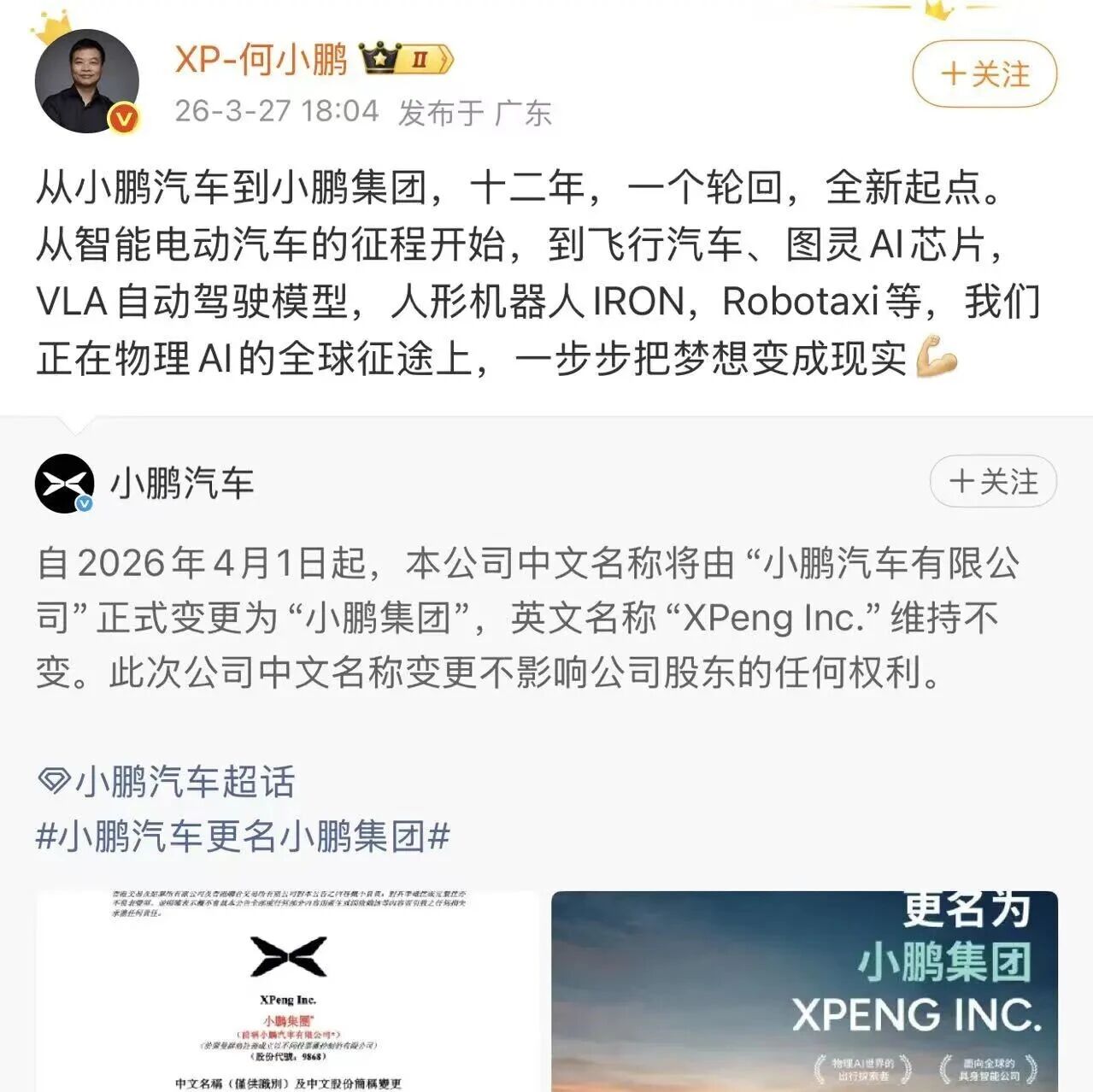
小鹏汽车改名,何小鹏称“在物理AI征途上把梦想变现实”
凤凰网财经· 2026-03-28 10:24
Group 1 - The core viewpoint of XPeng Motors is the rebranding from "XPeng Motors Limited" to "XPeng Inc." starting April 1, 2026, marking a new beginning for the company after twelve years of development in the smart electric vehicle sector [1] - XPeng's chairman and CEO, He Xiaopeng, emphasized the company's journey from smart electric vehicles to advancements in flying cars, AI chips, autonomous driving models, humanoid robots, and Robotaxi, indicating a commitment to turning ambitious dreams into reality [1]


小鹏汽车分析:技术引领,商业模式创新
数说新能源· 2026-03-24 03:02
Core Viewpoint - The article highlights the significant growth and strategic advancements of XPeng Motors, emphasizing its technological leadership and future growth potential in the electric vehicle market. Group 1: Sales and Market Performance - In 2025, XPeng achieved a substantial sales growth with a total of 429,000 vehicles sold, despite some late-stage growth fatigue. The company’s model competitiveness, particularly with models like Mona03 and P7+, has improved significantly, with over 10% of sales coming from overseas markets, contributing 20% to profits [2]. - The company plans to double its overseas sales this year, with revenue from international markets expected to reach 20%, positioning these markets as core drivers of future profitability [5]. Group 2: Technological Advancements - XPeng's technology services revenue reached 8.341 billion yuan for the year, with Q4 alone contributing 3.18 billion yuan. This revenue stream, derived from partnerships such as with Volkswagen, has significantly boosted the company's overall gross margin [2]. - The company is transitioning all models to self-developed Turing chips, with an annual shipment target of 1 million units, starting with Volkswagen as the initial partner [5]. - The VLA2.0 technology has been recognized for its leading advantages, with new versions set to be released quarterly, enhancing the company's smart driving capabilities and market share [4]. Group 3: Research and Development Investment - XPeng maintained high R&D investments, with Q4 spending increasing by 43.2% year-on-year and 18.3% quarter-on-quarter, totaling 2.87 billion yuan. This commitment to R&D, despite short-term profit pressures, is aimed at building long-term technological barriers [3]. - The company plans to increase its R&D investment to 7 billion yuan this year, up from 2.5 billion yuan last year, focusing on physical AI to create core competitive advantages [5]. Group 4: Future Growth Initiatives - XPeng aims to launch four new SUV models in the next three quarters, addressing current gaps in its product lineup and significantly boosting quarterly sales [4]. - The company is set to achieve mass production of Robotaxi, humanoid robots, and flying cars by the end of the year, indicating a clear development path focused on technology leadership and innovative business models [6].

【聚焦两会】“两会”期间车界声音汇总
乘联分会· 2026-03-18 08:36
Group 1 - The article discusses various suggestions from representatives at the National People's Congress aimed at enhancing the automotive industry's high-quality development and addressing social welfare issues [4][5][6][7][8][9][10][11][12][13][14][15][16][17][18][19][20][21][22][23][24][25][26][27][28][29][30][31][32][33][34][35][36][37][38][39][40][41][42][43][44][45][46][47][48][49][50] Group 2 - Suggestions include improving the rural electric vehicle market ecosystem to stimulate consumption, promoting battery swapping models, and enhancing the export of automobiles through standardization [5][6][7] - Emphasis on developing a senior-friendly transportation ecosystem and establishing a hydrogen fuel cell vehicle regulatory framework [8][9] - Recommendations for accelerating the legislative process for autonomous driving and enhancing the integration of artificial intelligence in the automotive sector [10][11][12][13][14][15][16][17][18][19][20][21][22][23][24][25][26][27][28][29][30][31][32][33][34][35][36][37][38][39][40][41][42][43][44][45][46][47][48][49][50] Group 3 - The article highlights the need for a focus on technological innovation and quality competition rather than price wars in the automotive industry [47][48][49][50] - It discusses the importance of integrating global operations and localizing production to enhance competitiveness [49][50] - The article also emphasizes the necessity of upgrading quality standards and improving the entire supply chain to achieve high-quality development [50]





广州,又到一个关键路口
21世纪经济报道· 2026-03-10 01:27
Core Viewpoint - Guangzhou is positioned as a key player in the development of the smart economy, leveraging its innovation density, talent pool, and application scenarios to redefine its role among China's first-tier cities [1][4]. Group 1: Smart Economy Development - The government work report emphasizes the creation of a new form of smart economy and the expansion of "AI+" initiatives, highlighting Guangzhou's pivotal role in the Guangdong-Hong Kong-Macao Greater Bay Area [1][6]. - Guangzhou's unique advantage lies in its rich application scenarios, which are essential for training large AI models, making it a valuable resource in the smart economy landscape [6][7]. - The city aims to cultivate over 1,000 AI industry vertical models by 2035, establishing several billion-level smart industry clusters and becoming a national demonstration zone for "AI + new industrialization" [7][8]. Group 2: Talent and Innovation - Talent acquisition and retention are critical for the growth of companies in Guangzhou, with a focus on creating an environment that attracts and keeps skilled individuals [10][11]. - The local government is committed to enhancing the talent development system, emphasizing the importance of comprehensive skill sets in the AI sector [11][12]. - The city is also working on building a public platform for AI literacy and reskilling, aiming to align talent development with industry needs [11][12]. Group 3: Economic Vitality - Guangzhou's economic vitality is reflected in its rapid growth in various sectors, including a 161.74% increase in low-altitude economy and a 109.03% rise in new AI business registrations [13][14]. - The city has seen a significant population increase, indicating a strong preference for its quality of life and entrepreneurial opportunities [14]. - The government aims to support the development of world-class city clusters, positioning Guangzhou as a key driver of high-quality growth in the Greater Bay Area [14].

2026 年军工行业军费变化点评:2026 年国防预算同比+7%,连续11 年稳健增长
Guoxin Securities· 2026-03-10 01:13
Investment Rating - The report maintains an "Outperform" rating for the defense industry, indicating expected performance above the market benchmark by over 10% [1][6]. Core Insights - The 2026 national defense budget is set at 1,909.561 billion RMB, reflecting a year-on-year increase of 7%, marking the 11th consecutive year of steady growth [2][3]. - Despite a slight decrease from the previous year's growth rate of 7.2%, the defense budget continues to emphasize a balanced approach to economic and military development, adapting to international security dynamics [2][3]. - The military industry is expected to see strong demand driven by the goal of achieving modernization by the centenary of the military, with a focus on executing the "14th Five-Year Plan" and accelerating major defense projects [3]. - The government report highlights aerospace as a newly defined pillar industry, underscoring its strategic importance in national development and technological self-reliance [4]. Summary by Sections Defense Budget Overview - The 2026 defense budget reflects a 7% increase, maintaining a trend of single-digit growth for over a decade, with a focus on coordinated growth in defense and economic development [2][3]. Military Industry Demand - The military industry is poised for strong demand due to the rigid requirements of achieving modernization goals, despite a slight slowdown in budget growth [3]. Emerging Industries - The government emphasizes the cultivation of new industries, with aerospace being recognized as a strategic pillar, indicating significant growth potential in both military and civilian applications [4]. Investment Recommendations - Focus on companies within the aerospace supply chain, commercial space, and low-altitude economy sectors, particularly those with strong competitive advantages and growth potential [5][7].
专访全国人大代表冯兴亚:汽车、低空经济与人形机器人要融合发展
21世纪经济报道· 2026-03-06 06:37
Core Viewpoint - The article emphasizes the importance of accelerating the development of legal regulations and standards for autonomous driving to facilitate the large-scale deployment of autonomous vehicles in China [1]. Group 1: Autonomous Driving and Technology Development - Multiple representatives at the National People's Congress highlighted autonomous driving as a key topic, with suggestions to advance policies from L2 to L4 levels while simplifying L3 [1]. - Morgan Stanley's report indicates that global automotive giants like Tesla will face competition from capable Chinese companies like Xpeng in the autonomous driving technology space [1]. - GAC Group's chairman, Feng Xingya, advocates for the integration of smart vehicles with low-altitude economy and humanoid robots, aiming to leverage the potential of low-altitude economic development [1]. Group 2: GAC's Strategic Initiatives - GAC has a mature supply chain and technology in the automotive sector, with over 70% of its components reusable in flying cars [2]. - The company is undergoing a transformation called "Panyu Action," focusing on self-revolution and integrated operations for its brands [2][12]. - GAC aims to enhance its market responsiveness and customer satisfaction through a customer-centric organizational transformation [14]. Group 3: Global Expansion and Ecosystem Building - GAC plans to expand its global footprint, transitioning from product exports to a comprehensive industry chain export model by 2026 [3]. - The company has seen a 47% year-on-year increase in overseas sales, with significant growth in new markets [18]. - GAC is actively building partnerships with leading companies like Huawei and Alibaba to enhance its technological capabilities and create a robust ecosystem [17]. Group 4: Innovation in Robotics and Low-Altitude Economy - GAC's humanoid robot, GoMate Mini, is set for small-scale production in March 2026, targeting the security sector as its initial application [9][8]. - The company is leveraging its experience in autonomous driving data collection to enhance the development of its humanoid robots [8]. - GAC's flying car, GOVY AirCab, has received nearly 2,000 orders and is expected to begin deliveries in 2026, showcasing the company's rapid production capabilities [10].

小鹏汽车-W(09868):港股研究|公司点评|小鹏汽车-W(09868.HK):小鹏汽车2026年2月销量点评:月销1.5万辆,第二代VLA即将发布
Changjiang Securities· 2026-03-04 23:30
Investment Rating - The investment rating for the company is "Buy" and is maintained [4]. Core Insights - In February 2026, the company delivered 15,256 new vehicles, representing a year-on-year decline of 49.9% and a month-on-month decline of 23.8%. The decline in sales is attributed to the impact of the Spring Festival holiday and seasonal factors. However, with the upcoming release of the second-generation VLA and a recovery in the automotive market, sales are expected to rebound [2][6]. - The company is entering a new vehicle cycle with the launch of models such as MONA M03 and P7+. The effects of scale enhancement, cost reduction from platforms and technologies, and the expansion of software profitability models, along with continued growth in international markets, suggest significant future earnings flexibility [2][6]. - The company anticipates delivering between 125,000 to 132,000 vehicles in Q4 2025, representing a year-on-year growth of 36.6% to 44.3%, with expected revenue between 21.5 billion to 23 billion CNY, a year-on-year increase of 33.5% to 42.8% [6]. Summary by Relevant Sections Sales Performance - February 2026 saw a total of 15,256 vehicles delivered, with a cumulative delivery of 35,000 vehicles in January and February, down 42.0% year-on-year. The sales performance is expected to improve in March as the market recovers from seasonal lows [4][6]. New Product Launches - The second-generation VLA is set to be released in March 2026, alongside the launch of the new X9 electric version. The company is also preparing for the mass production of the new generation IRON robot and the delivery of flying cars within the year [6]. Future Outlook - The company is positioned for a strong new vehicle year in 2026, with multiple new models expected to enhance sales cycles. The anticipated revenue for 2025-2026 is projected to be approximately 75.1 billion and 105 billion CNY, corresponding to price-to-sales ratios of 1.5 and 1.1 [6].
全国人大代表何小鹏:建议辅助驾驶政策从L2跳到L4
21世纪经济报道· 2026-03-04 11:11
Core Viewpoint - The article emphasizes the urgent need for advancing autonomous driving technology from L2 to L4 levels, highlighting the importance of policy and regulatory frameworks in facilitating this transition [4][5][10]. Group 1: Autonomous Driving Policy Recommendations - The current "gradual" management framework for autonomous driving faces challenges, necessitating a shift from L2 to L4 levels while maintaining safety [4]. - Four key recommendations are proposed: 1. Transitioning policies from L2 to L4 while simplifying the L3 intermediate stage [5]. 2. Establishing a registration and management system for L4 vehicles to enable compliant operation nationwide [5]. 3. Conducting traffic regulation assessments to optimize rules for both human and machine driving [5]. 4. Granting local pilot management rights for L4 applications in specific low-risk scenarios [5]. Group 2: Humanoid Robot Development - The article discusses the need for advancements in humanoid robots, particularly in developing a local "brain" for autonomous decision-making and execution [6]. - Recommendations include: 1. Promoting breakthroughs in high-level intelligent humanoid robot technology and commercial deployment [6]. 2. Establishing a standardization system for humanoid robots, similar to the autonomous driving classification standards [7]. Group 3: Low-altitude Airspace Management - The article highlights the significance of flying cars as a strategic emerging product in the low-altitude economy [9]. - Recommendations for low-altitude airspace management include: 1. Decentralizing airspace management authority to enhance local government involvement [9]. 2. Clarifying tax classifications for flying cars and implementing phased tax incentives to stimulate market demand [9][10].