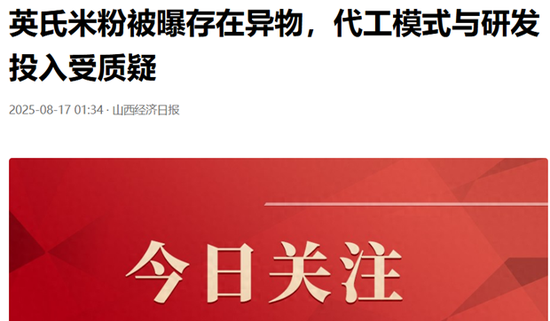
婴幼儿米粉

Search documents
预重整方案获通过 贝因美控制权归谁
Bei Jing Shang Bao· 2026-02-03 15:49
Core Viewpoint - The announcement from Beiyinmei reveals that its controlling shareholder, Zhejiang Xiaobei Damei Holdings, has passed a pre-restructuring plan, indicating potential changes in control and future uncertainties for the company [1][2]. Group 1: Restructuring and Control Changes - The pre-restructuring plan was approved by specific creditor groups, allowing for the continuation of restructuring efforts, although the success of the restructuring remains uncertain [2][8]. - The restructuring aims to help the company recover by introducing strategic investors and debt swaps, with the approval signaling initial support from creditors for the proposed restructuring path [2][8]. - The potential change in control may lead to new development strategies and personnel arrangements, but the management's primary responsibility will be to maintain operational stability [3][7]. Group 2: Financial Challenges and Historical Context - Xiaobei Damei Holdings holds 12.28% of Beiyinmei's total shares, with 98.85% of these shares pledged or frozen, highlighting a precarious equity situation [3][4]. - Beiyinmei, once a leader in the domestic milk powder industry, has seen a significant decline in revenue from 61.17 billion in 2013 to 24.91 billion in 2018, with substantial losses totaling over 1.8 billion during 2016-2017 [4][5]. - The company's financial imbalance has been a long-term issue, exacerbated by aggressive credit policies that increased accounts receivable from 425 million in 2014 to 1.363 billion in 2015, leading to severe cash flow issues [4][5]. Group 3: Market Concerns and Future Outlook - Concerns are rising regarding the impact of the controlling shareholder's restructuring on the stability of the management and the strategic coherence of Beiyinmei, especially during its transformation phase [6][7]. - Despite the ongoing challenges, Beiyinmei has emphasized that its production and operational status remain normal, and the restructuring will not significantly affect daily operations [7][8]. - The approval of the pre-restructuring plan opens a new chapter in the debt crisis narrative, but the outcome of the formal restructuring process and its implications for control and strategy remain uncertain [8].

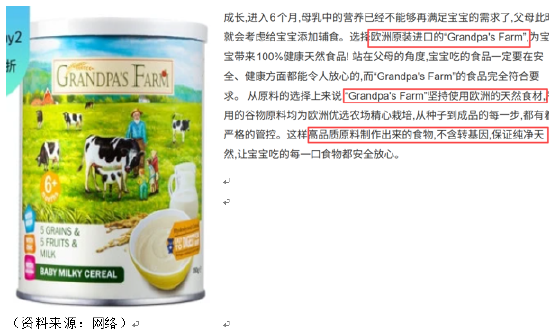
又一个洋老头?爷爷的农场早期市场开拓疑打假洋牌擦边球 产品近乎全靠代工多次抽检不合格被监管处罚
Xin Lang Cai Jing· 2026-01-15 09:38
Core Viewpoint - The brand "Grandpa's Farm" has submitted its prospectus to the Hong Kong Stock Exchange, aiming to become the second major player in the infant complementary food market, but faces significant challenges related to brand identity and product quality issues [1][19]. Group 1: Company Overview - "Grandpa's Farm" was launched in 2015 and introduced its first infant complementary food product in 2018, expanding into the family food sector in 2021 [3][20]. - The company plans to use the funds raised from the IPO to enhance product development, invest in supply chain improvements, strengthen internal production capabilities, and expand brand marketing and sales networks [1][19]. Group 2: Brand Identity Controversy - There is ongoing confusion among consumers regarding whether "Grandpa's Farm" is a Dutch or Chinese brand, largely due to early marketing emphasizing European origins and packaging predominantly in English [3][20]. - The brand's identity controversy is heightened by its founder's rapid establishment of companies in both the Netherlands and China, leading to allegations of "fake foreign brand" practices [11][27]. Group 3: Quality Control Issues - The company relies heavily on third-party OEM manufacturers for nearly all its product production, which has led to multiple regulatory penalties for product quality issues [2][29]. - From 2019 to 2021, "Grandpa's Farm" faced numerous quality complaints, including products failing safety inspections and consumer reports of contamination and spoilage [14][30]. - The reliance on a complex supply chain and outsourcing has resulted in frequent quality control problems, which are particularly critical in the infant food sector [29][33].

英氏控股IPO,上市敏感期被曝产品质量争议,公开承诺是否欺骗消费者?
Xin Lang Cai Jing· 2025-12-31 02:11
Core Viewpoint - Ying's Holdings Group Co., Ltd. is applying for an IPO on the Beijing Stock Exchange, focusing on infant nutrition and hygiene products, but faces challenges due to declining birth rates and recent product quality controversies [1][10]. Group 1: Company Overview - Ying's Holdings specializes in infant nutrition, particularly in scientific research on complementary foods, with core products including rice flour and hygiene products like diapers [1][10]. - The company has experienced rapid growth in 2022 and 2023, but forecasts a decline in growth for 2024, with a projected net profit decrease of 4.36% year-on-year [1][10]. Group 2: Market Challenges - The company acknowledges the risk of declining birth rates impacting the infant food and hygiene product market, which could adversely affect its business performance [1][10]. - Despite a projected net profit increase of 11.44% to 16.58% for the current year, the overall market environment remains challenging due to a continuous decrease in newborn numbers [1][10]. Group 3: Product Quality Controversy - In August, Ying's core product, infant rice flour, was reported to contain foreign objects, leading to widespread media coverage and scrutiny of its production methods [2][11]. - The company responded by asserting that all rice flour products are produced in-house and denied any outsourcing, emphasizing their commitment to quality and safety [6][15]. Group 4: Production Discrepancies - Despite the company's claims of in-house production, there are records in public disclosures indicating that a significant portion of raw materials is sourced from contracted manufacturers, raising questions about the accuracy of their statements [8][9][15][16]. - This discrepancy between public commitments and disclosed information may lead to consumer trust issues and complicate the company's IPO process [9][17].