存金通2号

Search documents
买积存金要被动态限额交易了
21世纪经济报道· 2026-03-06 13:13
Core Viewpoint - The article discusses the recent fluctuations in the gold market, highlighting the dynamic risk management strategies adopted by banks in response to these changes, as well as the increasing interest in gold as an investment asset. Group 1: Gold Price Fluctuations - As of March 6, the spot gold price hovered around $5,100 per ounce, with a slight daily decrease of 0.04% to $5,082.735 per ounce [1] - The gold market has experienced significant volatility, with prices showing multiple rounds of sharp increases and decreases over the past six months [10] - The World Gold Council reported a net inflow of $5.3 billion into global gold ETFs in February, marking the ninth consecutive month of inflows and the strongest start to a year on record [10] Group 2: Banks' Risk Management Strategies - Several banks, including China Construction Bank, have implemented dynamic trading limit management for gold products, reflecting a shift from static to dynamic risk management approaches [3][7] - Dynamic limits are set based on daily assessments of market risks, allowing banks to adjust trading limits in real-time according to market conditions and customer behavior [7][8] - This shift indicates a recalibration of gold accumulation products from low-threshold savings alternatives to medium-risk investment products [8] Group 3: Market Sentiment and Investment Trends - A survey by Bank of America revealed that buying gold has become the most crowded trade for the second consecutive month, with 50% of fund managers indicating a bullish stance on gold [11] - The largest gold ETF, SPDR, has seen its holdings exceed 1,100 tons, indicating a significant influx of capital into gold assets [10]


金价震荡下,国有大行密集调整积存金业务并发布风险提示
Jin Rong Jie· 2026-02-02 11:03
Core Viewpoint - Recent significant fluctuations in gold prices have prompted major state-owned banks in China to adjust their precious metals business rules and issue market risk warnings to enhance investor risk management [1] Group 1: Bank Adjustments - Industrial and Commercial Bank of China (ICBC) has raised the minimum purchase amount for gold accumulation from 1,000 yuan to 1,100 yuan and restricted the accumulation business to C3 balanced clients and above starting from January 12 [2] - China Construction Bank has increased the minimum investment amount for its gold accumulation products to 1,500 yuan, effective from February 2, with plans for future adjustments based on market conditions [3] - Agricultural Bank of China has introduced a requirement for clients to complete a unified risk assessment before engaging in gold accumulation operations, effective from January 30 [6] Group 2: Risk Management Measures - ICBC has advised investors to rationally invest based on their risk tolerance and to control their positions to mitigate volatility risks [2] - China Bank has issued a risk warning regarding all types of precious metal businesses, urging clients to manage their holdings according to their financial situation and risk tolerance [4] - Bank of Communications has tightened client risk level requirements, allowing only clients with growth, aggressive, or balanced risk profiles to access full functionalities of their precious metals wallet [5] Group 3: Investor Guidance - Agricultural Bank of China has recommended that investors participate in business activities rationally and enhance their risk awareness [7]



农业银行将对存金通黄金积存交易增加风险承受能力测评准入
Jin Tou Wang· 2026-01-27 03:14
Core Viewpoint - China Agricultural Bank (601288) announced new risk assessment requirements for individual customers participating in its gold accumulation service, effective January 30, 2026, to enhance consumer protection and comply with regulatory demands [1] Group 1: New Requirements - Starting January 30, 2026, individual customers must complete a risk assessment questionnaire and achieve at least a cautious rating to engage in gold accumulation services, including signing contracts, purchasing, and regular investments [1] - Existing customers with valid risk assessment results are exempt from retaking the assessment [1] Group 2: Existing Customers - Actions such as selling, withdrawing, executing or terminating existing investment plans, and contract cancellations for already signed customers are not subject to the new risk assessment requirements [1] Group 3: Consumer Awareness - The bank encourages customers to enhance their risk awareness and make rational decisions regarding the gold accumulation service based on their financial situation and risk tolerance [1]
黄金价格波动加大 多家银行调整积存金门槛从固定到浮动
2 1 Shi Ji Jing Ji Bao Dao· 2025-10-30 09:29
Core Viewpoint - The article discusses the significant fluctuations in gold prices, prompting several banks to adjust their gold accumulation investment thresholds from fixed to floating mechanisms to better align with market dynamics [2][3]. Group 1: Market Dynamics - Gold prices have entered a high-frequency oscillation phase, with a maximum fluctuation of nearly $500 per ounce, ranging from a high of $4381.11 to a low of $3886.3 within a short period [2]. - The shift to a floating mechanism allows investors to set accumulation amounts that are at least equal to the current gold price, providing more flexibility in investment decisions [3][4]. Group 2: Bank Adjustments - Several banks, including the Bank of Communications and Agricultural Bank of China, have implemented floating pricing mechanisms for gold accumulation plans, allowing for adjustments based on real-time gold prices [3][4]. - Other banks, such as Ping An Bank and Industrial and Commercial Bank of China, have raised their minimum investment amounts for gold accumulation products, reflecting the increased volatility in gold prices [5][6]. Group 3: Global Gold Demand - The World Gold Council reported that global gold demand reached a record high of 1313 tons in Q3 2024, a 5% year-on-year increase, with total demand exceeding $100 billion for the first time [7]. - Investment demand surged over 100% year-on-year to 364 tons, driven by increased interest in gold ETFs, while gold bar and coin demand decreased by 9% [7][8]. - Central bank gold purchases remained strong at 186 tons, maintaining the total for the year at 694 tons, consistent with the previous year [7][9]. Group 4: Supply and Market Outlook - Global gold supply increased by 5%, with mine production rising by 6% to 989.8 tons and recycled gold up by 11% to 323 tons [9]. - The outlook for the gold market remains optimistic due to factors such as a weakening dollar, expectations of interest rate cuts, and persistent stagflation risks, which may further support gold investment demand [9].
金价波动加剧 多家银行调整积存金起投门槛
Zheng Quan Ri Bao Zhi Sheng· 2025-10-29 17:11
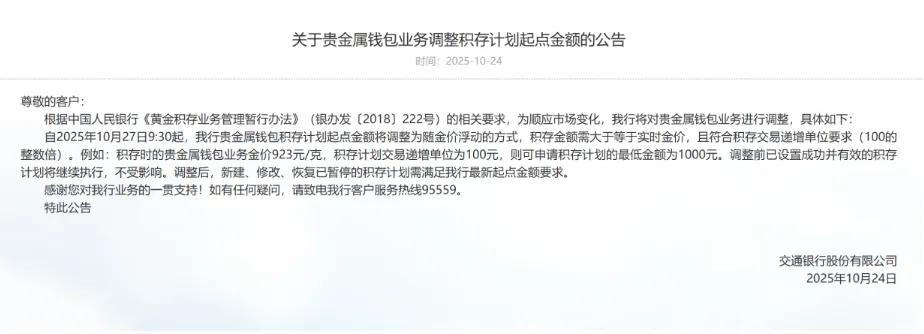
Core Insights - The international gold price has been experiencing significant fluctuations at high levels, leading commercial banks to adjust their precious metal business strategies, particularly by optimizing the investment thresholds for gold accumulation products [1][4] - Several banks have raised the minimum investment amounts for gold accumulation products, with the Bank of Communications implementing a floating adjustment mechanism linked to real-time gold prices [2][4] Summary by Category Market Trends - The current high volatility in gold prices has prompted banks to adapt their strategies to enhance service precision and risk management capabilities [1][3] - More financial institutions are expected to follow suit in adjusting their investment thresholds to provide investors with more flexible options that align with market changes [1][3] Bank Adjustments - The Bank of Communications announced that starting from October 27, 2025, its gold accumulation plan will have a minimum investment amount that fluctuates with real-time gold prices, requiring the investment to be at least equal to the current gold price [2] - Other banks, including Industrial and Commercial Bank of China, Bank of China, and Ping An Bank, have also raised their minimum investment amounts for gold accumulation products in October [4] Regulatory Compliance and Risk Management - The floating mechanism linked to real-time gold prices helps avoid frequent manual adjustments and aligns with regulatory requirements, ensuring compliance while managing risks effectively [3] - Banks are also focusing on investor education by issuing risk alerts to enhance awareness and encourage prudent investment behavior [5][6]

又有银行开启“随金价浮动”机制!业内人士:怕追高可以这样做
Xin Lang Cai Jing· 2025-10-26 22:35
Core Viewpoint - The recent adjustments by multiple banks in China to their gold accumulation plans reflect a response to the volatile gold market, with banks shifting to a pricing mechanism linked to real-time gold prices to better align with market fluctuations [5][10]. Group 1: Bank Adjustments - Bank of Communications announced that starting from October 27, 2025, the starting amount for its "Gold Wallet" accumulation plan will no longer be fixed but will instead fluctuate with gold prices, requiring the set amount to be at least equal to the real-time gold price [1][2]. - Agricultural Bank of China has also adjusted its gold accumulation plan to a floating pricing model, effective from September, to comply with regulatory requirements and enhance customer convenience [4]. - Several banks, including Industrial and Commercial Bank of China and China Bank, have raised their minimum investment thresholds for gold accumulation plans in October, indicating a trend among banks to increase entry barriers [6][7][8]. Group 2: Market Dynamics - The recent surge in gold prices is attributed to three main factors: the inverse relationship between gold prices and real interest rates, rising geopolitical tensions increasing demand for gold as a safe-haven asset, and central banks in emerging markets increasing their gold reserves [10]. - Analysts suggest that the floating pricing mechanism adopted by banks helps avoid delays in adjusting entry thresholds during periods of significant price volatility, thus providing a more responsive investment environment [8][9]. Group 3: Investor Guidance - Financial institutions have issued risk warnings to investors regarding the heightened volatility in precious metal prices, urging them to assess their risk tolerance and manage their investment positions carefully [9]. - Experts recommend that investors focus on long-term strategies for gold accumulation, emphasizing the importance of gradual investment rather than attempting to capitalize on short-term price movements [11].
银行密集上调积存金起购门槛,门槛最高已达1000元
Jin Rong Jie· 2025-10-16 07:31
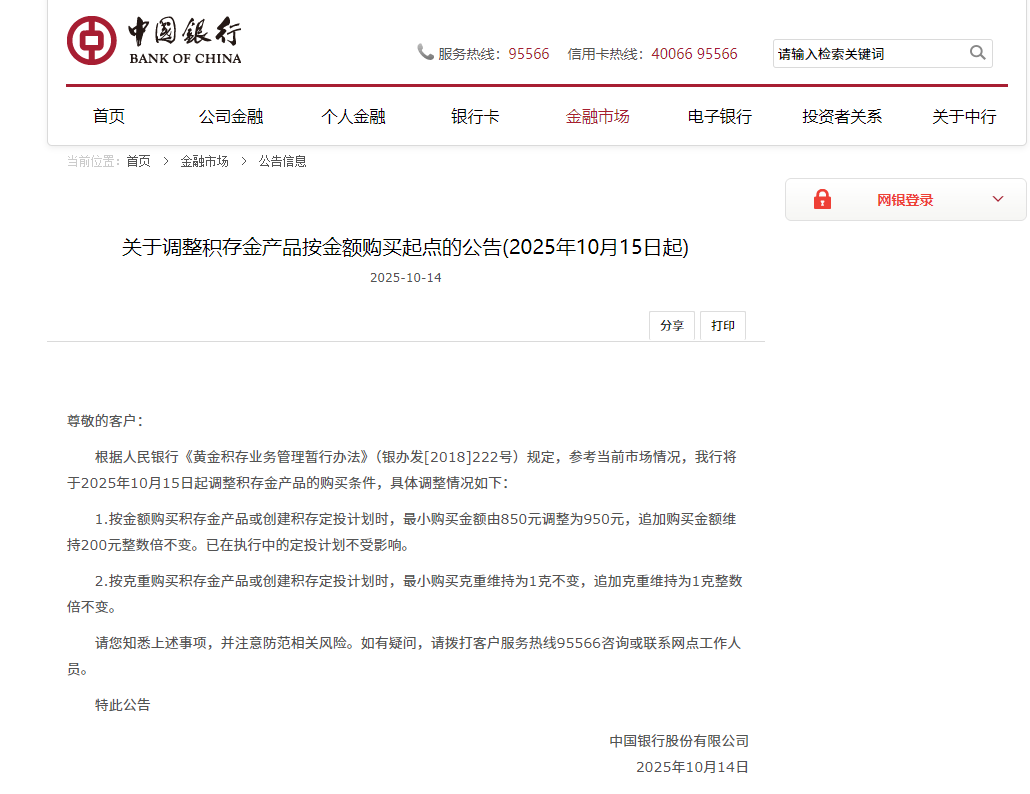
Core Insights - International gold prices have surpassed $4,200 per ounce, marking the strongest surge in nearly 46 years, prompting domestic banks in China to enhance risk control measures for gold investment [1][2] - Major Chinese banks, including Bank of China, Industrial and Commercial Bank of China, Ningbo Bank, and Industrial Bank, have raised the minimum investment amounts for gold accumulation products, with thresholds generally exceeding 1,000 yuan [1] Group 1: Bank Adjustments - Industrial and Commercial Bank of China increased the minimum investment for its gold accumulation business from 850 yuan to 1,000 yuan, the highest among state-owned banks [1] - Bank of China raised its minimum purchase amount from 850 yuan to 950 yuan, maintaining a flexible additional purchase amount of 200 yuan [1] - Both Ningbo Bank and Industrial Bank have set their minimum investment at 1,000 yuan, with Industrial Bank indicating potential future adjustments due to international macroeconomic and geopolitical factors [1] Group 2: Market Dynamics - This is not the first adjustment of the year; for instance, the minimum investment for Industrial and Commercial Bank's gold accumulation has increased by 53.8% from 650 yuan at the beginning of the year [2] - The gold market is characterized by high volatility and significant price increases, with international gold prices rising over 57% since 2025, the best performance since 1979 [2] - Domestic gold prices have also surged, with notable increases in retail prices for gold jewelry, such as Chow Tai Fook and Lao Feng Xiang [2] Group 3: Risk Factors - The recent surge in gold prices has been accompanied by significant fluctuations, with international gold prices experiencing a rise of over $300 within ten days and daily volatility exceeding 2% [2] - The Shanghai Gold Exchange has issued risk warnings twice in October, advising investors to trade rationally due to the heightened market risks [2]


金价,飙太猛!银行紧急上调
Jing Ji Wang· 2025-10-16 03:08
Core Viewpoint - The price of gold has surged approximately 55% this year, driven by expectations of interest rate cuts from the Federal Reserve, global central bank gold purchases, and increased holdings in gold ETFs, prompting several banks to adjust their gold accumulation business [1] Group 1: Bank Adjustments to Gold Accumulation Business - On October 14, Bank of China announced an increase in the minimum purchase amount for its gold accumulation products from 850 yuan to 950 yuan, effective October 15, 2025 [2] - On October 11, Industrial and Commercial Bank of China raised the minimum investment amount for its gold accumulation business from 850 yuan to 1000 yuan, while maintaining the minimum weight accumulation at 1 gram [2] - Ningbo Bank announced on October 9 that it would increase the minimum purchase amount for its gold accumulation business from 900 yuan to 1000 yuan, effective October 11, 2025 [4] - Agricultural Bank of China has adjusted its gold accumulation product's minimum purchase point to fluctuate with gold prices, marking its third adjustment this year [4][5] Group 2: Reasons for Adjustments - Banks are raising the minimum purchase thresholds primarily due to compliance requirements to ensure the minimum amount covers the real-time price of 1 gram of gold and to control risks by reducing speculative behavior [4][5] - The recent volatility in domestic gold prices has prompted these adjustments, with industry insiders expecting more banks to follow suit [5] Group 3: Historical Adjustments - Throughout 2023, several banks have repeatedly raised the minimum purchase amounts for their gold accumulation products, with Industrial and Commercial Bank of China increasing its minimum investment from 650 yuan to 1000 yuan in several steps [7][9] - Ningbo Bank also raised its minimum purchase amount from 700 yuan to 800 yuan earlier this year [8] Group 4: Market Adjustments and Risk Management - On September 24, Agricultural Bank of China announced adjustments to the trading limits for gold contracts, increasing the price fluctuation limits for various gold and silver contracts [6] - Banks are also enhancing risk management measures, with China Construction Bank and other institutions advising investors to be cautious due to increased market volatility [10]