平安金积存

Search documents
银行积存金从“赚利息”转向“看行情”
Mei Ri Shang Bao· 2026-01-29 23:23
Core Viewpoint - Ningbo Bank has announced a reduction in the interest rates for its fixed deposit gold products, effective from January 28, with the new rates set at 0% for demand deposits and ranging from 0.3% to 0.5% for various fixed terms, reflecting a broader trend among banks to adjust rates in response to high gold prices and market volatility [1][2][4]. Group 1: Interest Rate Adjustments - The new interest rates for Ningbo Bank's fixed deposit gold products are as follows: 0% for demand deposits, 0.3% for 1-month and 3-month deposits, 0.4% for 6-month deposits, and 0.5% for 12-month deposits [2]. - Other banks, such as Ping An Bank, have also announced similar reductions in their gold accumulation product rates, indicating a trend across the banking sector [3]. Group 2: Market Context and Implications - The international gold price recently surpassed $5,500 per ounce, with a significant increase of over $500 within 72 hours, leading to a market capitalization surge of over $3.5 trillion [4]. - The adjustments in interest rates are seen as risk management measures by banks to guide customer expectations and mitigate potential redemption risks due to high gold prices [4][5]. Group 3: Investment Strategy Recommendations - Industry experts suggest that investors should focus on the long-term value and volatility risks of gold investments, advocating for a dollar-cost averaging approach rather than fixating on minor interest rate differences [6]. - The recent policy changes by banks serve as a reminder that gold investments should be based on comprehensive assessments of macroeconomic factors, geopolitical situations, and monetary policies, rather than simplistic considerations of "deposits + interest" [6].


贵金属价格波动,两家银行同日调整黄金积存利率
Cai Jing Wang· 2026-01-27 10:26
Core Viewpoint - Several banks have adjusted their gold accumulation business rules, including lowering interest rates and increasing risk assessment thresholds due to fluctuations in precious metal prices [1][2][3]. Group 1: Interest Rate Adjustments - Ping An Bank announced a reduction in interest rates for its gold accumulation business effective February 4, 2026, with rates adjusted to 0.01% for demand deposits, 0.2% for 3-month fixed deposits, 0.4% for 6-month fixed deposits, and 0.8% for 1-year fixed deposits, reflecting a decrease of 19-30 basis points [1]. - Ningbo Bank will lower its fixed deposit rates for gold products starting January 28, 2026, with new rates set at 0% for demand deposits, 0.3% for 1-month and 3-month deposits, 0.4% for 6-month deposits, and 0.5% for 12-month deposits, indicating a reduction of 0-30 basis points [1][2]. Group 2: Risk Assessment and Investment Caution - Both Ping An Bank and Ningbo Bank have advised clients to exercise caution in precious metal investments, emphasizing the need for awareness of market volatility and personal risk tolerance [2]. - Industrial and Agricultural Banks have raised the risk assessment thresholds for their gold accumulation business, with Industrial Bank requiring clients to achieve a risk assessment level of C3 or above starting January 12, 2026 [3]. - Agricultural Bank will implement a similar requirement from January 30, 2026, mandating clients to obtain a cautious risk assessment level for their gold accumulation business [3]. Group 3: Minimum Investment Amount Adjustments - Ping An Bank has increased the minimum investment amount for its gold accumulation business from 1100 yuan to 1200 yuan effective January 29, 2026 [4]. - Industrial Bank raised its minimum investment amount from 1000 yuan to 1100 yuan starting January 8, 2026, while Ningbo Bank and Everbright Bank also adjusted their minimum investment amounts to 1200 yuan and 1100 yuan respectively [4].
金价波动加剧 多家银行调整积存金起投门槛
Zheng Quan Ri Bao Zhi Sheng· 2025-10-29 17:11
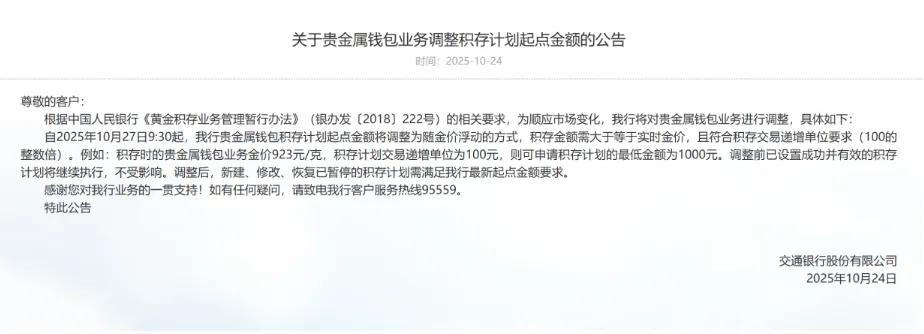
Core Insights - The international gold price has been experiencing significant fluctuations at high levels, leading commercial banks to adjust their precious metal business strategies, particularly by optimizing the investment thresholds for gold accumulation products [1][4] - Several banks have raised the minimum investment amounts for gold accumulation products, with the Bank of Communications implementing a floating adjustment mechanism linked to real-time gold prices [2][4] Summary by Category Market Trends - The current high volatility in gold prices has prompted banks to adapt their strategies to enhance service precision and risk management capabilities [1][3] - More financial institutions are expected to follow suit in adjusting their investment thresholds to provide investors with more flexible options that align with market changes [1][3] Bank Adjustments - The Bank of Communications announced that starting from October 27, 2025, its gold accumulation plan will have a minimum investment amount that fluctuates with real-time gold prices, requiring the investment to be at least equal to the current gold price [2] - Other banks, including Industrial and Commercial Bank of China, Bank of China, and Ping An Bank, have also raised their minimum investment amounts for gold accumulation products in October [4] Regulatory Compliance and Risk Management - The floating mechanism linked to real-time gold prices helps avoid frequent manual adjustments and aligns with regulatory requirements, ensuring compliance while managing risks effectively [3] - Banks are also focusing on investor education by issuing risk alerts to enhance awareness and encourage prudent investment behavior [5][6]

又有银行开启“随金价浮动”机制!业内人士:怕追高可以这样做
Xin Lang Cai Jing· 2025-10-26 22:35
Core Viewpoint - The recent adjustments by multiple banks in China to their gold accumulation plans reflect a response to the volatile gold market, with banks shifting to a pricing mechanism linked to real-time gold prices to better align with market fluctuations [5][10]. Group 1: Bank Adjustments - Bank of Communications announced that starting from October 27, 2025, the starting amount for its "Gold Wallet" accumulation plan will no longer be fixed but will instead fluctuate with gold prices, requiring the set amount to be at least equal to the real-time gold price [1][2]. - Agricultural Bank of China has also adjusted its gold accumulation plan to a floating pricing model, effective from September, to comply with regulatory requirements and enhance customer convenience [4]. - Several banks, including Industrial and Commercial Bank of China and China Bank, have raised their minimum investment thresholds for gold accumulation plans in October, indicating a trend among banks to increase entry barriers [6][7][8]. Group 2: Market Dynamics - The recent surge in gold prices is attributed to three main factors: the inverse relationship between gold prices and real interest rates, rising geopolitical tensions increasing demand for gold as a safe-haven asset, and central banks in emerging markets increasing their gold reserves [10]. - Analysts suggest that the floating pricing mechanism adopted by banks helps avoid delays in adjusting entry thresholds during periods of significant price volatility, thus providing a more responsive investment environment [8][9]. Group 3: Investor Guidance - Financial institutions have issued risk warnings to investors regarding the heightened volatility in precious metal prices, urging them to assess their risk tolerance and manage their investment positions carefully [9]. - Experts recommend that investors focus on long-term strategies for gold accumulation, emphasizing the importance of gradual investment rather than attempting to capitalize on short-term price movements [11].



教授每年强制自己定投100克黄金,黄金定投背后的理智与疯狂
Sou Hu Cai Jing· 2025-10-22 06:32
Core Insights - The article highlights the significant rise in gold prices and the increasing interest in gold investment among different demographics, particularly intellectuals and young consumers in China [1][3][8]. Group 1: Gold Price Surge - Gold prices have recently surpassed $4,200 per ounce, leading to a corresponding increase in domestic gold jewelry prices, with notable daily increases in prices from major retailers [3][5]. - The price of gold jewelry has seen substantial increases, with examples including a rise from 1,215 RMB per gram to 1,235 RMB per gram for Chow Tai Fook jewelry [3][5]. Group 2: Investment Trends - The trend of gold investment is particularly strong among two groups: intellectuals like Professor Yu, who view gold as a long-term investment, and young consumers who see it as a combination of personal enjoyment and savings [3][4]. - A report indicates that the gold jewelry ownership rate among young consumers has increased from 37% to 62% [3]. Group 3: Banking Actions - In response to rising gold prices, major banks in China have raised the minimum purchase amounts for gold investment products, marking a shift to a "thousand yuan era" for gold investment [5][6]. - The adjustments made by banks, such as China Bank and Industrial and Commercial Bank, are seen as risk management measures in light of the soaring gold prices [6]. Group 4: Factors Driving Gold Prices - Multiple factors are contributing to the surge in gold prices, including economic uncertainty, geopolitical tensions, and expectations of a renewed interest rate cut cycle by the Federal Reserve [8][9]. - The demand for gold as a defensive asset has significantly increased, with central banks contributing to price support through substantial gold purchases [9][10]. Group 5: Investment Strategies - Professor Yu's strategy of regular gold investment has proven effective, with historical data showing that gold can serve as a hedge against inflation and market volatility [12][14]. - The article emphasizes the importance of a disciplined investment approach, as demonstrated by Professor Yu, who views gold investment as a form of forced savings rather than speculation [15][16].