如意金积存

Search documents
黄金大跌7%失守4200美元!超10家银行集体出手
21世纪经济报道· 2026-03-23 07:03
Core Viewpoint - The gold and silver markets have experienced significant declines, with gold prices dropping over $320 in a single day, falling below $4200 per ounce, and erasing gains made in 2023, while silver prices have also seen a substantial drop of 9% [1][2]. Group 1: Market Performance - As of March 23, gold prices fell to $4169.75 per ounce, marking a decline of over $1000 since March began, despite having a peak increase of nearly 30% earlier in the year [1]. - Silver prices have also decreased significantly, currently reported at $61.6 per ounce [1]. Group 2: Bank Adjustments - Since February, over 10 banks have adjusted their precious metals trading operations, affecting gold spreads, limits, and trading channels [2][4]. - Notable banks making adjustments include Industrial and Commercial Bank of China, China Construction Bank, and Bank of Communications, with some banks like Postal Savings Bank and Ping An Bank gradually exiting personal precious metals trading [4][5]. - Postal Savings Bank announced plans to stop acting as an agent for personal precious metals trading, requiring clients to close positions by March 27 [4]. Group 3: Market Sentiment and Future Outlook - Multiple institutions predict that gold is currently in a weak position, with factors such as limited liquidity and a shift in investment focus towards oil impacting gold's appeal [7][8]. - Analysts suggest that the core logic of the gold market has shifted from being driven by risk aversion to being dominated by interest rates, with rising costs of holding gold due to hawkish Federal Reserve policies [8].


黄金动荡!多家银行出手,积存金或将“限购”
券商中国· 2026-03-14 08:41
Core Viewpoint - Recent fluctuations in gold prices have led to increased investment risks, prompting several banks to adjust their gold accumulation trading rules to manage these risks effectively [1][2]. Group 1: Bank Responses to Gold Price Volatility - China Construction Bank has implemented dynamic trading limits on its gold accumulation products to enhance risk control, with delivery times for physical gold orders extended to 10-15 working days starting March 3, 2026 [2]. - Industrial and Commercial Bank of China was the first to announce limits on gold accumulation purchases, effective February 7, 2026, during non-trading days, with various limit types being dynamically set [3]. - Zhejiang Commercial Bank may temporarily suspend its wealth gold accumulation business in response to significant market fluctuations or liquidity issues [3]. Group 2: Dynamic Limitations and Investor Behavior - The dynamic limit system allows banks to set daily total limits based on international market risks, preventing excessive buying once the limit is reached, while selling transactions remain unaffected [3][4]. - This approach aims to reduce speculative trading behaviors and protect banks from operational risks during extreme market conditions [4][5]. - Analysts suggest that these measures will guide investors towards more rational asset allocation, favoring long-term holders over short-term traders [5][6]. Group 3: Future Implications and Recommendations - As international gold prices continue to fluctuate, it is anticipated that more banks will adopt similar limit management measures for gold accumulation products [6]. - Experts recommend that banks enhance investor education and risk assessment processes to ensure appropriate product offerings align with investor risk profiles [7].




买积存金要被动态限额交易了
21世纪经济报道· 2026-03-06 13:13
Core Viewpoint - The article discusses the recent fluctuations in the gold market, highlighting the dynamic risk management strategies adopted by banks in response to these changes, as well as the increasing interest in gold as an investment asset. Group 1: Gold Price Fluctuations - As of March 6, the spot gold price hovered around $5,100 per ounce, with a slight daily decrease of 0.04% to $5,082.735 per ounce [1] - The gold market has experienced significant volatility, with prices showing multiple rounds of sharp increases and decreases over the past six months [10] - The World Gold Council reported a net inflow of $5.3 billion into global gold ETFs in February, marking the ninth consecutive month of inflows and the strongest start to a year on record [10] Group 2: Banks' Risk Management Strategies - Several banks, including China Construction Bank, have implemented dynamic trading limit management for gold products, reflecting a shift from static to dynamic risk management approaches [3][7] - Dynamic limits are set based on daily assessments of market risks, allowing banks to adjust trading limits in real-time according to market conditions and customer behavior [7][8] - This shift indicates a recalibration of gold accumulation products from low-threshold savings alternatives to medium-risk investment products [8] Group 3: Market Sentiment and Investment Trends - A survey by Bank of America revealed that buying gold has become the most crowded trade for the second consecutive month, with 50% of fund managers indicating a bullish stance on gold [11] - The largest gold ETF, SPDR, has seen its holdings exceed 1,100 tons, indicating a significant influx of capital into gold assets [10]
金价高位博弈,银行贵金属业务风控从“静态提门槛”到“动态限额度”
第一财经· 2026-03-04 13:15
Core Viewpoint - The article discusses the shift of commercial banks in China from static risk management to dynamic risk management in their precious metals business due to increased gold price volatility and speculative trading behavior among investors [3][5][11]. Group 1: Dynamic Risk Management Implementation - China Construction Bank announced the implementation of dynamic trading limits for its "Jianxing Gold" business starting March 4, 2026, in response to rising physical gold purchase volumes [5][10]. - This dynamic limit will be adjusted daily based on market conditions, allowing for more flexibility compared to previous static risk management methods [5][9]. - Other banks, such as Agricultural Bank of China and Zhejiang Commercial Bank, have also begun exploring dynamic control mechanisms to better manage risks associated with fluctuating gold prices [3][10]. Group 2: Market Volatility and Speculative Behavior - The gold market has experienced significant volatility, with prices fluctuating dramatically, such as a rise from approximately $5100 to $5419 per ounce within a few days [12]. - Many new investors, often lacking a deep understanding of gold trading, have entered the market, leading to increased speculative trading and subsequent losses [11][14]. - The article highlights individual cases of investors who faced substantial losses due to short-term trading strategies, which were not aligned with the intended long-term investment nature of gold accumulation products [13][14]. Group 3: Adjustments in Risk Management Standards - Banks are raising the risk tolerance levels for investors engaging in precious metals trading, with some banks requiring a minimum risk assessment rating of C3 (balanced) or higher [15][16]. - There is a trend towards tightening the rules for precious metals agency business, with many banks suspending new trades or limiting purchases [15][16]. - The article notes that banks are increasingly integrating compliance and risk management, emphasizing the importance of investor suitability and regular risk warnings [16].

短线投资者拍大腿后悔:金价暴跌想止损,非交易日连回购都停了
Sou Hu Cai Jing· 2026-02-11 14:18
Core Viewpoint - The recent adjustments in gold repurchase rules by major players in the Chinese gold market, including China Gold, are a response to significant price volatility and a shift towards more refined management practices in the industry [4][10][20]. Group 1: Announcement and Immediate Impact - On February 6, China Gold announced the suspension of gold repurchase services on non-trading days and implemented limits on repurchase amounts during trading days, requiring prior appointments [4][6]. - Following this announcement, other major gold retailers and banks, such as Cai Bai and Industrial and Commercial Bank of China, quickly adopted similar measures [4][10]. - The stock price of China Gold experienced volatility, peaking at 14.85 yuan per share on January 30, a 77.21% increase from January 22, but falling to 11.42 yuan by February 6, reflecting changing market expectations [4][10]. Group 2: Causes of the Rule Change - The immediate trigger for these adjustments was the extreme fluctuations in gold prices, with international gold prices experiencing significant ups and downs in early February [7][10]. - On February 6, spot gold prices dropped over 2% before rebounding, while silver prices showed even more volatility, highlighting the challenges faced by retailers in managing price risks [7][10]. - Domestic gold prices also mirrored this volatility, with significant price differences observed across various channels, complicating pricing strategies for retailers [7][10]. Group 3: Underlying Industry Dynamics - The adjustments reflect a deeper industry trend towards refined management practices, moving away from a previously chaotic operational model [10][20]. - The shift in market sentiment from a traditional "hedging mode" to a "speculative mode" has intensified price fluctuations, prompting the industry to implement risk management measures to stabilize the market [10][20]. - Recent statistics indicate a significant change in consumer behavior, with investment demand for gold surpassing traditional jewelry consumption for the first time, necessitating a more professional and regulated approach in the industry [10][20]. Group 4: Implications for Different Stakeholders - Ordinary consumers will face challenges in selling gold, as the new rules limit immediate transactions and require prior appointments, potentially changing their perception of gold as an instant liquidity source [12][16]. - For physical gold holders, the new rules increase the difficulty of liquidating assets, especially for those without proper purchase documentation [12][16]. - Short-term investors will find the new regulations complicate their trading strategies, as the inability to sell on non-trading days and the introduction of limits may increase their costs and risks [12][16]. Group 5: Future Outlook and Adaptation Strategies - The new regulations may lead to a more mature gold market, encouraging a return to gold's fundamental role as a store of value rather than a speculative asset [20]. - Stakeholders are advised to reassess their strategies, focusing on long-term investment perspectives and ensuring proper documentation for their gold assets [16][17]. - The changes may also open opportunities for innovative gold financial products, such as gold leasing and financing, catering to investors seeking liquidity [18][20].

中国黄金,宣布调整
Sou Hu Cai Jing· 2026-02-08 23:21
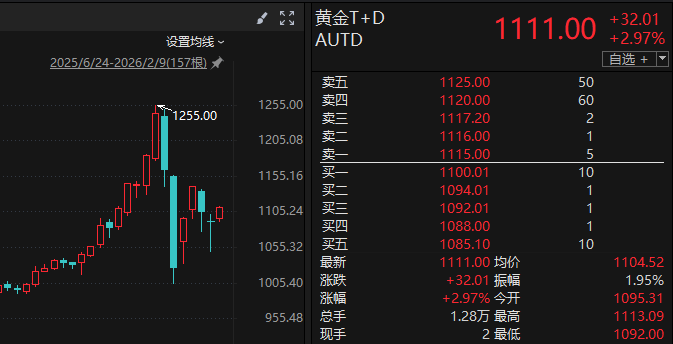
Core Viewpoint - The recent volatility in precious metal prices has prompted China Gold to adjust its gold repurchase business rules to enhance risk management and operational efficiency in response to market uncertainties [1][3]. Group 1: Market Conditions - Precious metal prices have shown significant fluctuations, with gold T+D prices recently at 1111 RMB per gram, up by 32.01 RMB (2.97%) from the previous trading day, but down 11.47% from a recent high of 1255 RMB per gram [2]. - The Shanghai gold futures market also reflects this volatility, with the latest price at 1114.5 RMB per gram, down 11.46% from a recent peak of 1258.72 RMB per gram [2]. Group 2: Business Adjustments - China Gold's adjustment to its repurchase rules includes limiting transactions to trading days to align with market pricing mechanisms, thereby avoiding pricing disputes and operational risks [1][3]. - The company aims to control its risk exposure during periods of price volatility, as acquiring physical gold without market price references could lead to significant losses [1][3]. - The new rules will implement limit management on repurchase transactions starting February 7, 2026, including daily repurchase limits and appointment systems, with adjustments based on market conditions [3]. Group 3: Industry Insights - Experts suggest that the adjustment is a necessary measure to stabilize the market and protect investor interests amid increasing price volatility and a lack of risk awareness among investors [3]. - Other major gold retailers are also adjusting their repurchase policies, indicating a broader industry trend towards enhanced risk management practices [7]. - The current trading sentiment in the precious metals market has shifted from risk aversion to speculation, exacerbating trading risks, particularly as stock market optimism grows [7].

部分品牌金店调整回购规则,节假期不能卖金了
Huan Qiu Wang· 2026-02-08 01:20
Group 1 - The core viewpoint of the articles is that major players in the gold market, including China Gold Group and Cai Bai Co., are adjusting their gold buyback policies due to increased volatility and uncertainty in gold prices [1][2] Group 2 - China Gold Group announced on February 6 that it will suspend gold buyback services during non-trading days of the Shanghai Gold Exchange starting February 7 [1] - The company will implement limit management on buyback transactions, including daily limits for individual customers and total limits for single transactions, along with an appointment system [1] - Cai Bai Co. also announced similar adjustments on February 2, including the suspension of buyback services on non-trading days and the implementation of limit management [1] Group 3 - Major commercial banks, such as Industrial and Commercial Bank of China, are also adjusting their gold accumulation services, implementing limit management on weekends and public holidays starting February 7 [2] - The limits will include overall or individual customer daily accumulation/redemption caps and total limits for single transactions, with dynamic settings in place [2]

大家千万不要太冲动!金价狂飙急跌,下周金价大盘估计这样走?
Sou Hu Cai Jing· 2026-02-07 17:20
Core Viewpoint - The recent fluctuations in the gold market have been dramatic, with significant price drops and increased volatility, prompting banks to issue risk warnings and adjust their precious metal business rules [1][3][5]. Group 1: Market Dynamics - On January 30, 2026, international gold prices fell sharply, with spot gold dropping below $4,700 per ounce, marking a nearly 10% decline, the largest single-day drop in 40 years [1]. - The volatility in gold prices is attributed to multiple factors, including political pressures on Trump, fiscal expansion, a weakening dollar, and a resurgence of liquidity in the market [3]. - The recent surge in gold prices had exceeded normal macro pricing rhythms, leading to concentrated positions and leverage among investors, which triggered a chain of sell-offs when market sentiment shifted [3][5]. Group 2: Geopolitical and Economic Influences - Geopolitical factors have also played a role, with a significant drop in gold prices on October 21, 2025, attributed to easing geopolitical tensions, particularly regarding the Ukraine conflict [5]. - A strengthening dollar has further suppressed gold prices, as the appreciation of the dollar increases the cost of purchasing gold for investors holding other currencies [5]. - The rapid rise in gold prices has led to a desire among investors to take profits, contributing to increased short-term volatility [3][7]. Group 3: Banking Sector Response - Major banks in China, including ICBC, CCB, and ABC, have issued multiple risk warnings and adjusted their gold accumulation business rules in response to market volatility [5][7]. - Banks have raised the minimum investment amounts for gold accumulation and emphasized the need for investors to operate cautiously based on their risk tolerance [7][10]. - Despite the banks' warnings, the demand for physical gold remains high, with many investment gold bars reported as "out of stock" or "sold out" [7][8]. Group 4: Investor Behavior and Market Sentiment - Investor behavior has shown a divide, with some viewing the price drop as a buying opportunity while others remain cautious due to potential further volatility [10][16]. - The market sentiment has shifted rapidly, with some investors feeling the urge to "catch the bottom," which poses operational risks during high volatility periods [16]. - The gold market's performance in 2025 saw prices rise from under $2,700 per ounce at the beginning of the year to over $4,500 per ounce by year-end, driven primarily by investment demand [12].

一周银行速览(1.30—2.6)
Cai Jing Wang· 2026-02-06 11:01
Industry Focus - The China Banking Association has released guidelines to regulate the collection behavior of credit card and personal consumer loan collections, aiming to promote healthy industry development. The guidelines clarify issues such as collection timing, reasonable frequency, and channels for obtaining contact information, establishing quantitative standards and specific definitions [1] Corporate Dynamics - Citic Bank plans to increase its capital contribution to Citic Financial Leasing by 2 billion yuan, raising the registered capital from 10 billion yuan to 12 billion yuan. This marks the second capital increase for Citic Financial Leasing by Citic Bank in a year [4] Financial Personnel - Qingdao Rural Commercial Bank has elected Liang Yanbo as the chairman of its fifth board of directors, pending approval from the Qingdao Financial Regulatory Bureau [5] - Ningbo Bank has received approval from the Ningbo Financial Regulatory Bureau for Fu Wensheng to serve as the vice president [6] - Guangfa Bank has received approval for Lin Zhaohui to serve as the director, vice chairman, and president, effective from January 30, 2026 [7] - The credit card center of Bank of Communications has appointed He Bo, the former vice president of the Zhejiang branch, as the new general manager, pending regulatory approval [8] - Bai Xiaodong has been appointed as the party secretary of Beijing Rural Commercial Bank, as announced during the bank's recent meeting [9] Market Trends - Despite an overall downward trend in market interest rates, many small and medium-sized banks have raised deposit rates by 5 to 20 basis points ahead of the Spring Festival, with some banks launching limited-time exclusive deposit products [3] Gold Market - Following a significant drop in gold prices, several banks have issued risk warnings and adjusted the entry thresholds for gold-related businesses, including increasing the minimum purchase amount for gold accumulation products [2]


金价大跳水!银行密集提示市场风险,为黄金投资“降温”
Xin Lang Cai Jing· 2026-02-03 01:29
Core Viewpoint - The global precious metals market is experiencing significant volatility, with gold prices dropping below $5000 per ounce and silver prices falling over 35% in late January and early February 2026, prompting banks to issue risk warnings and adjust their gold-related business practices [1][2][3]. Group 1: Market Volatility and Bank Responses - On January 31, 2026, gold prices saw a maximum drop of over 12%, falling below $5000 per ounce, and on February 2, they dipped below $4500 per ounce with a daily decline exceeding 9% [1]. - Major banks, including Industrial and Agricultural Banks, have issued multiple risk warnings to clients, advising them to assess their risk tolerance and avoid speculative trading in the current volatile market [3][5][6]. - Banks are increasing the minimum purchase amounts for gold accumulation products and raising the margin requirements for precious metal contracts to mitigate risks associated with market fluctuations [9][11]. Group 2: Changes in Investment Thresholds and Interest Rates - Industrial Bank raised the minimum investment for its gold accumulation product from 1000 yuan to 1100 yuan, while other banks like Construction Bank and Ping An Bank have also increased their minimum investment thresholds [9][10]. - Many banks have collectively reduced the interest rates on gold deposit products, with some rates dropping to near zero, indicating a shift back to the core investment logic of gold price fluctuations rather than interest income [10]. - The margin requirements for various gold trading contracts have been significantly increased, with some banks raising them from around 43% to as high as 80% to limit high-leverage trading [11][12]. Group 3: Demand for Physical Gold - Despite the price corrections in the gold market, there is a surge in demand for physical gold, with many consumers attempting to purchase gold bars, leading to stock shortages at several banks [13][14]. - The World Gold Council reported that global gold demand reached a record high of 5002 tons in 2025, with China's demand alone totaling 1003 tons, marking a 6% year-on-year increase [15]. - Experts emphasize that the primary function of gold is to preserve value and serve as a hedge against risks, advising investors to approach gold investments with caution and a long-term perspective rather than short-term speculation [16].