
完全自动驾驶FSD

Search documents
马斯克万亿美元薪酬背后:造车没意思了?
21世纪经济报道· 2025-11-11 09:12
Core Viewpoint - Tesla's CEO Elon Musk has been granted a ten-year compensation plan worth $1 trillion, which is essentially a high-stakes "bet" that requires the company's market value to increase from over $1 trillion to $8.5 trillion and annual profits to reach $400 billion within a decade [1] Group 1: Compensation Plan and Targets - The compensation plan is contingent upon achieving significant milestones, including breakthroughs in vehicle deliveries, Full Self-Driving (FSD), Robotaxi, and humanoid robots [1] - Achieving the profit target of $400 billion would require a twenty-fold increase from last year's profit of approximately $17 billion [1] Group 2: Business Model Transformation - Tesla aims to transition from being a traditional car manufacturer to a service-oriented business model, similar to "Apple on wheels," where the car serves as a data-collecting terminal and a mobile service platform [2] - The goal is to create a closed-loop ecosystem that encourages continuous user engagement and revenue generation through services [2] Group 3: Role of China - China is seen as a critical component in Tesla's strategy, leveraging its efficient supply chain to reduce R&D and innovation costs [3] - The Shanghai Gigafactory is highlighted as Tesla's most efficient and cost-effective factory globally, playing a vital role in achieving the ambitious scale targets [3] Group 4: Market Concerns - Despite the grand vision, market skepticism remains, as evidenced by Tesla's stock price decline, reflecting concerns over Musk's ability to manage multiple high-stakes ventures simultaneously [4] - The execution of this ambitious plan is fraught with challenges, and any failure in key areas could jeopardize the entire strategy [3][4]


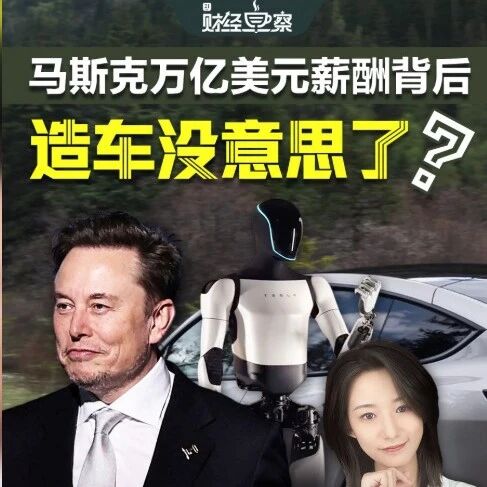
马斯克万亿美元薪酬背后:造车没意思了?
2 1 Shi Ji Jing Ji Bao Dao· 2025-11-11 07:49
Core Insights - Tesla's board has approved a ten-year compensation plan for CEO Elon Musk, valued at up to $1 trillion, which is more of a stringent "bet agreement" than a salary [1] - The plan requires Tesla's market value to increase from over $1 trillion to $8.5 trillion and annual profits to reach $400 billion, a 20-fold increase from last year's profit of approximately $17 billion [1] - The agreement emphasizes breakthroughs in four core areas: vehicle deliveries, Full Self-Driving (FSD), Robotaxi, and humanoid robots [1] Group 1 - Tesla aims to transform from a traditional car manufacturer to a service-oriented business model, akin to "Apple on wheels," where the car serves as a data-collecting platform and a service hub [2] - The strategy involves creating a closed-loop ecosystem that increases user dependency on Tesla's services, thereby enhancing customer retention and revenue generation [2] - Achieving these ambitious goals requires Tesla to simultaneously scale production, innovate technology, and significantly increase profits, which presents a challenging "impossible triangle" in traditional manufacturing [2] Group 2 - China plays a crucial role in Tesla's strategy, providing the most complete and efficient supply chain for the new energy industry, with the Shanghai Gigafactory being one of the most efficient and cost-effective facilities globally [3] - The plan is not just about establishing factories in China but deeply integrating into the local industrial ecosystem to leverage cost efficiencies and reduce R&D expenses [3] - Despite the grand vision, market skepticism remains, as evidenced by a decline in Tesla's stock price, reflecting concerns over the execution challenges and Musk's divided attention among multiple ventures [3]
马斯克万亿美元薪酬背后:造车没意思了?|财经早察
2 1 Shi Ji Jing Ji Bao Dao· 2025-11-11 07:40
Core Viewpoint - Tesla's board has approved a $1 trillion compensation plan for CEO Elon Musk, which is more of a stringent "bet agreement" than a salary, requiring the company's market value to rise from over $1 trillion to $8.5 trillion and annual profits to reach $400 billion within ten years [2][4] Summary by Sections Compensation Plan - The compensation plan is contingent on achieving ambitious targets, including a twenty-fold increase in profits from last year's $17 billion to $400 billion [2] - The agreement specifies breakthroughs in four core areas: vehicle deliveries, Full Self-Driving (FSD), Robotaxi, and humanoid robots [2] Business Model Transformation - Tesla aims to transition from being a traditional car manufacturer to a service-oriented business model, akin to "Apple on wheels," where the car serves as a data-collecting platform and a service hub [3] - The goal is to create a closed-loop ecosystem that locks users into Tesla's services, increasing customer retention and revenue [3] Challenges and Strategic Focus - Musk faces the challenge of scaling production, driving technological innovation, and achieving exponential profit growth simultaneously, which is described as a "impossible triangle" in traditional manufacturing [4] - The Chinese supply chain is identified as a critical lever for Tesla to achieve its ambitious goals, leveraging China's efficient and cost-effective production capabilities [4] Market Sentiment - Despite the grand vision, Tesla's stock has declined, reflecting market skepticism about the feasibility of Musk's ambitious plans and concerns over his divided attention among multiple companies [4][5] - The execution of this strategy is seen as highly challenging, with potential risks if any key aspect, such as FSD or Robotaxi, fails to materialize [4]