
商业模式转型

Search documents
花旗:下调国药控股(01099)目标价至22.8港元 维持“买入”评级
智通财经网· 2026-03-24 05:51
Core Viewpoint - Citigroup has downgraded the revenue forecasts for China National Pharmaceutical Group (国药控股) by 3% and 4% for the next two years, reflecting the latest guidance from management, and has also reduced the earnings per share forecast by 5% for both years, lowering the target price from HKD 23 to HKD 22.8 while maintaining a "Buy" rating [1] Group 1: Revenue and Earnings Forecasts - The revenue forecasts for China National Pharmaceutical Group have been reduced by 3% and 4% for the current and next year respectively [1] - The earnings per share forecasts have been adjusted downwards by 5% for both years [1] - The target price has been lowered from HKD 23 to HKD 22.8 [1] Group 2: Business Performance and Strategy - Management expects the pharmaceutical distribution business to remain flat year-on-year, while the medical device distribution and retail business is anticipated to recover further, showing positive growth [1] - The company aims to position itself as the cornerstone of the "1+4+x" strategy of China National Pharmaceutical Group, emphasizing its foundational role in the healthcare ecosystem [1] - The company plans to transform its business model to provide more comprehensive services across the entire value chain, supporting the launch of innovative drugs and accelerating hospital access [1] Group 3: Financial Metrics and Operational Insights - The retail business experienced a growth of 9.9% in the second half of last year, primarily driven by a 15% year-on-year increase in professional pharmacy sales [1] - The revenue decline in the medical device distribution business narrowed to 1.6% in the second half of the year [1] - The pharmaceutical distribution business saw a sales decline of 2%, impacted by the expansion of centralized procurement and price reductions from national medical insurance negotiations [1] - Service revenue, including CSO, SPD, and third-party logistics services, grew by 5% year-on-year to RMB 17 billion [1] Group 4: Accounts Receivable Management - The accounts receivable turnover days for China National Pharmaceutical Group extended to 130 days last year [2] - Management is confident in controlling accounts receivable over the next five years, benefiting from the anticipated full implementation of direct and immediate settlement policies in healthcare [2] - Improvements in hospital financial conditions, strict internal controls, and local government efforts to reduce leverage are expected to enhance payment liquidity in the healthcare ecosystem [2]

“规模陷阱”背后,潮宏基赴港上市卡壳
阿尔法工场研究院· 2026-03-19 04:06
Core Viewpoint - The article discusses the challenges faced by the jewelry brand Chao Hong Ji, particularly in its delayed IPO process and the impact of its business model on profitability amidst rising gold prices and increasing competition in the jewelry market [3][4][6]. Group 1: IPO and Market Position - Chao Hong Ji's IPO process has been unexpectedly delayed, with its prospectus becoming invalid after six months, despite previous claims of orderly progress [3][4]. - The company is required to provide additional information regarding its shareholders, data privacy practices, and pending litigation, indicating potential concerns from regulators [4]. - The capital market has shown growing concerns about Chao Hong Ji's future, as reflected in its stock price decline of over 24% in the past month [6]. Group 2: Financial Performance - Chao Hong Ji reported a projected net profit of 436 million to 533 million yuan for 2025, a year-on-year increase of 125% to 175%, yet its stock price has dropped nearly 40% from its peak [6][9]. - The company's revenue figures from 2022 to 2025 show a significant increase, but net profit has fluctuated dramatically, highlighting a disconnect between revenue growth and profitability [9]. - The shift from self-operated to franchise models has diluted profit margins, with franchise gross margins at 16.81% compared to 37.79% for self-operated stores [11]. Group 3: Market Strategy and Challenges - Chao Hong Ji has shifted its focus to younger consumers, leveraging cultural elements and innovative designs to capture market interest, particularly in the gold jewelry segment [6][12]. - Despite a growing market for gold jewelry, the company faces intense competition, with top brands dominating the market and limiting Chao Hong Ji's growth potential [12][13]. - The company's expansion into Southeast Asia is challenged by lower consumer income levels and higher domestic production costs, complicating its competitive positioning [11][12]. Group 4: Brand and Product Strategy - Chao Hong Ji's product strategy includes introducing affordable gold jewelry aimed at younger consumers, but tactical adjustments alone may not resolve underlying business model issues [16][18]. - The company has launched high-end product lines to attract premium customers, but this may increase operational costs without significantly altering brand perception [16][18]. - The diversification of brands under Chao Hong Ji has led to resource dilution, making it difficult to establish a strong core brand identity in a competitive market [18].



前沿生物:公司不会转型为单一的早期研发授权型企业
Zheng Quan Ri Bao Wang· 2026-02-25 13:13
Core Viewpoint - The company will not transition into a single early-stage research licensing entity, maintaining innovation as its core focus while leveraging both marketed innovative drugs and upcoming high-end generics for sustained cash flow to support R&D efforts [1] Group 1: Business Strategy - The recent collaboration in the small nucleic acid pipeline is viewed as a method for realizing pipeline value rather than a shift in business model [1] - The company plans to adopt a flexible business model in the small nucleic acid field, emphasizing the clinical value of products and selecting optimal paths for value realization based on product characteristics [1] Group 2: Collaboration and Development - The company aims to actively explore international collaborations with global pharmaceutical companies to leverage worldwide resources for market expansion [1] - For pipelines closely aligned with the company's long-term core strategy and where it possesses unique development advantages, the company will retain control and independently advance R&D and development efforts [1]

Booking反垄断启示录:告别“价格平价”,巨头如何重塑护城河?
ZHESHANG SECURITIES· 2026-02-02 10:25
Investment Rating - The industry investment rating is positive [1] Core Insights - The European Union's regulatory efforts have intensified, designating Booking as a "gatekeeper" under the Digital Markets Act (DMA), which prohibits the use of price parity clauses that restrict hotel pricing [2] - Despite antitrust measures aimed at promoting competition, Booking's market share in Europe has increased from approximately 60% in 2013 to over 71% in 2023, indicating a concentration of market power [3] - Booking is strategically shifting its business model from an agency model to a merchant model, allowing it to control pricing and cash flow while avoiding direct legal interference with hotel pricing [4] Summary by Sections Regulatory Environment - The EU's regulatory framework has evolved, with Booking being classified as a "gatekeeper" under the DMA, which mandates compliance with new rules prohibiting price parity clauses [12][18] - The historical context of antitrust actions against Booking highlights a growing trend of regulatory scrutiny across various jurisdictions [25][28] Market Competition - The competitive landscape remains concentrated, with Booking leveraging its dual-sided network effects to maintain its leading position, while competitors like Expedia and Airbnb are exploring differentiated strategies [5][6] - The cancellation of price parity clauses has not led to significant price competition among OTAs, as Booking continues to utilize algorithms and monitoring to maintain pricing control [3][56] Business Model Transformation - Booking's transition to a merchant model allows it to pre-collect payments and manage pricing, effectively circumventing legal restrictions on hotel pricing [4] - The company is investing heavily in Google advertising and membership programs to enhance its market presence and obscure pricing comparisons [4] Future Outlook - The report anticipates that the competitive dynamics in the OTA market will continue to evolve, with Booking's strong market position likely to persist despite regulatory challenges [5][6]

中科星图发布2025年业绩预告:转型期短期承压 新业务蓄力成长
Zhong Guo Zheng Quan Bao· 2026-01-23 14:22
Core Viewpoint - The company, Zhongke Xingtou, anticipates a revenue of 2.5 billion to 2.75 billion yuan and a net profit attributable to shareholders of 30 million to 45 million yuan for the year 2025, driven by a dual transition period of old and new momentum and business model transformation [1][2] Group 1: Business Performance - The company's traditional geographic information sector is experiencing a slowdown in business expansion due to structural changes in market demand, impacting overall performance despite being the main revenue contributor [1] - Emerging sectors such as commercial aerospace and low-altitude economy are still in the initial stages of development, with their benefits not yet fully realized [1] Group 2: Strategic Initiatives - Zhongke Xingtou has completed a full industry chain layout in the commercial aerospace field, launching the "Star Eye" space perception constellation plan, with plans to launch 156 satellites starting in the first half of 2026 to address traffic safety management issues caused by space debris [1] - The low-altitude economy sector is implementing a "1+2+N+M" strategic system, with benchmark projects in cities like Hanzhong and Chongqing, although the short market cultivation period limits immediate profitability [1] Group 3: Transformation and Investment - The company is transitioning from a project-based to a product-based model, enhancing its business model towards scalability and sustainability through the development of the Star Map Cloud platform and developer ecosystem [2] - Research and development investment intensity remains above 20%, with over 20 new products launched by the Low Altitude Product Research Institute, although this has temporarily squeezed profit margins [2] - The company expects a net cash flow from operating activities to increase by 221 million to 251 million yuan year-on-year in 2025, indicating improved cash management and business quality [2]

宜家不再是一个特别“目的地”
Jing Ji Guan Cha Wang· 2026-01-08 13:27
Core Insights - IKEA has been a unique destination for consumers in China's first and second-tier cities since its entry in 1998, offering not just products but an experience of a beautiful lifestyle [1][2] - The company's business model, characterized by global design consistency, flat-packaging, and self-service, has created an efficient operational system [1][2] Market Changes - Since the end of 2021, the real estate sector in China has been undergoing significant adjustments, leading to a slowdown in new home deliveries and renovation demands, which has directly impacted the home furnishings industry, including IKEA [4] - IKEA's sales in the Chinese market have decreased from a peak of 15.8 billion yuan in the 2019 fiscal year to an expected 11.2 billion yuan in the 2024 fiscal year [4] Competitive Landscape - Local brands like Suoyuan and Fanji are attracting consumers seeking cultural identity with designs that resonate more with Eastern aesthetics [4] - Brands like Muji are integrating home goods with lifestyle offerings, appearing more frequently in daily consumer visibility due to shopping center expansions [4] - Online furniture brands, such as Yuan Shimu Yu, are leveraging established e-commerce systems to penetrate the affordable and practical market [4] Consumer Behavior - The rise of social media has made home inspiration and solutions easily accessible, reducing the necessity for consumers to visit physical stores [4] - The low-frequency nature of furniture purchases contrasts with the high-frequency needs of essential goods sold in warehouse-style stores, making IKEA's previous unique experience less compelling [4] Strategic Adjustments - IKEA is adapting by becoming more flexible and accessible, opening smaller community stores, integrating into larger commercial complexes, and fully embracing online sales through platforms like JD.com [5] - The decision to close seven physical stores by January 7, 2026, reflects a systematic reassessment of its business model and market approach [5] Future Direction - The company aims to transition from being a destination that requires special trips to a more frequent presence in consumers' lives, focusing on lowering barriers to engagement [6] - As consumer choices expand, IKEA must reevaluate its connection with the market and adapt to the evolving landscape of consumer preferences [6]
能源矿产 | 煤炭上市公司深度研究系列:财务篇(下),周期落幕和价值重估
Sou Hu Cai Jing· 2026-01-08 04:48
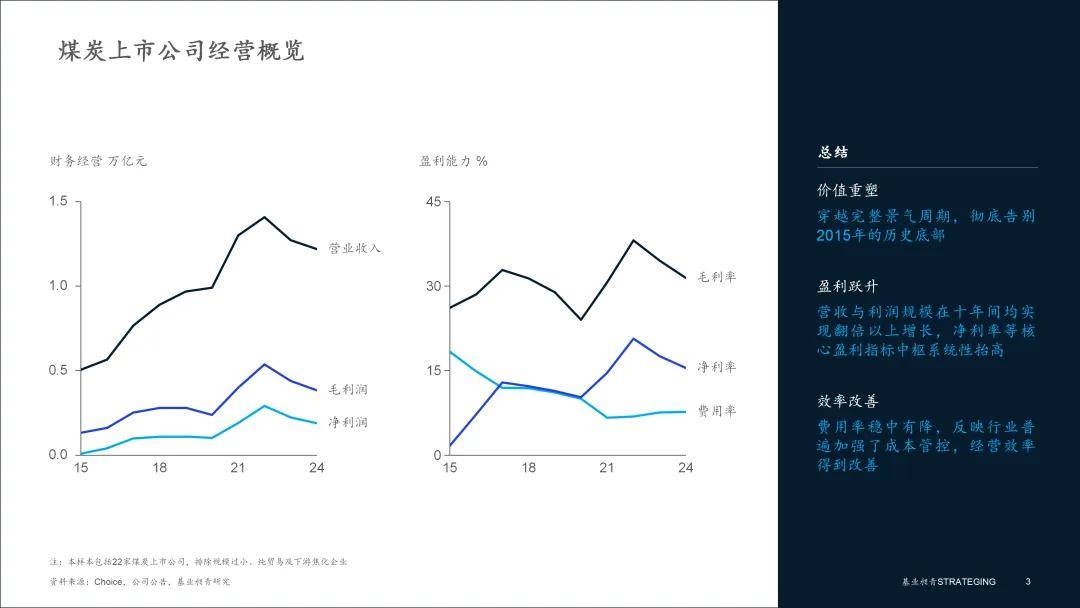
Core Insights - The coal industry has undergone a significant transformation from 2015 to 2024, moving from a historical low in profitability to a new phase characterized by elevated profit levels and improved development quality [2][29] - The industry's overall prosperity is giving way to pronounced differentiation among companies, driven by strategic choices in business models, cost control, and asset management [29] Industry Performance - The coal industry's total revenue reached a peak of 1,408.3 billion yuan in 2022, a 179% increase from 2015, with net profit soaring to 291.2 billion yuan, 34.5 times that of 2015 [2] - Despite a downturn in 2023-2024, key financial metrics remain significantly above the starting point of the cycle, indicating a fundamental reshaping of the industry's value center [2][4] Financial Characteristics - Revenue growth peaked, with a compound annual growth rate (CAGR) of 15.8% from 2015 to 2022, primarily driven by rising coal prices [3] - Profitability has shown significant elasticity, with net profit margins increasing from 2% in 2015 to a peak of 21% in 2022, demonstrating a qualitative change in profitability [3] - Operational efficiency has improved, with the overall expense ratio declining from 18% in 2015 to 7%-8% post-2021, indicating a shift from extensive to refined development models [3][4] Revenue Structure Analysis - In 2024, total revenue for sample companies is expected to remain above 1.2 trillion yuan, although growth momentum is slowing [6] - Major players like China Shenhua and China Coal Energy dominate the revenue rankings, benefiting from integrated business models that combine coal production with stable electricity and transportation operations [6][7] Profitability Insights - Profitability is highly concentrated among leading firms, with China Shenhua and Shaanxi Coal Industry together accounting for over 1 billion yuan in net profit, highlighting the significant head effect [9] - Integrated leaders demonstrate resilience during market downturns, with minor profit declines, showcasing the advantages of their business models [9][10] Cost and Efficiency Analysis - High gross margins are linked to resource endowments, with companies like Jinko Coal enjoying high margins due to the scarcity and high value of their products [15][16] - Cost control is critical, as evidenced by Shaanxi Coal's ability to maintain a gross margin of 32.7% despite being a standard coal producer [17] - Companies with high expense ratios, such as Anyuan Coal and Dayou Energy, face significant profitability challenges due to poor cost management [18][19] Strategic Choices and Future Outlook - The future of coal companies hinges on strategic decisions regarding business model evolution, cost control, and proactive asset management [29] - Companies must transition from reliance on price fluctuations to building robust operational defenses, leveraging digital and intelligent technologies for integrated operations [29]




PC巨头开启利润保卫战:集体宣布涨价
智通财经网· 2025-12-11 01:39
Core Viewpoint - The recent price increases by major PC manufacturers Lenovo, Dell, and HP, with rises of 15%-20%, are primarily driven by unprecedented surges in memory chip prices, specifically DRAM and NAND flash [1][2]. Group 1: Price Increase Drivers - The operating profit margins for Lenovo, HP, and Dell are notably low, with Lenovo at 8.3%, and HP and Dell at 5.8% and 6% respectively, making them vulnerable to cost fluctuations in memory components, which account for 15%-18% of total costs [2]. - DRAM prices have surged by 170% year-on-year, with forecasts indicating further increases of 5%-20% for DRAM and NAND contracts by Q4 2025 [2][4]. - The demand for high-performance memory products driven by the AI industry has led to a structural change in the semiconductor supply chain, causing a significant supply shortage for traditional PC memory components [4][6]. Group 2: Market Dynamics and Opportunities - The collective price increase provides a rare opportunity for PC giants to raise prices without losing market share, as the entire industry faces similar cost pressures [3][7]. - The transition from a volume-driven to a profit-centered business model is seen as a positive development by capital markets, alleviating concerns about future profitability [3][9]. - The end of Windows 10 support and the rising demand for AI-capable PCs are creating a rigid replacement demand, allowing manufacturers to pass on costs to business customers [5][7]. Group 3: Competitive Landscape - Lenovo's proactive inventory management, with a 50% higher stock of critical components, positions it favorably to navigate the supply shortages expected through 2026 [8]. - The price increases are expected to reshape the competitive rules in the PC industry, moving the focus from scale to profit quality, with gross margin stability becoming a key competitive indicator [9][10]. - The price hikes are not merely reactive but are strategic moves to establish pricing discipline and enhance pricing power within the industry [11].

涨幅最高20%!戴尔、联想集体宣布涨价 开启利润保卫战
Ge Long Hui· 2025-12-11 01:35
Core Viewpoint - The recent price increase by major PC manufacturers Lenovo, Dell, and HP, with increases of 15%-20%, is primarily driven by unprecedented rises in DRAM and NAND flash memory prices, which has led to warnings from Wall Street regarding future profits and subsequent stock downgrades for these companies [1][2]. Group 1: Price Increase Reasons - The price increase is a response to a significant rise in memory chip costs, with DRAM prices soaring by 170% year-on-year, and predictions of further increases of 5%-20% for DRAM and NAND contracts by Q4 2025 [2][4]. - The cost of memory components constitutes 15%-18% of the total cost for PC manufacturers, making them highly sensitive to price fluctuations [2][4]. - The current memory price surge is attributed to a structural change in the semiconductor supply chain driven by the explosion of the AI industry, leading to a "super cycle" in memory demand [4][6]. Group 2: Market Dynamics - The collective price increase provides a rare opportunity for PC giants to raise prices without losing market share, as all major players face similar cost pressures [3][7]. - The demand from commercial clients, who prioritize reliability and total cost of ownership over initial purchase price, allows manufacturers to pass on costs more effectively [7][8]. - The end of support for Windows 10 and the rising demand for AI-capable PCs create a rigid replacement demand, further supporting the price increases [5][7]. Group 3: Competitive Landscape - The price increase marks a shift in the PC industry from a volume-driven model to a profit-centered approach, with a focus on maintaining gross margins [9][10]. - Companies like Lenovo, with a market share exceeding 25%, have positioned themselves advantageously by maintaining higher inventory levels and securing favorable contracts with suppliers [8][11]. - The price hikes are seen as a strategic move to establish pricing discipline and enhance pricing power, which is crucial for long-term profitability [10][11]. Group 4: Future Implications - The current price adjustments are expected to lead to a structural shift in the PC market, with average selling prices likely to rise rather than fall as seen in the past [10][11]. - Stable profits from core PC operations will provide the necessary cash flow for companies to transition towards higher-growth service and solution-oriented business models [11].


视频 | 马斯克万亿美元薪酬背后:造车没意思了?
2 1 Shi Ji Jing Ji Bao Dao· 2025-11-11 09:43
Core Insights - Tesla's board has approved a ten-year compensation plan for CEO Elon Musk, valued at up to $1 trillion, which is more of a stringent "bet agreement" than a salary [1] - The plan requires Tesla's market value to increase from over $1 trillion to $8.5 trillion and annual profits to reach $400 billion, a 20-fold increase from last year's profit of approximately $17 billion [1] - The agreement emphasizes breakthroughs in four core areas: vehicle deliveries, Full Self-Driving (FSD), Robotaxi, and humanoid robots [1] Group 1 - Tesla aims to transform from a traditional car manufacturer to a service-oriented business model, similar to Apple's ecosystem, where the car becomes a data-collecting platform and a service hub [2] - The company plans to leverage its Shanghai Gigafactory, which is the most efficient and cost-effective in its global network, to achieve significant profit margins [2][3] - The strategy involves deep integration with China's robust supply chain to reduce R&D and innovation costs, making it a crucial lever for achieving ambitious targets [3] Group 2 - Despite the grand vision, market skepticism remains, as reflected in Tesla's stock price decline, indicating concerns over the execution difficulty of Musk's ambitious plans [3] - The simultaneous management of multiple companies by Musk, including SpaceX and Neuralink, raises questions about whether he is spreading his focus too thin [3] - The transition from car manufacturing to creating an ecosystem poses significant risks, with potential failures in any key area threatening the entire business model [3]
