
无人出租车Robotaxi

Search documents
【西街观察】自动驾驶:该批判的批判,该批准的批准
Bei Jing Shang Bao· 2025-12-18 14:29
Core Insights - The automotive industry is progressing towards true autonomous driving, with the Ministry of Industry and Information Technology granting the first conditional L3 autonomous driving vehicle licenses to two companies and their models [1] - Artificial intelligence is significantly impacting various industries, with autonomous driving being one of the fastest-growing sectors, integrating with electric vehicles, smart cities, and smart transportation [1] - Companies like Baidu and Pony.ai are already operating Robotaxi services in designated autonomous driving zones, with some services evolving to L4 level, indicating a shift towards normalization and revenue generation [1] Group 1 - The approval of L3 conditional autonomous driving vehicle licenses marks a significant step towards consumer ownership of autonomous vehicles, with expectations for pilot applications on public roads by Q1 2026 [2] - The experience of autonomous driving is diverse and progressive, with the ultimate goal of fully relinquishing control to machines being pursued through incremental advancements [2] - The automotive industry faces challenges with marketing claims that may exaggerate capabilities, leading to potential safety concerns and a disconnect between consumer expectations and actual product capabilities [2] Group 2 - Safety is a fundamental requirement for the development of intelligent vehicles, emphasizing that efficiency cannot be solely entrusted to algorithms [3] - New regulations proposed by the Ministry of Public Security address emerging issues related to intelligent driving, including requirements for driver monitoring and activation conditions for assistance systems, establishing a "safety red line" for assisted driving [3] - The industry must balance the approval of new technologies with critical assessments, ensuring that safety and regulatory compliance are prioritized [3]
马斯克万亿美元薪酬背后:造车没意思了?
21世纪经济报道· 2025-11-11 09:12
Core Viewpoint - Tesla's CEO Elon Musk has been granted a ten-year compensation plan worth $1 trillion, which is essentially a high-stakes "bet" that requires the company's market value to increase from over $1 trillion to $8.5 trillion and annual profits to reach $400 billion within a decade [1] Group 1: Compensation Plan and Targets - The compensation plan is contingent upon achieving significant milestones, including breakthroughs in vehicle deliveries, Full Self-Driving (FSD), Robotaxi, and humanoid robots [1] - Achieving the profit target of $400 billion would require a twenty-fold increase from last year's profit of approximately $17 billion [1] Group 2: Business Model Transformation - Tesla aims to transition from being a traditional car manufacturer to a service-oriented business model, similar to "Apple on wheels," where the car serves as a data-collecting terminal and a mobile service platform [2] - The goal is to create a closed-loop ecosystem that encourages continuous user engagement and revenue generation through services [2] Group 3: Role of China - China is seen as a critical component in Tesla's strategy, leveraging its efficient supply chain to reduce R&D and innovation costs [3] - The Shanghai Gigafactory is highlighted as Tesla's most efficient and cost-effective factory globally, playing a vital role in achieving the ambitious scale targets [3] Group 4: Market Concerns - Despite the grand vision, market skepticism remains, as evidenced by Tesla's stock price decline, reflecting concerns over Musk's ability to manage multiple high-stakes ventures simultaneously [4] - The execution of this ambitious plan is fraught with challenges, and any failure in key areas could jeopardize the entire strategy [3][4]


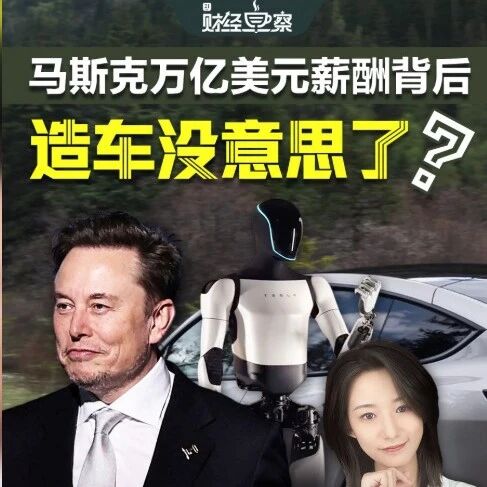
马斯克万亿美元薪酬背后:造车没意思了?
2 1 Shi Ji Jing Ji Bao Dao· 2025-11-11 07:49
Core Insights - Tesla's board has approved a ten-year compensation plan for CEO Elon Musk, valued at up to $1 trillion, which is more of a stringent "bet agreement" than a salary [1] - The plan requires Tesla's market value to increase from over $1 trillion to $8.5 trillion and annual profits to reach $400 billion, a 20-fold increase from last year's profit of approximately $17 billion [1] - The agreement emphasizes breakthroughs in four core areas: vehicle deliveries, Full Self-Driving (FSD), Robotaxi, and humanoid robots [1] Group 1 - Tesla aims to transform from a traditional car manufacturer to a service-oriented business model, akin to "Apple on wheels," where the car serves as a data-collecting platform and a service hub [2] - The strategy involves creating a closed-loop ecosystem that increases user dependency on Tesla's services, thereby enhancing customer retention and revenue generation [2] - Achieving these ambitious goals requires Tesla to simultaneously scale production, innovate technology, and significantly increase profits, which presents a challenging "impossible triangle" in traditional manufacturing [2] Group 2 - China plays a crucial role in Tesla's strategy, providing the most complete and efficient supply chain for the new energy industry, with the Shanghai Gigafactory being one of the most efficient and cost-effective facilities globally [3] - The plan is not just about establishing factories in China but deeply integrating into the local industrial ecosystem to leverage cost efficiencies and reduce R&D expenses [3] - Despite the grand vision, market skepticism remains, as evidenced by a decline in Tesla's stock price, reflecting concerns over the execution challenges and Musk's divided attention among multiple ventures [3]
马斯克万亿美元薪酬背后:造车没意思了?|财经早察
2 1 Shi Ji Jing Ji Bao Dao· 2025-11-11 07:40
Core Viewpoint - Tesla's board has approved a $1 trillion compensation plan for CEO Elon Musk, which is more of a stringent "bet agreement" than a salary, requiring the company's market value to rise from over $1 trillion to $8.5 trillion and annual profits to reach $400 billion within ten years [2][4] Summary by Sections Compensation Plan - The compensation plan is contingent on achieving ambitious targets, including a twenty-fold increase in profits from last year's $17 billion to $400 billion [2] - The agreement specifies breakthroughs in four core areas: vehicle deliveries, Full Self-Driving (FSD), Robotaxi, and humanoid robots [2] Business Model Transformation - Tesla aims to transition from being a traditional car manufacturer to a service-oriented business model, akin to "Apple on wheels," where the car serves as a data-collecting platform and a service hub [3] - The goal is to create a closed-loop ecosystem that locks users into Tesla's services, increasing customer retention and revenue [3] Challenges and Strategic Focus - Musk faces the challenge of scaling production, driving technological innovation, and achieving exponential profit growth simultaneously, which is described as a "impossible triangle" in traditional manufacturing [4] - The Chinese supply chain is identified as a critical lever for Tesla to achieve its ambitious goals, leveraging China's efficient and cost-effective production capabilities [4] Market Sentiment - Despite the grand vision, Tesla's stock has declined, reflecting market skepticism about the feasibility of Musk's ambitious plans and concerns over his divided attention among multiple companies [4][5] - The execution of this strategy is seen as highly challenging, with potential risks if any key aspect, such as FSD or Robotaxi, fails to materialize [4]