家居商品

Search documents
贵州:78亿元补贴撬动738亿元消费
Sou Hu Cai Jing· 2026-01-21 01:18
Core Insights - The Guizhou government plans to implement a "trade-in" program in 2025, utilizing a subsidy of 7.828 billion yuan to stimulate consumer spending of 73.82 billion yuan [1] Group 1: Automotive Sector - The program aims to scrap and update 66,300 vehicles, with a fiscal subsidy of 1.224 billion yuan, generating 9.284 billion yuan in new automotive consumption [1] - A total of 313,900 vehicles will be replaced, using 4.223 billion yuan in subsidies, leading to 50.41 billion yuan in new automotive consumption [1] Group 2: Home Appliances - The initiative includes the replacement of 2.2423 million home appliances, supported by 1.568 billion yuan in subsidies, resulting in 8.287 billion yuan in new home appliance consumption [1] Group 3: Home Goods - The program will facilitate the replacement of 133,700 home goods, with 182 million yuan in subsidies, generating 1.25 billion yuan in new home goods consumption [1] Group 4: Digital Products - The trade-in program will also cover 1.5334 million digital products, utilizing 557 million yuan in subsidies, leading to 4.382 billion yuan in new digital product consumption [1] Group 5: Electric Bicycles - The initiative includes the replacement of 81,100 electric bicycles, with a subsidy of 73.8636 million yuan, resulting in 207 million yuan in new electric bicycle consumption [1]
日本家居界“拼多多”NITORI宜得利,为何在中国不吃香?
3 6 Ke· 2025-06-20 02:32
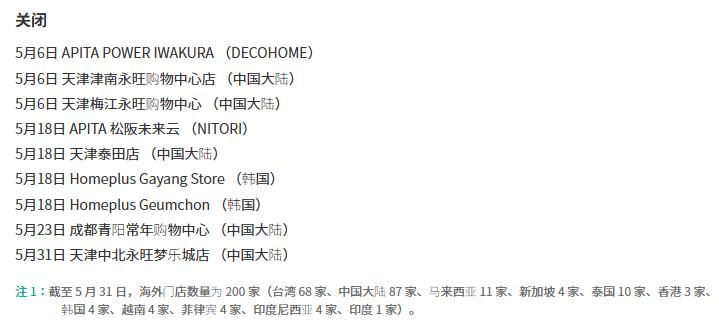
Core Viewpoint - NITORI, Japan's largest home goods retailer, is experiencing a contraction in its Chinese market operations, with a significant reduction in store numbers and declining global revenues, raising questions about its overseas strategy and market fit [1][3][5]. Group 1: Company Background and Expansion - Founded in 1967, NITORI began as a small furniture store and evolved into a retail giant by adopting a low-cost model inspired by U.S. home goods stores [1][2]. - The company expanded rapidly in Japan, achieving significant milestones such as surpassing 1,000 stores globally by March 2024 and setting a goal of 3,000 stores by 2032 [2][3]. Group 2: Challenges in the Chinese Market - NITORI entered the Chinese market in 2014 and saw rapid growth, with store numbers increasing from 46 in February 2022 to 106 by early 2025, but has since faced setbacks [3][4]. - As of May 2025, NITORI's Chinese stores decreased from 106 to 87, indicating a net loss of 19 stores in less than six months [4]. Group 3: Financial Performance - NITORI's global revenue has fluctuated, with figures of 948 billion yen in 2022, 895.7 billion yen in 2023, and 928.9 billion yen in 2024, while net profit dropped from 951 billion yen to 768 billion yen over the same period [5][16]. Group 4: Reasons for Underperformance in China - Price competitiveness is lacking, as NITORI's prices do not significantly undercut those found on platforms like Pinduoduo and Taobao [14]. - The brand's positioning is unclear, lacking the experiential marketing seen with competitors like IKEA and Muji, which diminishes its appeal to Chinese consumers [14][15]. - High operational costs associated with large store formats hinder profitability, especially in areas with insufficient foot traffic [14]. - NITORI's brand recognition is low in China compared to its competitors, impacting its market penetration [14]. - The product design does not resonate with younger consumers, who are a key demographic for home goods [15][16].

宜家深圳宝安商场将于6月19日开业
Sou Hu Cai Jing· 2025-06-17 16:12
Group 1 - IKEA announced the opening of a new store in Bao'an, Shenzhen on June 19, marking its third location in the city since entering the market in 2008 [1] - Shenzhen has become a key market for IKEA in China, driven by high-quality market development and evolving consumer demands [1] - The new store will enhance IKEA's omnichannel development strategy in Shenzhen, following the establishment of the first design order center in the city in May 2024 [1] Group 2 - The Shenzhen Bao'an store covers an area of 1,455 square meters and is designed to meet the needs of local young families, featuring six life scenario exhibition areas [3] - The store offers over 1,000 popular home goods, focusing on essential categories such as storage, textiles, kitchenware, bathroom items, and bedding [3] - IKEA aims to maximize consumer demand by ensuring a wide range of product categories and deep inventory [3] Group 3 - The new store will introduce a concept called "Swedish Flavor Food Collection," designed for smaller stores, combining a Swedish restaurant, small eateries, and a specialty food shop [4] - This concept aims to provide a space for casual dining, takeout, and purchasing ingredients for home cooking [4]