小米汽车Yu7

Search documents
小米汽车销量创新高,华为鸿蒙月销逼近9万,12月国产新能源百花齐放
Xin Lang Cai Jing· 2026-01-09 11:54
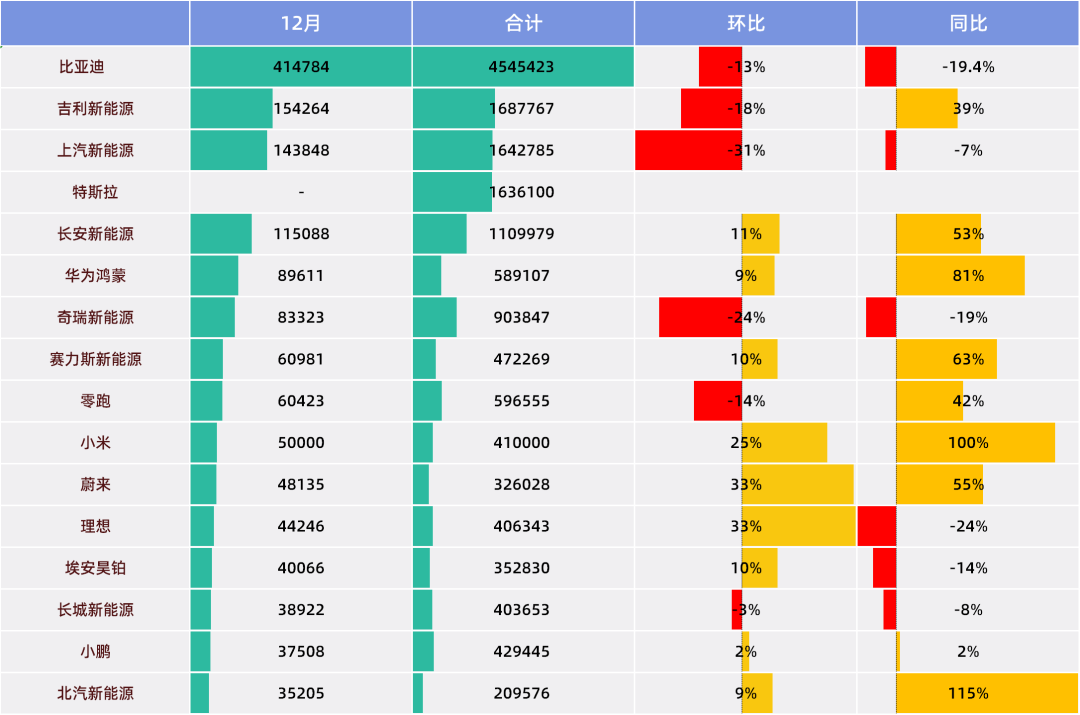
Core Insights - BYD's sales surged from 426,000 units in 2020 to 4.545 million units in 2025, achieving a compound annual growth rate of 60% [1] - Despite rapid growth, BYD faced intense competition from other automakers and did not meet its performance targets in 2025 [1] - The Chinese automotive market is undergoing significant changes, with many companies preparing for global expansion [1] Sales Performance - In December, BYD sold 414,784 units, a decrease of 13% month-over-month and 19.4% year-over-year [3] - Among 15 Chinese automakers, only five achieved both month-over-month and year-over-year sales growth [4] - The average sales volume dropped to 94,427 units in December, primarily due to declines in the first and second-tier companies [4] Market Dynamics - The Chinese government continues to support the automotive market with subsidies exceeding 1.1 billion yuan [2] - The competition is intensifying, with several brands achieving historical sales highs, particularly in the third tier [6] - The central economic work conference emphasized the importance of domestic demand, indicating ongoing support for the automotive sector [7] Company-Specific Developments - Only five out of 14 automakers met their sales targets for 2025, with companies like Li Auto and Aion falling short [8] - BYD's electric vehicle sales reached 2.2567 million units, surpassing Tesla's 1.636 million units for the first time [11] - The export volume of Chinese automobiles is expected to exceed 7 million units in 2025, with BYD emerging as a key player [14] Technological Advancements - The introduction of L3 autonomous driving technology is gaining momentum, with several companies, including BYD and Huawei, conducting road tests [17][18] - The competition for L3 autonomous driving capabilities is expected to intensify in 2026 [18] Brand Strategies - Huawei's HarmonyOS ecosystem has expanded, contributing to record sales for its vehicles [19] - Xiaomi's sales reached over 500,000 units in 2025, but the company faced a public relations crisis that may impact future products [21][23] - NIO and Xpeng have shifted to lower price segments to maintain competitiveness, with NIO achieving a record monthly sales of 48,135 units in December [24][27] Future Outlook - The automotive industry is expected to continue evolving rapidly, with companies focusing on both domestic and international markets [49] - The competitive landscape is shifting, with traditional automakers adapting to new market realities and consumer preferences [49]







小米仍在狂飙
虎嗅APP· 2025-08-20 00:22
Core Viewpoint - The article discusses Xiaomi's recent financial performance and its strategic moves across various industries, highlighting its growth in the home appliance and smart car sectors while facing challenges in the smartphone market [5][8][21]. Financial Performance - Xiaomi reported a revenue of 116 billion yuan for Q2 2025, marking a 30.5% year-on-year increase, with adjusted net profit rising by 75.4% to 10.8 billion yuan [5]. - The company has achieved six consecutive quarters of record-breaking financial results, indicating strong operational performance [5]. Home Appliance Sector - In the home appliance segment, Xiaomi's air conditioner, washing machine, and refrigerator shipments grew by 60%, 25%, and 45% respectively [5]. - The "IoT and Lifestyle Products" segment saw a revenue increase of 44.7% to 38.7 billion yuan, with wearable products growing by 70.9% and tablet sales increasing by 41.4% [11][12]. Smart Car Business - Xiaomi's smart car revenue reached 21.2 billion yuan, with a gross margin of 26.4%, exceeding market expectations [6]. - The operating loss in the smart car business narrowed to 300 million yuan, with expectations of achieving profitability in the second half of the year [7]. Smartphone Market Challenges - Xiaomi's smartphone revenue declined by 2.1% to 45.5 billion yuan, ending a streak of seven consecutive quarters of growth [21]. - Despite the overall market decline, Xiaomi was the only domestic manufacturer to achieve positive growth in Q2, with a 3.4% increase in shipment volume [22][21]. Strategic Approach - Xiaomi employs a "hit product model," focusing resources on creating standout products, which has proven effective in the air conditioning market [15]. - The company is also pushing for ecosystem integration, enhancing user stickiness through interconnected devices [16]. Market Dynamics - The smartphone market is experiencing a slowdown, with a longer replacement cycle for consumers, leading to a strategic focus on maintaining market share through competitive pricing [25][26]. - Xiaomi's high-end smartphone strategy is showing results, with increased market share in the 4000-5000 yuan and 5000-6000 yuan price segments [26].