生态联动

Search documents
合作无间:看QYResearch市场部与研究部如何协作产出爆款行业文章
QYResearch· 2026-02-12 02:40
Core Viewpoint - The article emphasizes the collaborative effort between the marketing and research departments at QYResearch to create impactful industry articles that address customer pain points and generate business opportunities [1]. Group 1: Demand Identification - The marketing department serves as the source of trending topics by identifying customer pain points through daily interactions with clients and channel partners, allowing QYResearch to capture market "itch" or "boiling point" topics effectively [3]. Group 2: Knowledge Extraction - The research department acts as the quality assurance for content, providing rigorous analysis and data-backed insights that transform scattered market information into deep industry insights, ensuring the articles are recognized by professional readers [4]. Group 3: Language Adaptation - The translation and copywriting team plays a crucial role in bridging the gap between complex academic language and the commercial logic needed by decision-makers, ensuring that reports resonate across different cultural contexts [5]. Group 4: Communication Strategy - The marketing team strategically disseminates high-quality content to maximize commercial value, utilizing various channels to engage target audiences and monitor data for dynamic optimization [6]. Group 5: Continuous Improvement - QYResearch employs a review process to assess the impact of articles on sales leads and industry discussions, fostering a culture of collaboration and continuous learning that enhances organizational capabilities [7]. Company Overview - QYResearch, established in 2007, operates in high-tech industry sectors, including electronic semiconductors, chemical raw materials, advanced materials, machinery manufacturing, and new energy vehicles, with headquarters in Los Angeles and Beijing [8].


物流各领域盈利分化显著,京东物流等联动伙伴仓网实现生态协同
Sou Hu Cai Jing· 2025-12-04 17:11
Core Insights - The logistics real estate and express delivery sectors are experiencing a profitability pattern characterized by "strong performance from leading companies and pressure on smaller firms," with industry acceleration towards high-value creation driven by network integration and capital operations [2] Group 1: Logistics Real Estate - The core trend in logistics real estate focuses on optimizing cost structures and adjusting business models, with Wanwei Logistics reporting total revenue of 3.18 billion yuan, a year-on-year increase of 7.4%, by transitioning to a "heavy asset + light asset" model [2] - Baowang Logistics reported total revenue of 1.38 billion yuan, a year-on-year decrease of 3.91%, with net profit declining by 57.71% due to long cultivation periods for newly opened parks and investments in smart park renovations and photovoltaic projects [2] Group 2: Express Delivery Sector - The express delivery industry is seeing improved profitability driven by simultaneous increases in volume and price, with JD Logistics achieving revenue of 55.084 billion yuan, a year-on-year increase of 24.1%, despite a 15% decline in net profit due to an increase in full-time delivery personnel [2] - SF Holding reported total operating revenue of 225.26 billion yuan, a year-on-year increase of 8.89%, and a net profit of 8.31 billion yuan, up 13.69%, indicating simultaneous growth in business scale and profitability [3] Group 3: Cold Chain and Cross-Border Logistics - In the cold chain sector, Hailong Cold Chain reported total revenue of 2.43 billion yuan, a year-on-year increase of 15.20%, with a net profit margin of 12.26%, while Iceberg Cold Chain saw a revenue decline of 2.73% [3] - In cross-border logistics, Jiacheng International reported total revenue of 0.95 billion yuan, a year-on-year decrease of 3.40%, but maintained a high net profit margin of 15.86% [3] Group 4: Investment and M&A Activities - Six investment events were recorded during the reporting period, with leading companies driving industry advancement through technology cooperation, capacity implementation, and capital mergers and acquisitions [3] - Notable investment activities include Zhongtong Express acquiring land for 381 million yuan to build a smart operation center, and JD Logistics launching multiple projects to enhance its logistics network [4][5] Group 5: Technological Innovation - Companies are deepening the integration of technology and logistics applications to enhance operational efficiency, with ProLogis launching an automated warehouse equipped with smart sorting robots and AGV systems [4] - JD Logistics and JD Industrial Development are collaborating on a project to integrate core resources such as warehousing and distribution, improving order processing efficiency by 50% [5][6] Group 6: Capital Operations - Capital operations and asset transactions are becoming crucial for optimizing resource allocation in the logistics industry, with notable transactions including Tianjin Port Group's plan to transfer 60% of China Railway Storage and Transportation's equity [8] - Red Star Cold Chain has submitted a listing application to the Hong Kong Stock Exchange, aiming to raise funds for expanding its cold chain network and upgrading temperature control technology [9]

新能源汽车风云录:从蔚小理到新势力崛起,未来投资密码何在?
雪球· 2025-11-28 04:43
Core Viewpoint - The article discusses the dynamic landscape of the electric vehicle (EV) industry, highlighting the competition among established players like BYD and Tesla, as well as new entrants like Seres and Xiaomi, while emphasizing the need to decode future investment opportunities amidst technological advancements and market shifts [4]. Market Status: Opportunities Amidst Differentiation - The EV market in 2025 shows a duality of growth and cooling, with production and sales increasing by 45% year-on-year in the first five months, and penetration rates surpassing 44%, indicating that one in every two new cars is an EV [5]. - However, the overall vehicle market growth is only 3%, signaling a shift from rapid expansion to more refined strategies [5]. - The competitive landscape is dominated by BYD and Tesla, with BYD leveraging vertical integration and technological iteration, while Tesla focuses on Full Self-Driving (FSD) to penetrate global markets [5]. - New entrants are experiencing differentiation: Li Auto maintains a strong position through precise targeting, NIO solidifies its high-end market with battery swapping, and Seres benefits from Huawei's smart driving technology [5]. Technological Warfare: Battery, Smart Driving, and Ecosystem - The article identifies three critical technological battlegrounds: 1. Battery Revolution: Solid-state batteries are on the horizon, with CATL's "Shenxing Battery" achieving 400 km range in just 10 minutes of charging, although mass production of solid-state batteries remains a challenge [6]. 2. Smart Driving Competition: The transition from L2 to "City NOA" is underway, with Tesla's FSD evolving and Huawei and Xpeng pushing for urban NOA implementation, making smart driving a standard feature rather than just a selling point [6]. 3. Ecosystem Integration: Companies like Xiaomi and Huawei are integrating their ecosystems into vehicles, creating a holistic user experience that extends beyond the car itself [6]. Investment Insights: Identifying Certainty Across Cycles - Future investments should focus on three key logics: 1. Head Concentration: Betting on "the strong will get stronger," with BYD and Tesla showing resilience due to scale, technology, and brand barriers, while Seres and Xiaomi offer differentiated competitive advantages [7]. 2. Technological Positioning: Focusing on critical points in the supply chain, such as battery production led by CATL and BYD, and smart driving chips dominated by Huawei and Horizon [7]. 3. Risk Avoidance: Being cautious of "pseudo-innovation" and "low barriers," as smaller companies lacking core technology may face elimination during market consolidation [7]. User Transition: From High-End to Rational Demand - The market is undergoing a structural shift, with second-tier and lower-tier cities accounting for over 50% of sales, indicating a move from policy-driven to market-driven demand [8]. - User profiles are becoming clearer, with urban middle-class consumers seeking smart features and cost-effectiveness, while younger consumers in smaller cities are eager to try new technologies [8]. - Decision-making is becoming more rational, with key considerations including range, charging, resale value, and safety, prompting companies to address these pain points [8]. Industry Insights: A Paradigm-Shifting Revolution - The EV wave offers insights that extend beyond the automotive industry: 1. Balancing "Fast" and "Slow": While technological iterations occur rapidly, the maturity of the supply chain requires years of development, necessitating a balance between innovation speed and quality [10]. 2. Inevitable Cross-Industry Integration: The entry of tech companies disrupts traditional automotive boundaries, leading to a three-dimensional competition involving software, hardware, and ecosystems [11]. 3. Globalization as a Double-Edged Sword: Chinese automakers face opportunities abroad but must also navigate geopolitical and trade barriers [12]. 4. Long-Termism as a Winning Strategy: Post-subsidy reductions, only companies that invest in R&D and build brand moats will survive through cycles [13]. Conclusion - The EV industry stands at a historical crossroads, where technological breakthroughs and market dynamics intersect, and user demands collide with capital logic [14]. - Future winners will be those who lead change through technological innovation, control the supply chain to mitigate risks, and define products with a user-centric approach [14].



汽车产业正向“生态联动”进阶
Zheng Quan Ri Bao· 2025-09-24 16:36
Group 1 - The automotive industry is undergoing a transformation where component manufacturers are gaining more influence in the value chain due to the integration of technology and the shift towards smart mobility solutions [1][2] - Recent acquisitions, such as Huayu Automotive's purchase of a 49% stake in SAIC Qingtao for 206 million yuan, highlight the focus on solid-state battery technology and the collaboration between traditional components and new energy technologies [1][2] - The shift from a linear supply chain to a networked ecosystem is evident, with companies like Volkswagen shortening R&D cycles and enhancing supply chain security through collaborative approaches [2] Group 2 - The integration of battery technology with chassis and thermal management systems exemplifies the trend of ecological linkage, where the battery becomes a key variable for optimizing vehicle range and safety [2] - Successful ecosystem integration requires a scientific mechanism design that balances innovation and synergy among business units, especially in rapidly evolving technological fields [2][3] - The future of the automotive industry will be driven by open-mindedness towards cross-domain partnerships, collaborative resource integration, and user-driven innovation, leading to a transformation from mechanical to intelligent ecological industries [3]
小米仍在狂飙
虎嗅APP· 2025-08-20 00:22
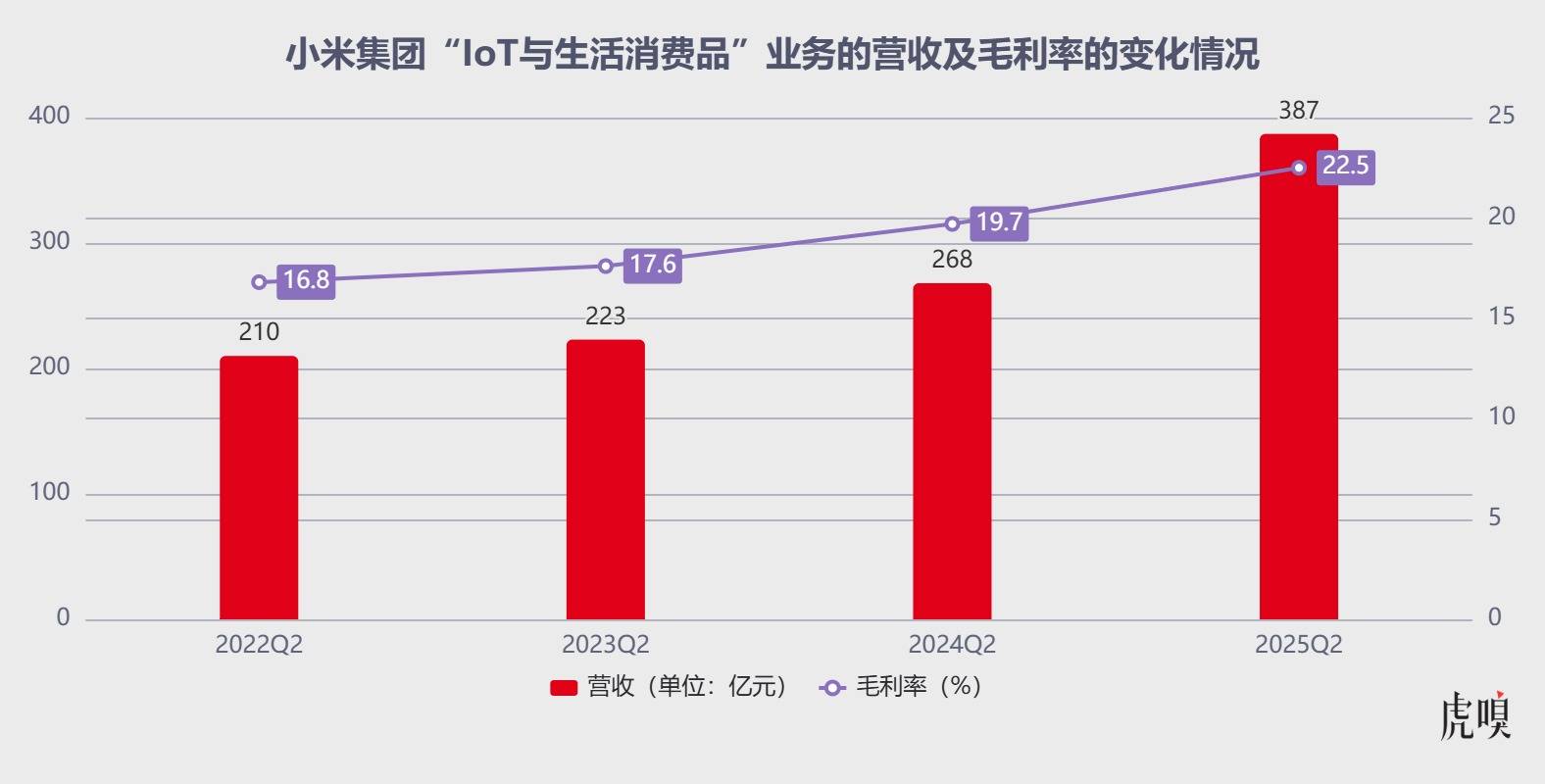
Core Viewpoint - The article discusses Xiaomi's recent financial performance and its strategic moves across various industries, highlighting its growth in the home appliance and smart car sectors while facing challenges in the smartphone market [5][8][21]. Financial Performance - Xiaomi reported a revenue of 116 billion yuan for Q2 2025, marking a 30.5% year-on-year increase, with adjusted net profit rising by 75.4% to 10.8 billion yuan [5]. - The company has achieved six consecutive quarters of record-breaking financial results, indicating strong operational performance [5]. Home Appliance Sector - In the home appliance segment, Xiaomi's air conditioner, washing machine, and refrigerator shipments grew by 60%, 25%, and 45% respectively [5]. - The "IoT and Lifestyle Products" segment saw a revenue increase of 44.7% to 38.7 billion yuan, with wearable products growing by 70.9% and tablet sales increasing by 41.4% [11][12]. Smart Car Business - Xiaomi's smart car revenue reached 21.2 billion yuan, with a gross margin of 26.4%, exceeding market expectations [6]. - The operating loss in the smart car business narrowed to 300 million yuan, with expectations of achieving profitability in the second half of the year [7]. Smartphone Market Challenges - Xiaomi's smartphone revenue declined by 2.1% to 45.5 billion yuan, ending a streak of seven consecutive quarters of growth [21]. - Despite the overall market decline, Xiaomi was the only domestic manufacturer to achieve positive growth in Q2, with a 3.4% increase in shipment volume [22][21]. Strategic Approach - Xiaomi employs a "hit product model," focusing resources on creating standout products, which has proven effective in the air conditioning market [15]. - The company is also pushing for ecosystem integration, enhancing user stickiness through interconnected devices [16]. Market Dynamics - The smartphone market is experiencing a slowdown, with a longer replacement cycle for consumers, leading to a strategic focus on maintaining market share through competitive pricing [25][26]. - Xiaomi's high-end smartphone strategy is showing results, with increased market share in the 4000-5000 yuan and 5000-6000 yuan price segments [26].

小米仍在狂飙
Hu Xiu· 2025-08-19 23:44
Core Viewpoint - The article discusses the competitive dynamics in the air conditioning industry, highlighting Xiaomi's rapid growth and market share gains against traditional players like Gree, amidst a backdrop of broader industry challenges and Xiaomi's financial performance. Group 1: Xiaomi's Market Position - Xiaomi's air conditioning market share reportedly surpassed Gree's in July, leading to public disputes over data accuracy between the companies [1] - The competitive landscape indicates that Xiaomi has become a significant threat to traditional manufacturers in the air conditioning sector [1] Group 2: Financial Performance - Xiaomi's Q2 2025 revenue reached 116 billion yuan, a 30.5% year-on-year increase, with adjusted net profit rising 75.4% to 10.8 billion yuan [2][3] - The company has achieved six consecutive quarters of record financial performance, with notable growth in non-core businesses such as home appliances [3] Group 3: Product Performance - In the home appliance sector, Xiaomi's air conditioners, washing machines, and refrigerators saw shipment increases of 60%, 25%, and 45% respectively [3] - Xiaomi's smart car business generated 21.2 billion yuan in revenue, with a gross margin of 26.4%, exceeding market expectations [3] Group 4: Strategic Approaches - Xiaomi employs a "hit product model," focusing resources on a few standout products to dominate market segments, as seen with the "Mijia Air Conditioner Pro" [11] - The company is also enhancing its ecosystem, with 20.5 million users connecting five or more devices to its AIoT platform, reflecting a 26.8% year-on-year growth [11] Group 5: Challenges in Smartphone Business - Xiaomi's smartphone revenue declined by 2.1% to 45.5 billion yuan, marking the end of seven consecutive quarters of growth [4][16] - Despite being the only domestic manufacturer to achieve positive shipment growth in Q2, the company faces a dilemma between maintaining volume and pricing strategies [4][22] Group 6: Market Dynamics - The overall smartphone market in China saw a 4.1% decline in shipments, with Xiaomi's performance being relatively strong compared to competitors [16][17] - The company is navigating a challenging environment where consumer demand has been affected by previous promotional activities and longer replacement cycles for smartphones [18][26]