
小米汽车Su7

Search documents
小米汽车销量创新高,华为鸿蒙月销逼近9万,12月国产新能源百花齐放
Xin Lang Cai Jing· 2026-01-09 11:54
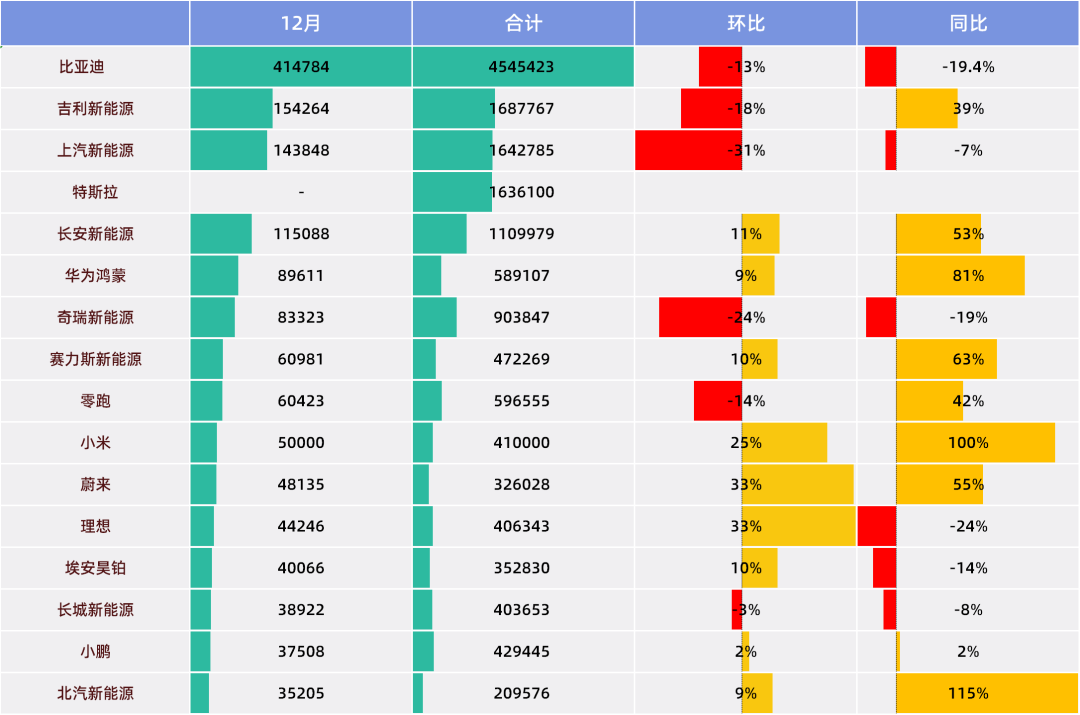
Core Insights - BYD's sales surged from 426,000 units in 2020 to 4.545 million units in 2025, achieving a compound annual growth rate of 60% [1] - Despite rapid growth, BYD faced intense competition from other automakers and did not meet its performance targets in 2025 [1] - The Chinese automotive market is undergoing significant changes, with many companies preparing for global expansion [1] Sales Performance - In December, BYD sold 414,784 units, a decrease of 13% month-over-month and 19.4% year-over-year [3] - Among 15 Chinese automakers, only five achieved both month-over-month and year-over-year sales growth [4] - The average sales volume dropped to 94,427 units in December, primarily due to declines in the first and second-tier companies [4] Market Dynamics - The Chinese government continues to support the automotive market with subsidies exceeding 1.1 billion yuan [2] - The competition is intensifying, with several brands achieving historical sales highs, particularly in the third tier [6] - The central economic work conference emphasized the importance of domestic demand, indicating ongoing support for the automotive sector [7] Company-Specific Developments - Only five out of 14 automakers met their sales targets for 2025, with companies like Li Auto and Aion falling short [8] - BYD's electric vehicle sales reached 2.2567 million units, surpassing Tesla's 1.636 million units for the first time [11] - The export volume of Chinese automobiles is expected to exceed 7 million units in 2025, with BYD emerging as a key player [14] Technological Advancements - The introduction of L3 autonomous driving technology is gaining momentum, with several companies, including BYD and Huawei, conducting road tests [17][18] - The competition for L3 autonomous driving capabilities is expected to intensify in 2026 [18] Brand Strategies - Huawei's HarmonyOS ecosystem has expanded, contributing to record sales for its vehicles [19] - Xiaomi's sales reached over 500,000 units in 2025, but the company faced a public relations crisis that may impact future products [21][23] - NIO and Xpeng have shifted to lower price segments to maintain competitiveness, with NIO achieving a record monthly sales of 48,135 units in December [24][27] Future Outlook - The automotive industry is expected to continue evolving rapidly, with companies focusing on both domestic and international markets [49] - The competitive landscape is shifting, with traditional automakers adapting to new market realities and consumer preferences [49]







小米质疑声中创新高,华为月销逼近9万,12月国产新能源百花齐放
Xin Lang Cai Jing· 2026-01-09 08:19
Core Viewpoint - The Chinese automotive industry is experiencing intense competition, with companies rapidly evolving from single product lines to full product lines and expanding from domestic to global markets [3][52]. Group 1: Sales Performance - BYD's sales surged from 426,000 units in 2020 to 4.545 million units in 2025, achieving a compound annual growth rate of 60% [4][5]. - In December, the average sales dropped to 94,427 units, with major players like BYD, Geely, and SAIC experiencing month-on-month declines [9][57]. - Among 15 Chinese automakers, only five maintained both year-on-year and month-on-month growth in December [9][57]. Group 2: Market Dynamics - The Chinese government continues to support the automotive market with additional subsidies exceeding 1.1 billion yuan [6][54]. - The competition is intensifying, with traditional automakers facing pressure from new entrants and third-tier companies achieving record sales [9][60]. - In December, 12 out of 29 brands reported record high sales, primarily from mid-tier and lower-tier brands [9][60]. Group 3: Company-Specific Insights - Only five companies, including Xiaopeng and Geely, met their annual sales targets, while others like Aion and Ideal fell short [12][61]. - BYD's electric vehicle sales reached 2.2567 million units, surpassing Tesla's 1.636 million units for the first time [15][64]. - Geely has become the fastest-growing player in the new energy sector, achieving over 1 million annual sales [43][63]. Group 4: Export Trends - China's automotive exports exceeded 700,000 units in 2025, with BYD and Chery leading the charge [19][67]. - BYD's overseas sales have significantly increased, with expectations to become the top exporter in 2026 [19][67]. Group 5: Technological Advancements - The introduction of L3 autonomous driving technology is gaining traction, with several companies, including BYD and Changan, actively testing and preparing for market entry [23][71]. - Huawei's HarmonyOS ecosystem has expanded, contributing to record sales for its automotive partners [25][73]. Group 6: Competitive Strategies - Price wars initiated by BYD have faced backlash, leading to a halt in aggressive pricing strategies [39][88]. - Geely's restructuring and focus on group synergy have positioned it for future growth, particularly in the high-end electric vehicle market [43][94]. - GAC has made significant internal adjustments to enhance its brand image and sales performance [49][95].
换道造车,雷老板的最后一次创业,小米的第五次升级尝试
Quan Jing Wang· 2025-08-13 05:51
Core Insights - Xiaomi has transitioned from a budget smartphone brand to a more premium positioning, facing challenges in balancing its "cost-performance" reputation with high-end aspirations [1][5][14] - The launch of the Su7 electric vehicle marks a significant step in Xiaomi's strategy to redefine its brand and expand into new markets, aiming to enhance its high-end image [9][14] Group 1: Historical Context and Challenges - Xiaomi's initial success was built on high cost-performance products, but this strategy has limited its market share and profitability [1][4] - The company's attempts to enter the high-end market have faced setbacks, including the poor reception of the Xiaomi Note series and the MIX series, which struggled with design and user experience issues [2][3][4] - The brand's identity became muddled as it attempted to compete in both low and mid-range markets, leading to confusion among consumers [5][6] Group 2: Strategic Shifts - In 2019, Xiaomi separated the Redmi brand to focus on different market segments, allowing for a dual-brand strategy that aims to optimize product structure and enhance brand value [5][6] - The introduction of the Xiaomi 9 marked a shift in pricing strategy, but consumer expectations remained tied to the brand's low-cost roots, leading to mixed reactions [6][7] - The launch of the Xiaomi 10 series in 2020 saw a successful entry into the high-end market, with significant sales figures indicating a potential turnaround [7][8] Group 3: Recent Developments and Future Outlook - The Su7 electric vehicle has generated significant interest, with rapid sales and a strong market response, indicating a successful entry into the automotive sector [12][14] - Xiaomi's financial performance has improved, with a reported revenue of 111.3 billion yuan in Q1 2025, reflecting a 47.4% year-on-year growth [14][16] - The company's focus on high-end products and integration of its IoT ecosystem has led to increased average selling prices and market share in the smartphone segment [15][16]
