
山杏

Search documents
治沙播绿兴产富民
Xin Lang Cai Jing· 2026-02-07 22:52
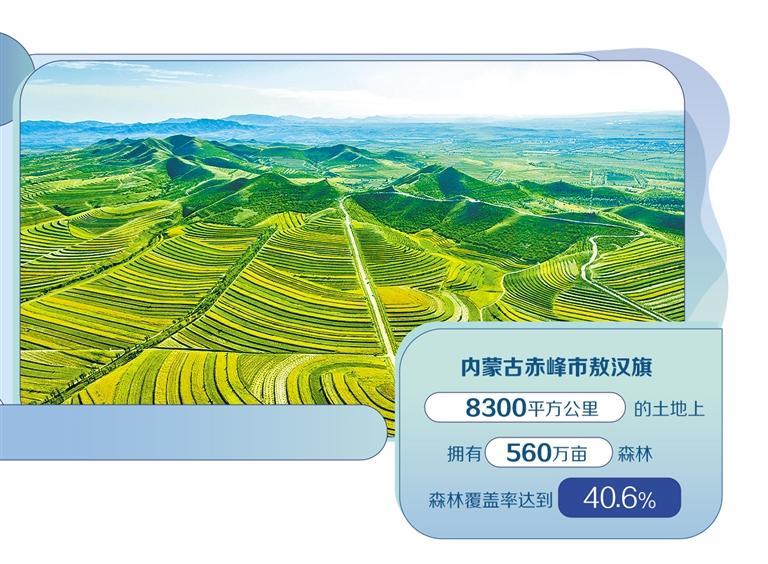
Core Viewpoint - The article highlights the ecological transformation of Aohan Banner, Inner Mongolia, showcasing its journey from high desertification to becoming a national model for ecological civilization, significantly improving both the environment and local livelihoods [2][3][4][5]. Group 1: Ecological Transformation - Aohan Banner has achieved a forest coverage rate of 40.6% over 8300 square kilometers, recovering from a desertification rate of 76% at the founding of New China [2]. - The region has implemented innovative drought-resistant afforestation techniques, increasing tree survival rates from below 30% to over 95% [2]. - Over the past five years, Aohan Banner has completed sand control tasks covering 171,700 acres, leading to a qualitative leap in the ecological environment [3]. Group 2: Economic Benefits - The local economy has benefited from the ecological initiatives, with the forestry and grassland industry expected to reach a value of 1.696 billion yuan by 2025, providing income opportunities for nearly 10,000 households [3][4]. - The Aohan Banner has created job opportunities for over 4000 people through the sand thorn industry, with an average income increase of over 15,000 yuan per person during the harvesting season [4]. - The transformation of barren land into productive areas has led to increased agricultural yields, with grain production per acre rising from 200 to over 800 jin [5]. Group 3: Sustainable Practices - Aohan Banner has adopted a comprehensive governance model combining engineering and biological methods to combat desertification, focusing on the last 61,500 acres of shifting sand [5]. - The region's approach emphasizes the integration of ecological value into economic value, creating a virtuous cycle of ecological beauty, industrial prosperity, and increased wealth for the local population [4][5]. - The local government is committed to maintaining a long-term strategic vision for ecological and economic benefits, ensuring a unified approach to achieving ecological, economic, and social outcomes [5].

绿满拉萨南北山(辉煌60载 魅力新西藏)
Ren Min Ri Bao· 2025-07-20 21:52
Core Viewpoint - The article highlights the significant ecological and social advancements in Tibet over the past 60 years, particularly focusing on the greening efforts in Lhasa and the successful implementation of the North-South Mountain Greening Project, which has led to increased biodiversity and improved living conditions for local residents [1][7]. Summary by Sections Historical Context - The establishment of the Tibet Autonomous Region in 1965 has led to comprehensive progress and historical achievements, especially since the 18th National Congress of the Communist Party of China [1]. Greening Efforts - The North-South Mountain Greening Project has successfully completed afforestation of 1.0793 million acres and planted over 120 million trees, achieving a survival rate of over 85% [3][5]. - The project has introduced 12 native tree species that are resilient to cold and drought, contributing to the increased greening of the surrounding mountains [3]. Employment and Economic Impact - The greening project has created over 9 million job opportunities and generated an income of 2.9 billion yuan, demonstrating a successful integration of ecological restoration and economic development [5][6]. Ecological Benefits - The project has significantly improved the ecological environment around Lhasa, with estimates indicating an annual increase in water storage of approximately 49.8 million tons, carbon fixation of 22.91 million tons, oxygen release of 19.3 million tons, and nutrient retention of 2.71 million tons, translating to an annual ecological value of 1.485 billion yuan [7]. Community Engagement - Local residents have embraced the greening initiatives, recognizing the benefits of improved ecology on their quality of life, leading to a cultural shift towards environmental stewardship [7].