
德邦稳盈增长灵活配置混合基金

Search documents
公募基金流量危机隐现
虎嗅APP· 2026-03-17 00:08
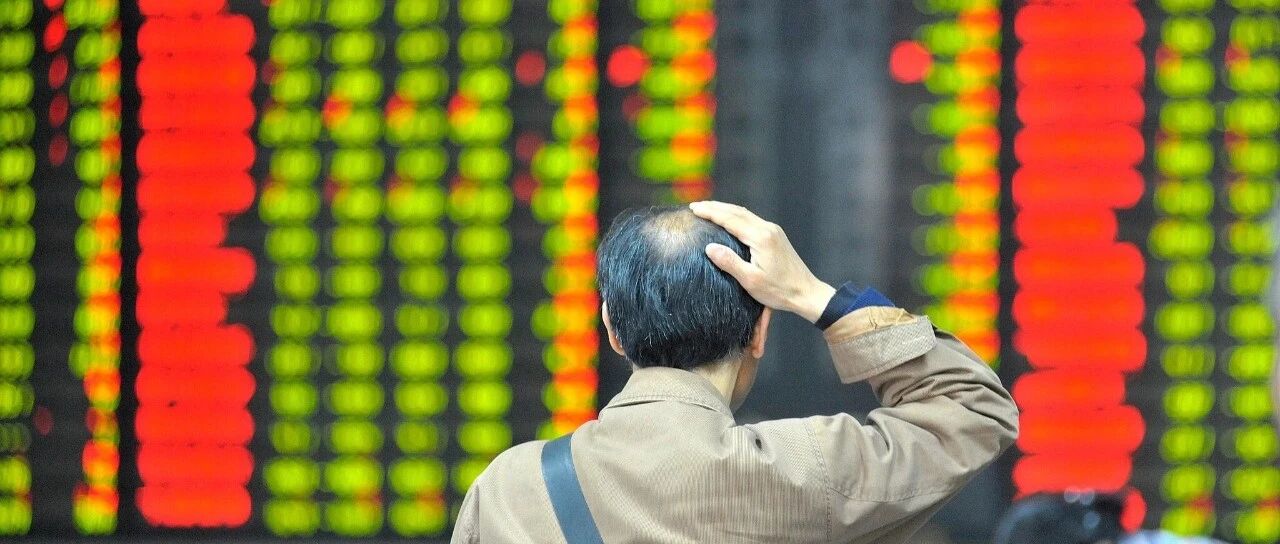
Core Viewpoint - The article discusses the challenges faced by fund companies in the current market, particularly the backlash from excessive focus on attracting flow and the performance issues of popular thematic funds, especially in the AI sector [4][9]. Group 1: Fund Performance Issues - The performance of the Qianhai Kaiyuan Artificial Intelligence fund has been poor, with a return of -4.15% in 2025, ranking 2242 out of 2274 in its category, and a return of -13.97% in 2026, ranking 2344 out of 2347 [5]. - Other previously high-performing thematic funds, such as Yongying Technology and AVIC Opportunity, have also seen significant declines in performance, with returns of -0.93% and 2.02% respectively in 2026, compared to their previous returns of 233% and 167% [6]. - The Penghua Technology Driven fund, managed by Yan Siqian, has experienced a drastic drop in performance, with a return of -17.17% in 2026 after achieving a 47% return the previous year [6]. Group 2: Flow and Regulatory Challenges - The National Investment Ruijin faced a compensation issue due to valuation adjustments of its silver futures LOF fund, with estimated compensation reaching 431 million yuan, which could consume most of its profits for the year [7]. - Debon Fund encountered regulatory scrutiny for collaborating with unqualified internet influencers for marketing, leading to a suspension of new fund issuance and accountability for senior management [8]. - The article highlights that the desire for flow has led to various issues, including regulatory penalties and reputational damage for fund companies [9][19]. Group 3: Shift in Fund Strategies - Fund companies are shifting from promoting star fund managers to adopting a more tool-oriented product strategy in response to market conditions [10][13]. - The rise of tool-based products, such as ETFs and actively managed funds focusing on specific sectors, is seen as a way to attract investors while managing flow-related pressures [13][15]. - The article notes that while tool-based products can provide flexibility and attract investment, they also carry higher volatility and risk, especially in fluctuating market conditions [20][21]. Group 4: Potential Crisis and Recommendations - The article warns of a potential crisis stemming from the high volatility of tool-based products and the influx of inexperienced investors, which could lead to reputational damage and increased complaints for fund companies [20][21]. - It suggests that fund companies should not only embrace flow but also ensure compliance and professional marketing strategies to mitigate risks associated with rapid growth [25][26]. - Recommendations include proactive communication of product performance and risks, as well as educational outreach to investors to improve understanding and reduce misalignment of expectations [26].

蛇年最后的基金风暴:大V“爱理财的小羊”带货德邦基金growing up ,董事长左畅going down坚称是工作调整
Xin Lang Cai Jing· 2026-02-14 09:31
Core Viewpoint - The incident involving Debund Fund and the influencer "Xiaoyang" has led to significant regulatory scrutiny, resulting in the resignation of the chairman and a halt on new fund issuance due to violations in fund sales practices [2][4][19]. Group 1: Incident Overview - Debund Fund's chairman, Zuo Chang, was removed from his position due to a "work adjustment" following the controversy surrounding the influencer's promotion of the fund [2][10]. - The fund experienced a dramatic increase in subscriptions, with over 12 billion yuan (approximately 1.8 billion USD) in a single day, growing from less than 1 billion yuan to over 13 billion yuan (an increase of over 16 times) [5][20]. - The China Securities Regulatory Commission (CSRC) expressed strong discontent with the fund's practices, leading to penalties and the influencer being permanently banned from all platforms [4][11][19]. Group 2: Regulatory Actions and Consequences - The CSRC issued a statement prohibiting the use of internet influencers to conduct fund sales, highlighting the regulatory framework governing such activities [7][22]. - Debund Fund was found to have collaborated with an unqualified influencer, failed to meet investor suitability obligations, and allegedly manipulated market sentiment through pre-announced large purchases [11][26]. - The new chairman, Wu Xiaochun, took over on February 12, 2026, following the resignation of Zuo Chang [9][24]. Group 3: Influencer's Role - The influencer "Xiaoyang," who has 4 million followers, publicly disclosed a substantial investment in Debund Fund, which contributed to the fund's rapid growth [6][21]. - Xiaoyang was reported to have concealed financial relationships and was alleged to have received a commission of approximately 3.6 million yuan (around 540,000 USD) for promoting the fund [11][26].
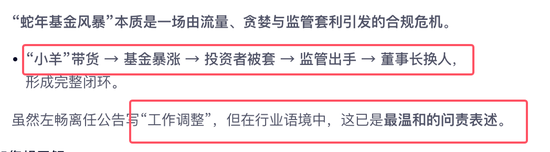
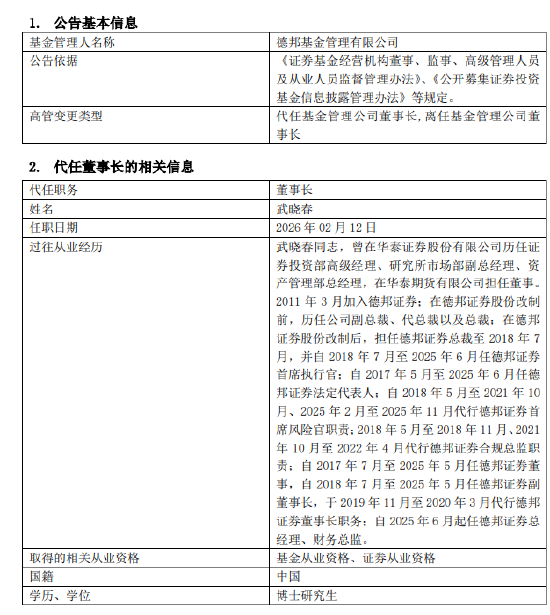
德邦基金换帅!左畅因工作调整离任董事长,德邦证券总经理武晓春代职
Xin Lang Cai Jing· 2026-02-14 06:19
Core Viewpoint - The recent leadership change at Debon Fund, with the departure of Chairman Zuo Chang and the appointment of Wu Xiaochun as acting chairman, reflects ongoing governance optimization within the company amidst regulatory challenges and industry trends [1][7][20]. Group 1: Leadership Change - Zuo Chang has stepped down as chairman due to work adjustments, effective February 12, 2026, without transitioning to another role within the company [1][4]. - Wu Xiaochun, the general manager and CFO of Debon Securities, has taken over the chairman's responsibilities starting February 12, 2026 [1][3]. - Wu Xiaochun has over 30 years of experience in the financial industry, having held various senior positions at Debon Securities and other firms [6][18]. Group 2: Company Growth - Under Zuo Chang's leadership from April 2018 to February 2026, Debon Fund's assets under management grew from approximately 13.3 billion RMB to about 69.7 billion RMB, a 5.24-fold increase [5][17]. - Debon Fund was established in March 2012 and is headquartered in Shanghai, with a registered capital of 590 million RMB [5][17]. Group 3: Regulatory Issues - Recently, Debon Fund faced significant regulatory penalties due to a major violation involving improper sales practices, which included collaborating with unqualified internet influencers to promote its products [7][19]. - The fund's assets surged dramatically, with over 12 billion RMB raised in a single day, raising concerns about risk disclosure and compliance [19]. Group 4: Industry Context - The recent leadership changes at Debon Fund are part of a broader trend in the public fund industry, where 49 executives across 24 fund companies have changed since the beginning of 2026 [9][21]. - This trend reflects the industry's need for continuous optimization of management capabilities and governance structures in response to rapid development and market dynamics [12][24].
德邦基金违规打造百亿爆款基金被罚,督察长徐晓红被指不尽责,曾任职于检察院、证监局、长城证券、国盛证券
Xin Lang Cai Jing· 2026-01-30 10:07
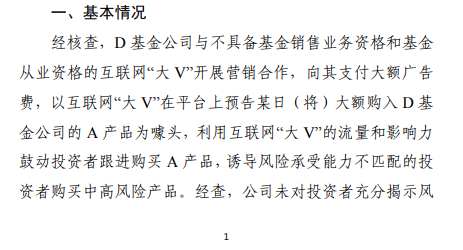
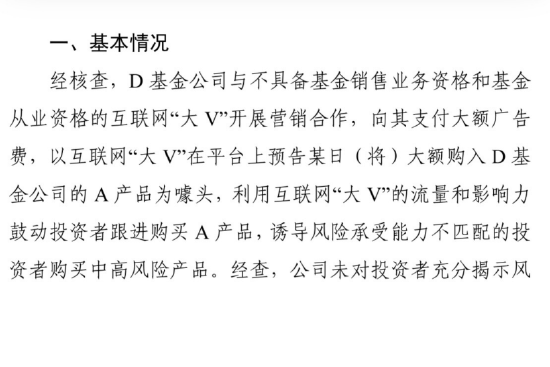
Core Viewpoint - The China Securities Regulatory Commission (CSRC) confirmed that Debang Fund engaged in illegal marketing practices by collaborating with unqualified internet influencers, leading to regulatory actions including the suspension of new fund registrations and accountability for senior management [1][19][21]. Group 1: Incident Exposure - The incident originated from rumors on January 12, 2026, claiming that Debang Fund's "Debang Stable Growth Flexible Allocation Mixed Fund" attracted 12 billion yuan in a single day [4][22]. - Following the rumors, Debang Fund issued two purchase limit announcements on January 13, drastically reducing the purchase limits for different share classes due to the influx of funds [5][23]. - The rapid influx of funds diluted the fund's net value, with the fund's A/C share return rate exceeding 8% on January 12, while the net return rate on January 13 was only 0.05% despite significant stock gains [5][23]. Group 2: Violations and Misleading Practices - The core violation involved Debang Fund's collaboration with unqualified internet influencers, paying them substantial advertising fees to promote specific fund products [6][24]. - The marketing strategy was provocative, with influencers announcing large purchases of Debang Fund products to encourage investor participation [6][24]. - The marketing was also linked to a previously banned feature, "real-time fund valuation," which misled investors about the fund's performance, showing inflated returns compared to official figures [7][25]. Group 3: Regulatory Actions and Accountability - The CSRC identified two major violations: failure to manage investor suitability and illegal collaboration with unqualified third parties, violating regulatory guidelines [8][26]. - The regulatory response included a mandate for Debang Fund to correct its practices and a suspension of new fund product registrations [8][26]. - Senior management, including the general manager and compliance officer, were held accountable for these violations [9][28]. Group 4: Industry Warnings and Regulatory Requirements - The regulatory notice serves as a warning to the entire industry, highlighting significant issues in fund sales practices [13][33]. - It emphasizes three key regulatory requirements: prohibition of collaborations with unqualified influencers, self-inspection by sales institutions, and the removal of misleading features from platforms [14][34]. - The notice reiterates the principle of investor suitability, stressing the importance of matching appropriate products with suitable investors [15][35].

德邦基金罪与罚:找大V忽悠投资者买入超百亿 总经理张騄被监管追责
Xin Lang Cai Jing· 2026-01-30 06:31
Core Viewpoint - The regulatory body has taken strict action against Debang Fund for alleged violations in sales practices, particularly involving the use of internet influencers to drive significant inflows into their funds, leading to a suspension of new fund registrations and accountability for senior management [1][2][5]. Group 1: Regulatory Actions - The China Securities Regulatory Commission (CSRC) reported that a fund company, identified as Debang Fund, had over 10 billion yuan in daily subscriptions, raising concerns about illegal sales practices [1][2]. - The CSRC has mandated corrective actions and suspended the acceptance of new public fund product registrations for Debang Fund, holding the general manager and other key personnel accountable [2][7]. Group 2: Marketing Practices - Debang Fund collaborated with unqualified internet influencers, paying substantial advertising fees to promote their products, which misled investors into purchasing high-risk funds [2][4]. - Influencers with over a million followers showcased their substantial investments in Debang's funds, which attracted significant attention and raised questions about the legitimacy of such marketing tactics [2][7]. Group 3: Fund Management and Holdings - Debang Fund's flagship product, the Debang Stable Growth Flexible Allocation Mixed Fund, is managed by Lei Tao and Lu Yang, with a heavy focus on AI-related stocks among its top holdings [1][6]. - The top ten holdings of the fund include companies like Hehe Information, Zhuoyi Information, and Wanxing Technology, indicating a strategic bet on the AI sector [1][6]. Group 4: Industry Implications - The incident highlights a broader issue within the industry regarding the use of non-compliant marketing strategies, prompting the CSRC to emphasize the need for proper investor suitability management and adherence to legal standards [4][10]. - The regulatory response serves as a warning to the fund industry about the potential risks associated with influencer marketing and the importance of maintaining investor trust and compliance [5][10].
德邦基金违规引流遭通报:与“大V”营销合作属实,高管遭问责,产品注册被暂停
Xin Lang Cai Jing· 2026-01-30 04:14
Core Viewpoint - The regulatory body has issued a warning regarding the improper sales practices of Debon Fund, particularly concerning the significant daily subscription surge of 12 billion yuan for its Debon Stable Growth Flexible Allocation Mixed Fund, which raised compliance concerns [6][19][20]. Group 1: Regulatory Actions - The China Securities Regulatory Commission (CSRC) has mandated corrective actions and suspended the acceptance of new public fund product registrations for Debon Fund due to violations of sales regulations [6][19]. - The company collaborated with unqualified internet influencers to promote the fund, leading to a lack of adequate risk disclosure and inappropriate investor suitability management [6][19]. - Key executives, including the general manager and heads of relevant departments, have been held accountable for these violations [6][19]. Group 2: Fund Performance and Market Reaction - The Debon Stable Growth Fund had a remarkable performance, with a monthly increase of over 34%, and its top holdings were primarily in AI-related sectors [9][22]. - Prior to the regulatory announcement, the fund's subscription volume had already attracted significant market attention, with reports of a single-day sales figure of 12 billion yuan, which was notable given the total management scale of all Debon Fund's equity products was only 15.473 billion yuan [20][22]. - Following the surge in subscriptions, the fund implemented emergency purchase limits, indicating an intention to cool down the excessive inflow [20][22]. Group 3: Industry Implications - The incident serves as a wake-up call for the entire fund industry, highlighting the need to balance innovative marketing channels with strict compliance to protect investor interests [25]. - The regulatory stance emphasizes that any expansion at the cost of investor rights and market order will face severe penalties [25]. - The industry must shift from a scale-oriented approach to one focused on investor interests and professional value, moving away from short-term, traffic-driven marketing strategies [25].
德邦基金“吸金120亿”合规拷问:实盘大V无证荐基是否触碰红线?
Xin Lang Cai Jing· 2026-01-20 09:20
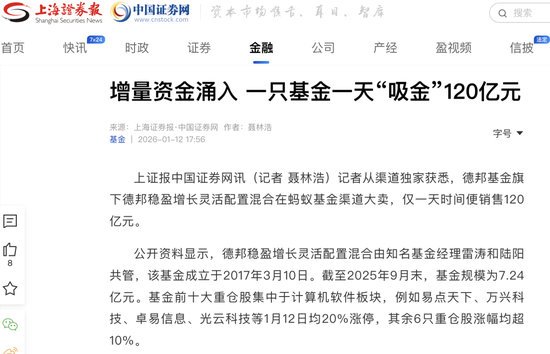
Core Viewpoint - The article discusses the phenomenon of a significant influx of capital into the Debon Fund's "Debon Stable Growth Flexible Allocation Mixed Fund," which reportedly attracted 12 billion yuan in a single day, highlighting the interplay of social media influencers, platform algorithms, and the anxiety of smaller fund companies in the public fund industry [1][23]. Group 1: Fund Performance and Market Reaction - On January 12, the Debon Stable Growth Fund experienced a surge, with both A and C shares rising over 8% as the AI application sector in the A-share market exploded [2][24]. - The fund's management denied the authenticity of the reported capital influx, emphasizing reliance on periodic reports, yet market reactions indicated skepticism due to rapid implementation of purchase limits [4][25]. Group 2: Marketing Strategies and Influencer Impact - The marketing strategy employed by the fund resembles "hunger marketing," creating a sense of scarcity and urgency among investors [6][27]. - A prominent social media influencer showcased a significant investment in the fund, leading to a wave of follower investments, although the influencer later clarified that claims of collaboration and commission were unfounded [7][28]. Group 3: Regulatory and Ethical Concerns - Many influencers lack the necessary qualifications for fund sales and engage in questionable practices by promoting funds without proper risk disclosures, which raises ethical concerns [8][29]. - Reports suggest that Debon Fund offered unusually high commission rates to influencers, potentially leading to misrepresentation of the fund's risk profile and encouraging impulsive investment decisions among followers [8][29]. Group 4: Fund Characteristics and Risks - The Debon Stable Growth Fund, despite its name suggesting stability, has a high stock allocation of 93.98% and minimal bond exposure, indicating a high-risk profile [9][30]. - The fund's historical performance has been underwhelming, with an annual return of only around 8% in 2025, which is below its benchmark [13][34]. Group 5: Company Context and Strategic Decisions - Following a change in control to state-owned assets, Debon Fund faces pressure to improve its scale and market presence, leading to aggressive marketing strategies [15][36]. - The company operates as a small public fund with a total scale of approximately 66.5 billion yuan, ranking around 80th in the industry, which drives its pursuit of rapid growth through high-risk products [16][37]. Group 6: Market Dynamics and Investor Implications - The article highlights the disconnect between the marketing strategies employed and the actual risks faced by investors, particularly during market volatility [19][40]. - The long-term value of the fund for investors remains uncertain, especially as market conditions change and the initial excitement fades [20][41].
公募基金掀起“限购潮”
Jin Rong Shi Bao· 2026-01-16 02:04
Core Viewpoint - The recent surge in public funds implementing purchase limits is driven by a recovering market sentiment, the ongoing enthusiasm for AI and technology themes, and the rapid increase in net asset values of several high-performing funds [1] Group 1: Fund Purchase Limits - As of January 14, 2026, 26 public fund products have announced purchase limits, significantly exceeding historical levels [1] - Notable fund managers such as China Europe Fund, E Fund, and others have issued purchase limit announcements to maintain stable fund operations and protect the interests of existing investors [1] - The Debon Growth Flexible Allocation Mixed Fund became a focal point of this trend, announcing purchase limits twice in two days due to a single-day net value surge of 8.32% and a cumulative increase of 29.42% over six trading days [2] Group 2: Specific Fund Actions - China Europe Fund implemented purchase limits on three of its products, with the China Europe Small Cap Growth Mixed Fund completely suspending subscriptions and transfers due to exceeding its asset cap of 20 billion yuan [3] - The other two products from China Europe Fund adopted a more moderate approach, setting daily purchase limits at 1 million yuan [3] - The varying purchase limit strategies reflect considerations of different fund types, with active equity products facing stricter limits compared to passive index products [3] Group 3: Rationale Behind Purchase Limits - The primary reason for implementing purchase limits is to prevent the dilution of investment strategies due to rapid scale expansion and to manage operational pressures from irrational market inflows [4] - The current hot themes, such as AI and high-end equipment, have led to significant short-term inflows, making it challenging for fund managers to allocate assets quickly, which could dilute existing investors' returns [4] - The rapid growth in fund size can exceed effective management capacity, leading to strategy distortion and increased trading costs, ultimately harming long-term returns [5] Group 4: Industry Trends - The "purchase limit wave" reflects a shift in the industry from a focus on scale to a focus on investor returns, aligning with regulatory guidance [6] - Fund managers are actively limiting scale to enhance performance sustainability, prioritizing long-term interests of existing investors over short-term management fee income [6] - This trend indicates a transition from extensive growth to refined operations within the industry [6]
德邦基金一日两道“限购令”,什么情况?
Guo Ji Jin Rong Bao· 2026-01-14 05:05
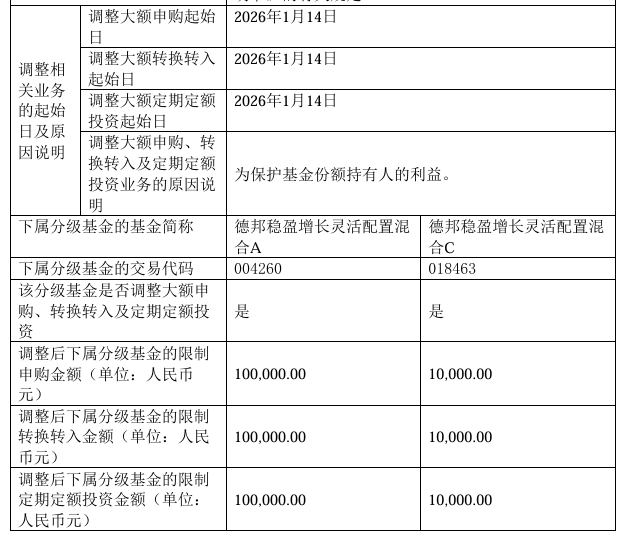
Core Viewpoint - The rapid inflow of funds into the Debon Stable Growth Flexible Allocation Mixed Fund has led to the implementation of purchase limits to protect the interests of existing fund holders [1][4][5]. Group 1: Fund Performance and Market Reaction - On January 12, the Debon Stable Growth Fund was rumored to have attracted over 12 billion yuan in a single day, significantly boosting market sentiment [1][4]. - The fund focuses on "AI applications," and its performance has been bolstered by the booming AI sector, with a one-year return of 52.12% as of January 12, outperforming the CSI 300 Index [7]. - The fund's asset allocation is heavily weighted towards stocks, with a 70.29% concentration in its top ten holdings, indicating a high-risk profile [8]. Group 2: Fund Management and Strategy - The fund's management has adjusted the purchase limits for its A and C shares to 100,000 yuan and 10,000 yuan, respectively, effective January 14, to mitigate potential dilution of returns from large inflows [5][6]. - The fund's performance metrics are influenced by a relatively lenient benchmark, which includes a 50% weighting of the CSI 300 Index and a 50% weighting of the Zhongzheng Composite Bond Index [7][8]. Group 3: Company Background and Growth - Debon Fund, established in 2012, has seen its public fund management scale grow to 60.516 billion yuan as of the end of Q3 2025, a significant increase from previous years [3][9]. - The company is still considered a small fund manager in the industry, and the recent surge in fund size could help address its operational challenges [10].
上证早知道|机构逆势买入AI应用;事关工业互联网 重要方案印发
Shang Hai Zheng Quan Bao· 2026-01-13 23:10
Group 1 - The State Council's Tariff Commission decided to continue imposing anti-dumping duties on imported solar-grade polysilicon from the US and South Korea for five years starting January 14, 2026, due to potential harm to China's polysilicon industry [4] - The railway system in China will implement a new train operation schedule starting January 26, 2025, increasing the number of scheduled passenger trains to 12,130 and freight trains to 23,748, enhancing transportation capacity and efficiency [2] - The Ministry of Industry and Information Technology released an action plan for the high-quality development of industrial internet platforms from 2026 to 2028, aiming for over 450 influential platforms and a significant increase in industrial equipment connectivity [6] Group 2 - Japan's corporate bankruptcy cases reached a new high since 2013 in 2025, with 10,300 cases involving debts over 10 million yen, marking a 2.9% increase from the previous year [3] - The second China eVTOL Innovation Development Conference will be held on January 15-16, 2026, focusing on technological breakthroughs and commercialization in the electric vertical takeoff and landing aircraft sector [7] - Companies like TCL Technology and Dazhu CNC are projecting significant profit increases for 2025, with TCL expecting a net profit of 4.21 billion to 4.55 billion yuan, a year-on-year growth of 169% to 191% [8]

