
逆向销售

Search documents
德邦基金“吸金120亿”合规拷问:实盘大V无证荐基是否触碰红线?
Xin Lang Cai Jing· 2026-01-20 09:20
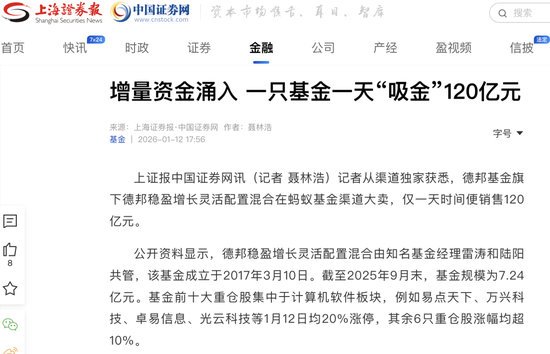
Core Viewpoint - The article discusses the phenomenon of a significant influx of capital into the Debon Fund's "Debon Stable Growth Flexible Allocation Mixed Fund," which reportedly attracted 12 billion yuan in a single day, highlighting the interplay of social media influencers, platform algorithms, and the anxiety of smaller fund companies in the public fund industry [1][23]. Group 1: Fund Performance and Market Reaction - On January 12, the Debon Stable Growth Fund experienced a surge, with both A and C shares rising over 8% as the AI application sector in the A-share market exploded [2][24]. - The fund's management denied the authenticity of the reported capital influx, emphasizing reliance on periodic reports, yet market reactions indicated skepticism due to rapid implementation of purchase limits [4][25]. Group 2: Marketing Strategies and Influencer Impact - The marketing strategy employed by the fund resembles "hunger marketing," creating a sense of scarcity and urgency among investors [6][27]. - A prominent social media influencer showcased a significant investment in the fund, leading to a wave of follower investments, although the influencer later clarified that claims of collaboration and commission were unfounded [7][28]. Group 3: Regulatory and Ethical Concerns - Many influencers lack the necessary qualifications for fund sales and engage in questionable practices by promoting funds without proper risk disclosures, which raises ethical concerns [8][29]. - Reports suggest that Debon Fund offered unusually high commission rates to influencers, potentially leading to misrepresentation of the fund's risk profile and encouraging impulsive investment decisions among followers [8][29]. Group 4: Fund Characteristics and Risks - The Debon Stable Growth Fund, despite its name suggesting stability, has a high stock allocation of 93.98% and minimal bond exposure, indicating a high-risk profile [9][30]. - The fund's historical performance has been underwhelming, with an annual return of only around 8% in 2025, which is below its benchmark [13][34]. Group 5: Company Context and Strategic Decisions - Following a change in control to state-owned assets, Debon Fund faces pressure to improve its scale and market presence, leading to aggressive marketing strategies [15][36]. - The company operates as a small public fund with a total scale of approximately 66.5 billion yuan, ranking around 80th in the industry, which drives its pursuit of rapid growth through high-risk products [16][37]. Group 6: Market Dynamics and Investor Implications - The article highlights the disconnect between the marketing strategies employed and the actual risks faced by investors, particularly during market volatility [19][40]. - The long-term value of the fund for investors remains uncertain, especially as market conditions change and the initial excitement fades [20][41].

新规重塑基金圈,流量炒作被叫停,关键卡点难住所有人
Sou Hu Cai Jing· 2025-12-17 02:15
Core Viewpoint - The new regulatory draft for public offering securities investment fund sales is set to reshape the industry, requiring both practitioners and investors to adapt to new standards [1] Group 1: Assessment and Evaluation Changes - The new regulations emphasize detailed fee disclosures, aiming to address issues of hidden fees and inducements for frequent trading [4] - Fund managers, even those who significantly underperform, can still earn substantial management fees, raising questions about how the new rules will manage this situation [6] - Sales performance evaluation will shift from focusing solely on sales volume to a more complex KPI system, creating challenges for sales teams [8] Group 2: Promotion and Marketing Adjustments - The new rules prohibit misleading performance advertising, such as promoting short-term gains, and restrict performance disclosures to those over three years [11] - The practice of highlighting star fund managers is being phased out, with a focus now on investment strategies and themes instead [14] - The regulations aim to eliminate the "star-making" approach in fund promotions, as past performance does not guarantee future success [14] Group 3: Compliance and Operational Challenges - There are still unclear areas in compliance, particularly regarding the definition of "consideration" for ETF launches and the legality of certain sales practices [18] - The regulations signal a shift from a product-selling mentality to a service-oriented approach within the fund industry, indicating a move towards more responsible growth [19] - The industry is expected to face short-term challenges as it adjusts to these new operational standards [19]

事关公募基金销售,最新发布
Zhong Guo Zheng Quan Bao· 2025-12-12 12:31
Core Viewpoint - The China Securities Investment Fund Industry Association has issued a draft for public consultation on the "Regulations on the Sales Behavior of Publicly Raised Securities Investment Funds," aiming to standardize the sales practices of fund companies and distribution agencies. Group 1: Key Regulations on Fund Sales Practices - The draft includes 37 articles covering various aspects such as fund promotion behavior, live streaming for promotion, disclosure of sales information and fees, performance evaluation of sales activities, integrity in operations, and self-regulation [1] - It addresses core issues in current fund sales practices, such as the emphasis on short-term performance rankings and excessive promotion of "star fund managers," aiming to align the interests of fund managers and sales institutions with investor returns [1] Group 2: Performance Disclosure Requirements - Fund managers and sales institutions must objectively and comprehensively present fund performance, ensuring that past performance does not guarantee future returns, and must not promise future returns in any form [2] - Performance data must cover periods longer than six months, and rankings should be based on publicly available data from fund evaluation agencies for periods of three years or more [2] - Risk indicators related to fund performance must be displayed alongside performance data, and promotional language that may downplay risks is prohibited [2] Group 3: Fund Manager Promotion Guidelines - The draft emphasizes the importance of promoting the research team and platform capabilities rather than excessively promoting individual fund managers [3] - It prohibits misleading representations that conflate fund managers' years of experience with their actual investment management experience [3] - When promoting index funds, the focus should be on their utility and asset allocation functions, while adequately disclosing risks associated with net value fluctuations in money market-like funds [3] Group 4: Sales Performance Evaluation - The draft mandates the establishment of a scientific and reasonable performance evaluation system for fund sales, including clear indicators and accountability mechanisms for short-term sales behaviors [4] - Performance evaluation indicators should encompass both sales activity and investor profit and loss situations, with a focus on long-term investment outcomes [5] - The evaluation must prioritize the retention of equity fund holdings and the long-term profitability of investors, rather than solely focusing on sales revenue and scale [5] Group 5: Fee Disclosure and Live Streaming Regulations - The draft outlines requirements for live streaming promotions, mandating that presenters hold relevant qualifications and that platforms disable tipping features [6] - Fund managers and sales institutions must fully disclose all types of fees associated with fund transactions, including subscription fees, service fees, and redemption fees, ensuring transparency in fee structures [6] - Different fee levels for various share classes must be disclosed, and investors should be informed of redemption fees at the time of transaction [6]
重构基金销售底层逻辑 推动公募与投资者“双向奔赴”
Zhong Guo Zheng Quan Bao· 2025-09-18 21:53
Group 1: Industry Transformation - The public fund sales industry is undergoing a transformation to rebuild trust with investors by focusing on long-term value and customer profitability rather than short-term sales metrics [1][2][8] - The competition landscape is shifting from product promotion to investment solution provision, emphasizing long-term customer value over short-term performance [1][9] - Regulatory changes, such as the CSRC's action plan for high-quality development, are prompting firms to adjust their assessment mechanisms to prioritize customer retention and satisfaction [8][9] Group 2: Sales and Service Model - The traditional sales model, which relied on transaction commissions, is being replaced by a model that aligns the income of institutions with the long-term interests of clients [2][9] - Firms are adopting a "three parts investment, seven parts advisory" service model to enhance client engagement and prevent impulsive trading behaviors [3][6] - Technology is being leveraged to provide personalized services and improve client understanding of their investment behaviors, fostering more rational investment habits [3][7] Group 3: Collaborative Ecosystem - The collaboration between fund managers and sales institutions is essential for enhancing investor service capabilities and creating a comprehensive financial service ecosystem [9][10] - Both parties are encouraged to develop a shared understanding of client needs and to provide proactive, tailored services using advanced technologies [11] - The focus is on creating a healthy ecosystem where investor profitability and institutional growth coexist, ensuring high-quality development in the industry [10][11]
重构基金销售底层逻辑推动公募与投资者“双向奔赴”
Zhong Guo Zheng Quan Bao· 2025-09-18 20:24
Core Viewpoint - The public fund sales industry is undergoing a transformation to rebuild trust with investors by focusing on long-term value and aligning the interests of institutions and clients [1][6][7]. Group 1: Industry Transformation - The public fund sales sector is shifting from a product-pushing model to one focused on investment solutions and long-term client value [1][7]. - The industry is moving towards a high-quality development phase, emphasizing collaboration between fund managers and sales institutions to enhance investor service capabilities [7][8]. - The core of the transformation involves changing the revenue model from transaction commissions to advisory fees, promoting a buy-side advisory approach [1][7]. Group 2: Investor-Centric Strategies - Companies are implementing strategies to improve investor experience, such as personalized asset planning based on individual goals and risk preferences [2][5]. - The introduction of AI-driven tools for 24/7 online service aims to address investor queries and promote rational investment habits [2][5]. - A focus on long-term investment strategies is being encouraged, with firms providing clients with performance analysis and rebalancing suggestions [3][4]. Group 3: Regulatory and Competitive Landscape - The China Securities Regulatory Commission (CSRC) has introduced guidelines to promote high-quality development in the public fund sector, including reducing fees and establishing evaluation mechanisms for sales institutions [6][7]. - The competitive landscape is evolving from price competition to service capability competition, necessitating a deeper integration of technology in the sales process [7][8]. - Firms are adjusting their assessment metrics to prioritize long-term client retention and satisfaction over short-term sales figures [6][8].
