手术及护理类医疗器械

Search documents
海圣医疗(920166):新股覆盖研究
Huajin Securities· 2026-02-04 13:30
Investment Rating - The investment rating for the company is "Buy," indicating an expected relative increase of over 15% in the next 6-12 months compared to relevant market indices [43]. Core Insights - The company, Haiseng Medical, specializes in the research, production, and sales of anesthesia and monitoring medical devices, with a strong market presence in various clinical departments such as anesthesia, ICU, and emergency [2][7]. - The company has demonstrated a solid financial performance with projected revenues of 306 million CNY in 2023, 304 million CNY in 2024, and 345 million CNY in 2025, reflecting year-over-year growth rates of 14.25%, -0.70%, and 13.68% respectively [10][4]. - The company has established itself as a leading player in the domestic market for anesthesia and monitoring medical consumables, with a comprehensive product matrix and a robust sales network covering over 600 top-tier hospitals [35][36]. Summary by Sections Basic Financial Status - The company is expected to achieve revenues of 3.06 billion CNY, 3.04 billion CNY, and 3.45 billion CNY from 2023 to 2025, with corresponding net profits of 780 million CNY, 710 million CNY, and 860 million CNY [10][4]. - The company’s revenue sources are primarily from anesthesia and monitoring medical devices, which together account for over 80% of total revenue [10]. Industry Situation - The medical device industry is one of the fastest-growing sectors globally, with a projected market size of 6,379.6 billion USD by 2028, driven by increasing health demands [20][21]. - The domestic medical device market has rapidly expanded, with a compound annual growth rate of 14.76% from 2017 to 2024, indicating significant growth potential [24]. Company Highlights - Haiseng Medical has competitive advantages in core technologies, product variety, and marketing channels, having developed advanced technologies that exceed industry standards [35][36]. - The company is actively engaged in product innovation and development, collaborating with universities to enhance its technological capabilities [36]. Fundraising Project Investments - The company plans to invest in three main projects through its IPO, including upgrading production facilities, establishing a research and testing center, and building a marketing service base [37][38]. Peer Comparison - Compared to similar companies, Haiseng Medical's revenue is below the average of its peers, but its sales gross margin is positioned in the mid-to-high range of the industry [39][40].
【2月4日IPO雷达】海圣医疗申购,易思维缴款
Xuan Gu Bao· 2026-02-04 00:04
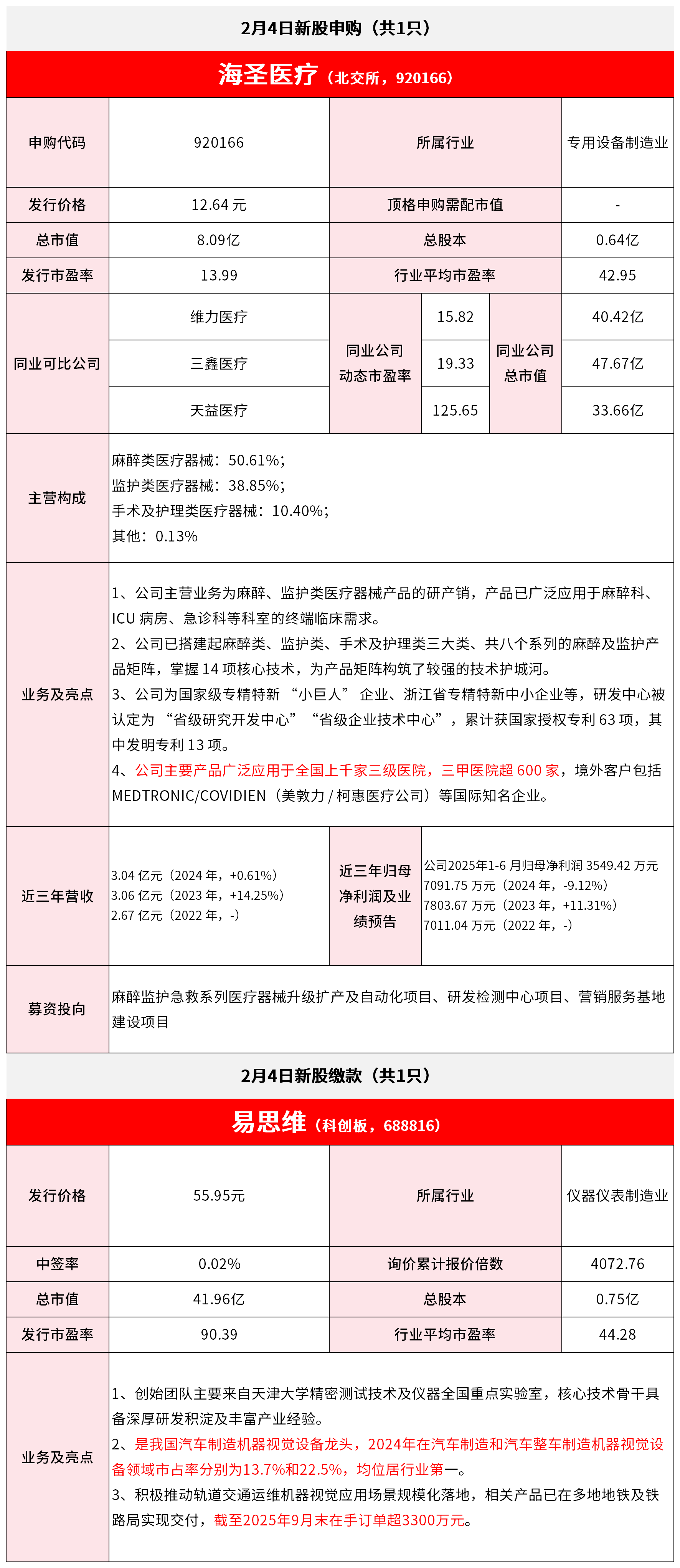
1、公司主营业务为麻醉、监护类医疗器械产品的 2月4日新股申购(共1只 | | | 海圣医疗(北交所,920 | | --- | --- | --- | | 申购代码 | 920166 | | | 发行价格 | 12.64 元 | 顶格 | | 总市值 | 8.09亿 | | | 发行市盈率 | 13.99 | 行业 | | 同业可比公司 | 维力医疗 | 同业公司 动态市盈率 | | | 三鑫医疗 | | | | 天益医疗 | | | | 麻醉类医疗器械: 50.61%; | | | | 监护类医疗器械: 38.85%; | | 手术及护理类医疗器械: 10.40%; 其他:0.13% | | 易思维(科创板,68881 | | --- | --- | | 发行价格 | 55.95元 | | 智签署 | 0.02% | 询价! | | --- | --- | --- | | 总市值 | 41.96亿 | | | 发行市盈率 | 90.39 | 行业 | | 业务及亮点 | 1、创始团队主要来自天津大学精密测试技术及仪 | | | | 备深厚研发积淀及丰富产业经验。 | | | | 2、是我国汽车制造机器视觉 ...

海圣医疗(920166):北交所新股申购策略报告之一百六十:国内麻醉监护耗材头部企业,募投扩产提高市场份额-20260203
Shenwan Hongyuan Securities· 2026-02-03 12:53
2026 年 02 月 03 日 海圣医疗(920166):国内麻醉监护 耗材头部企业,募投扩产提高市场 份额 ——北交所新股申购策略报告之一百六十 证 券 研 究 相关研究 - 证券分析师 刘靖 A0230512070005 liujing@swsresearch.com 王雨晴 A0230522010003 wangyq@swsresearch.com 联系人 王雨晴 A0230522010003 wangyq@swsresearch.com 本研究报告仅通过邮件提供给 中庚基金 使用。1 请务必仔细阅读正文之后的各项信息披露与声明 策 略 研 究 申 购 策 略 报 告 ⚫ 基本面:深耕麻醉监护领域,产品线种类丰富。公司 2000 年成立,总部位于浙江省绍兴 市,主要产品包括麻醉类、监护类、手术及护理类三大类医疗器械,涵盖气道与呼吸管理、 生命信息监测、椎管及神经阻滞等八大系列,广泛应用于麻醉科、ICU 病房、急诊科等 临床科室的终端需求。根据中国医疗器械行业协会出具的证明文件,2023 年公司在国内 麻醉、监护类医用耗材市场的市场份额名列前茅。核心技术具备竞争优势,国内外客户资 源优质。公司已在核心技 ...
海圣医疗:8 成收入靠经销却年换 200 + 经销商,销售高投入人均创收垫底| IPO观察
Sou Hu Cai Jing· 2025-11-05 06:47
Core Viewpoint - Zhejiang Haiseng Medical Equipment Co., Ltd. is set to go public on the Beijing Stock Exchange, with an IPO of up to 11.2941 million shares, primarily relying on a distribution model for revenue generation, which poses inherent risks due to high dealer turnover and profitability discrepancies between new and exiting dealers [2][3][4]. Revenue and Profitability - The company reported revenues of 268 million yuan, 306 million yuan, 304 million yuan, and 156 million yuan for the years 2022 to 2024 and the first half of 2025, with net profits of 70.11 million yuan, 78.04 million yuan, 70.92 million yuan, and 35.39 million yuan, indicating a revenue decline of 0.7% and a net profit decline of 9.12% in 2024 [3][4]. - The main revenue source is anesthesia equipment, which accounted for 47.92% to 52.6% of total revenue during the reporting period, with sales increasing from 130 million yuan to 160 million yuan [3][4]. Distribution Model - The distribution model is the core sales channel, contributing 90.43%, 89.57%, 85.06%, and 83.16% of total revenue from 2022 to the first half of 2025, with over 80% of revenue generated through distributors [4][5]. - The dealer structure shows significant volatility, with over 200 dealers entering and exiting annually, leading to concerns about the stability and profitability of the distribution network [5][6]. Dealer Profitability - There is a notable difference in gross profit margins between new and exiting dealers, with exiting dealers consistently showing higher margins, indicating that the company earns more profit from exiting dealers compared to new ones [7][8]. Sales and Expenses - Sales expenses over the past three and a half years totaled approximately 105 million yuan, nearly double the R&D expenses of about 56.42 million yuan, with a sales expense ratio rising to 10.63%, significantly higher than the industry average of 6.25% [9][10]. - Employee compensation constitutes over 60% of sales expenses, with the company having a higher proportion of sales personnel compared to peers, yet generating lower revenue per employee [9][10][11]. Comparison with Peers - Compared to peers like Weili Medical and Sanxin Medical, Haiseng Medical has a higher proportion of sales personnel and higher average salaries, but lower revenue generation per employee, highlighting inefficiencies in personnel utilization [10][12].