麻醉类医疗器械

Search documents
北交所消费服务产业跟踪第五十七期(20260329):我国医药器械市场规模超万亿且增速较高,关注北交所医疗器械相关公司
Hua Yuan Zheng Quan· 2026-03-29 09:45
Market Overview - The Chinese medical device market is expected to grow to 1.66 trillion yuan by 2030, with significant growth potential in the medical consumables sector[2] - The global medical device industry reached a total scale of $47.936 billion in 2023, projected to grow to $63.796 billion by 2028[2][7] - By 2025, China's medical device market is anticipated to reach 1.2442 trillion yuan, with a compound annual growth rate (CAGR) of 14.76% from 2017 to 2024[9] Medical Consumables Insights - In 2024, the medical consumables market in China is expected to account for 63.18% of the total medical device market, with a market size of approximately 595 billion yuan[14] - The high-value medical consumables market in China grew from 60.2 billion yuan in 2015 to 250.4 billion yuan in 2024, reflecting a CAGR of 17.2%[15] - The vascular intervention consumables segment is the largest, projected to reach about 91.8 billion yuan in 2024, representing 36.7% of the high-value consumables market[15] Market Performance - The median stock price change for the North Exchange's consumer service sector was -3.78% from March 23 to March 27, 2026, with 7% of companies experiencing an increase[37] - The total market capitalization of the North Exchange consumer service sector decreased from 100.036 billion yuan to 95.322 billion yuan during the same period[41] - The median price-to-earnings (P/E) ratio for the North Exchange consumer service sector fell from 37.5X to 36.5X[40] Company Announcements - Yisheng Mushrooms reported a revenue of 739.29 million yuan for 2025, a year-on-year increase of 19.91%, but a net profit decline of 23.05%[54] - The company plans to distribute a cash dividend of 5.00 yuan per 10 shares, totaling approximately 51.52 million yuan[54]
【2月4日IPO雷达】海圣医疗申购,易思维缴款
Xuan Gu Bao· 2026-02-04 00:04
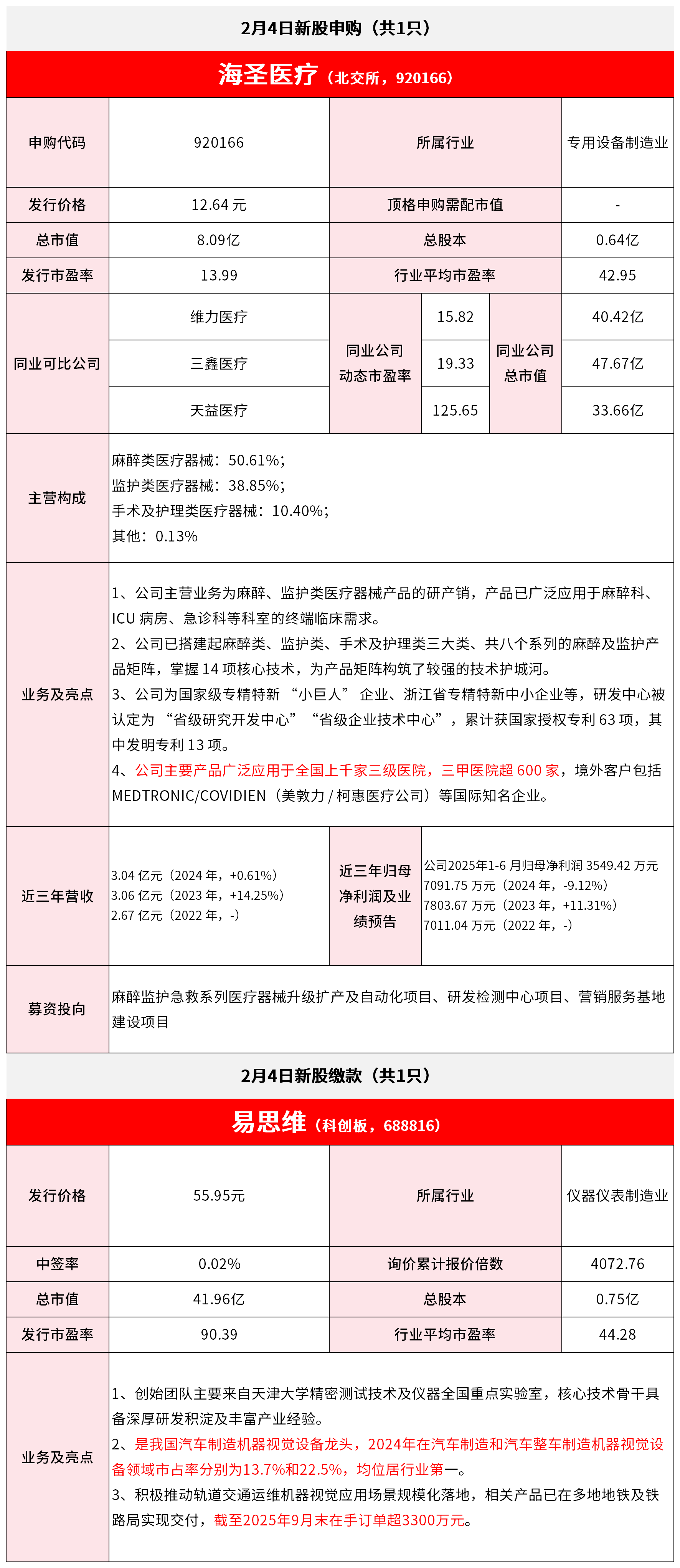
Group 1 - The company, Hai Sheng Medical, focuses on anesthesia and monitoring medical devices, with a total market value of 8.09 billion yuan and an issuance price of 12.64 yuan per share [2][3] - The company has established a product matrix for anesthesia, monitoring, and surgical care, holding 14 core technologies and recognized as a national-level "specialized and innovative" small giant enterprise [3] - The company's main products are widely used in over a thousand tertiary hospitals across the country, with recent revenue figures showing 3.06 billion yuan in 2023, reflecting a 14.25% increase from the previous year [3] Group 2 - The company, Yi Si Wei, is a leader in machine vision equipment for automotive manufacturing, with a total market value of 41.96 billion yuan and an issuance price of 55.95 yuan per share [4] - The founding team has a strong background in precision testing technology and equipment, contributing to the company's competitive edge in the industry [4] - The company is actively promoting machine vision applications in rail transit operations, with over 331 million yuan in orders as of September 2025 [4]

海圣医疗(920166):北交所新股申购策略报告之一百六十:国内麻醉监护耗材头部企业,募投扩产提高市场份额-20260203
Shenwan Hongyuan Securities· 2026-02-03 12:53
Investment Rating - The investment rating for the company is not explicitly stated in the provided documents, but the report suggests active participation in the stock subscription due to its favorable valuation and market position [23]. Core Insights - The company, established in 2000 and headquartered in Shaoxing, Zhejiang, specializes in anesthesia and monitoring medical devices, with a diverse product line that includes anesthesia, monitoring, surgical, and nursing equipment [3][7]. - The company holds a leading market share in the domestic anesthesia and monitoring consumables market, supported by its competitive advantages in core technologies and a strong customer base [3][8]. - Revenue is projected to reach 304 million yuan in 2024, with a three-year CAGR of +6.51%, while net profit is expected to be 70.92 million yuan, with a CAGR of +0.57% [9]. Summary by Sections 1. Company Overview - The company is a leading player in the domestic anesthesia monitoring consumables market, with a strong brand presence and a wide range of products used in various clinical settings [7]. - It has established competitive advantages in key technologies, including invasive blood pressure sensor packaging and bioelectrical signal acquisition [8]. 2. Issuance Plan - The new share issuance will adopt a direct pricing method, with an issue price of 12.64 yuan per share and an initial issuance scale of 11.2941 million shares, accounting for 15% of the total share capital post-issuance [13][14]. - The expected market capitalization after issuance is 952 million yuan, with a PE ratio of 11.09, significantly lower than the median PE of comparable listed companies at 18 [14][26]. 3. Industry Situation - The demand for anesthesia monitoring devices is driven by the aging population and increasing surgical volumes, with over 65 million general anesthesia surgeries performed annually in China [16]. - The global market for medical devices is expanding, and Chinese medical device companies are increasingly gaining a foothold internationally [16]. 4. Competitive Advantages - The company has a comprehensive product matrix that meets the needs of various clinical applications, supported by a robust sales network covering all provinces in China [17]. - It has established long-term partnerships with international medical device companies, enhancing its market position [18]. 5. Comparable Companies - The company’s revenue structure shows a significant focus on anesthesia consumables (52.6%) and monitoring consumables (36.6%), indicating a strong specialization in these areas compared to peers [22].
海圣医疗:8 成收入靠经销却年换 200 + 经销商,销售高投入人均创收垫底| IPO观察
Sou Hu Cai Jing· 2025-11-05 06:47
Core Viewpoint - Zhejiang Haiseng Medical Equipment Co., Ltd. is set to go public on the Beijing Stock Exchange, with an IPO of up to 11.2941 million shares, primarily relying on a distribution model for revenue generation, which poses inherent risks due to high dealer turnover and profitability discrepancies between new and exiting dealers [2][3][4]. Revenue and Profitability - The company reported revenues of 268 million yuan, 306 million yuan, 304 million yuan, and 156 million yuan for the years 2022 to 2024 and the first half of 2025, with net profits of 70.11 million yuan, 78.04 million yuan, 70.92 million yuan, and 35.39 million yuan, indicating a revenue decline of 0.7% and a net profit decline of 9.12% in 2024 [3][4]. - The main revenue source is anesthesia equipment, which accounted for 47.92% to 52.6% of total revenue during the reporting period, with sales increasing from 130 million yuan to 160 million yuan [3][4]. Distribution Model - The distribution model is the core sales channel, contributing 90.43%, 89.57%, 85.06%, and 83.16% of total revenue from 2022 to the first half of 2025, with over 80% of revenue generated through distributors [4][5]. - The dealer structure shows significant volatility, with over 200 dealers entering and exiting annually, leading to concerns about the stability and profitability of the distribution network [5][6]. Dealer Profitability - There is a notable difference in gross profit margins between new and exiting dealers, with exiting dealers consistently showing higher margins, indicating that the company earns more profit from exiting dealers compared to new ones [7][8]. Sales and Expenses - Sales expenses over the past three and a half years totaled approximately 105 million yuan, nearly double the R&D expenses of about 56.42 million yuan, with a sales expense ratio rising to 10.63%, significantly higher than the industry average of 6.25% [9][10]. - Employee compensation constitutes over 60% of sales expenses, with the company having a higher proportion of sales personnel compared to peers, yet generating lower revenue per employee [9][10][11]. Comparison with Peers - Compared to peers like Weili Medical and Sanxin Medical, Haiseng Medical has a higher proportion of sales personnel and higher average salaries, but lower revenue generation per employee, highlighting inefficiencies in personnel utilization [10][12].