
抵押支持证券

Search documents
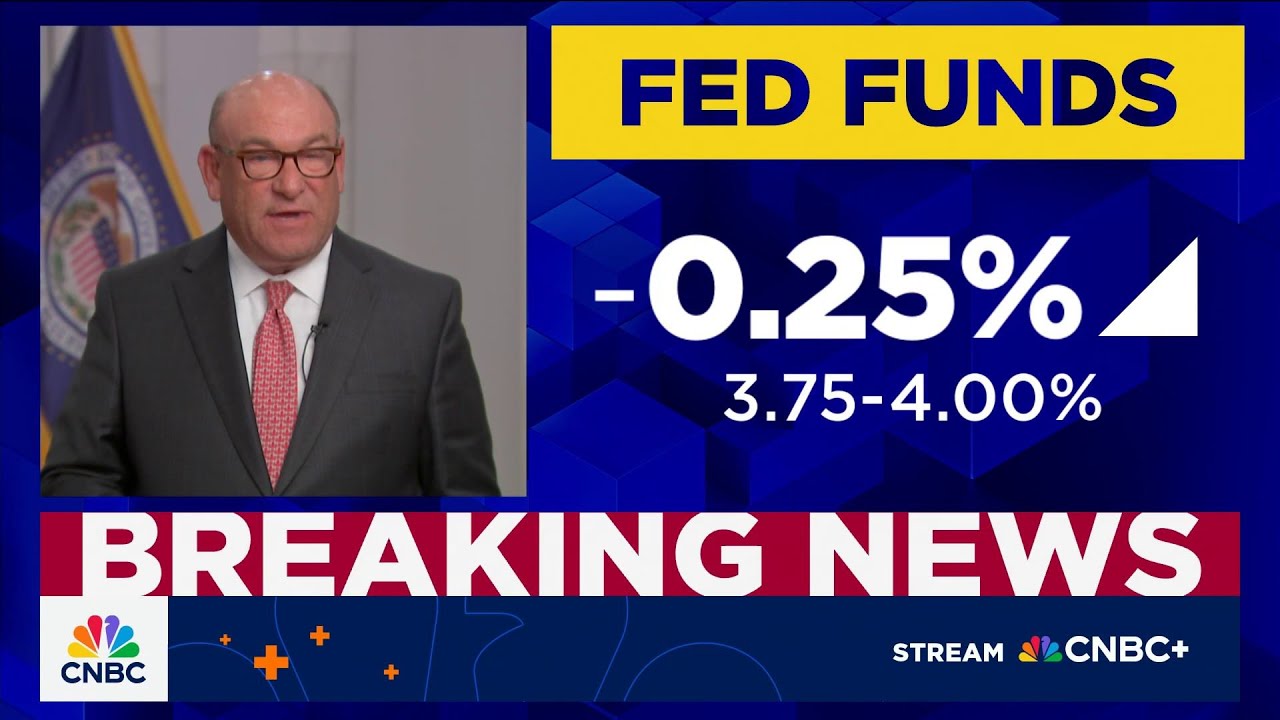
Federal Reserve cuts interest rates by quarter point
Youtube· 2025-10-29 18:25
Federal Reserve Interest Rate Decision - The Federal Reserve has cut interest rates by a quarter point to a new range of 3.75% to 4% [1] - There were two dissents regarding the decision, with one governor advocating for a 50 basis point cut and another preferring no change at all [1][5] Quantitative Tightening and Balance Sheet Management - The Federal Reserve announced it will stop quantitative tightening and the roll-off of its balance sheet starting in December [1][5] - Future rolloffs of treasuries and mortgage-backed securities will be reinvested into T-bills, marking a shift in strategy [2] Economic Indicators and Outlook - The Fed noted that economic activity has expanded at a moderate pace, indicating a slight upgrade from previous assessments [2][3] - Job gains have slowed, but unemployment remains low as of August, with recent indicators aligning with these trends [3] - Inflation has increased since earlier this year and remains somewhat elevated, consistent with previous characterizations [4]

美国流动性短缺 回购市场压力加剧
Sou Hu Cai Jing· 2025-10-19 16:16
Core Insights - The current financial market is facing significant challenges due to liquidity shortages and rising pressures in the repurchase market, reminiscent of past crises in 2019 and 2023 [1][6][10] - Regional banks are particularly vulnerable, with increasing concerns over credit events and potential contagion effects on larger banks and the broader financial system [2][3][9] Group 1: Regional Bank Challenges - Regional banks, such as Zions Bancorporation and Western Alliance Bank, are experiencing severe financial strain due to high exposure to commercial loans and consumer credit, leading to significant write-offs and lawsuits [2][3] - The economic divide is exacerbating the situation, with high-income groups benefiting from asset price increases while low-income groups face inflation and unemployment pressures, impacting loan quality [2][3] Group 2: Broader Market Implications - The turmoil in regional banks is beginning to affect larger financial institutions, with notable declines in stock prices for major banks like Citigroup and Goldman Sachs, indicating a potential spillover of credit risk [3][4] - The widening credit spreads, as indicated by the LQD/HYG ratio, suggest increasing investor preference for investment-grade bonds over high-yield bonds, reflecting heightened credit risk [3][9] Group 3: Repurchase Market Dynamics - The repurchase market is under significant stress, with the SOFR rate reaching its highest level since 2019, indicating a shift from liquidity abundance to scarcity [4][5] - The recent activation of the Federal Reserve's Standing Repo Facility (SRF) signals a critical need for liquidity support, particularly in the mortgage-backed securities market [5][6] Group 4: Policy and Economic Factors - The liquidity crisis is driven by multiple factors, including a substantial fiscal deficit, the rebuilding of the Treasury General Account (TGA), and ongoing quantitative tightening by the Federal Reserve [7][8] - The potential for credit events and market volatility is increasing, necessitating careful monitoring of key indicators and possible policy responses from the Federal Reserve and Treasury [9][10]