斯帕基(Sparky)

Search documents
拥抱AI 沃尔玛跻身“万亿美元俱乐部”
Sou Hu Cai Jing· 2026-02-04 14:35
Core Insights - Walmart has become the first retailer to achieve a market capitalization of $1 trillion, marking a successful transformation over the past decade [1][4] - The company's online business became profitable for the first time last year, with projected annual e-commerce sales reaching approximately $140 billion [1][4] - Walmart is heavily investing in AI, allocating billions for supply chain automation to enhance fresh product quality, speed up delivery, and optimize inventory forecasting [1][5] Market Capitalization - On Tuesday, Walmart's stock rose by 2.9% to $127.71, resulting in a market cap of $1.018 trillion [4] - Over the past year, Walmart's stock has increased by nearly 26%, joining the exclusive club of companies with a market cap exceeding $1 trillion, previously dominated by tech giants [4] - Walmart and Berkshire Hathaway are the only non-tech companies in the U.S. with a market cap over $1 trillion, while the remaining are tech firms [4] E-commerce Growth - In the past five years, Walmart's online marketplace has expanded to over 500 million products, introduced one-hour delivery services, and launched the Walmart+ membership program to compete with Amazon Prime [5] - Walmart's U.S. e-commerce sales grew by 28% due to online orders and advertising business, with annual revenue expected to exceed $700 billion [5][6] AI Investments - Walmart has partnered with OpenAI to introduce an "instant checkout" feature and is integrating Google's Gemini AI chatbot into its shopping process [5][6] - The company is transitioning from traditional web or app searches to AI-driven shopping experiences, reflecting changing consumer behaviors [6] Leadership Transition - The recent leadership change with CEO John Furner, a strong advocate for AI investment, signifies a shift towards a decade-long transformation focused on AI and digitalization [8][9] - Walmart plans to maintain its global workforce of approximately 2.1 million employees over the next three years, despite significant changes in job roles due to AI technology [9]



AI购物火热,沃尔玛谷歌联手重塑零售新格局
Huan Qiu Wang· 2026-01-12 08:51
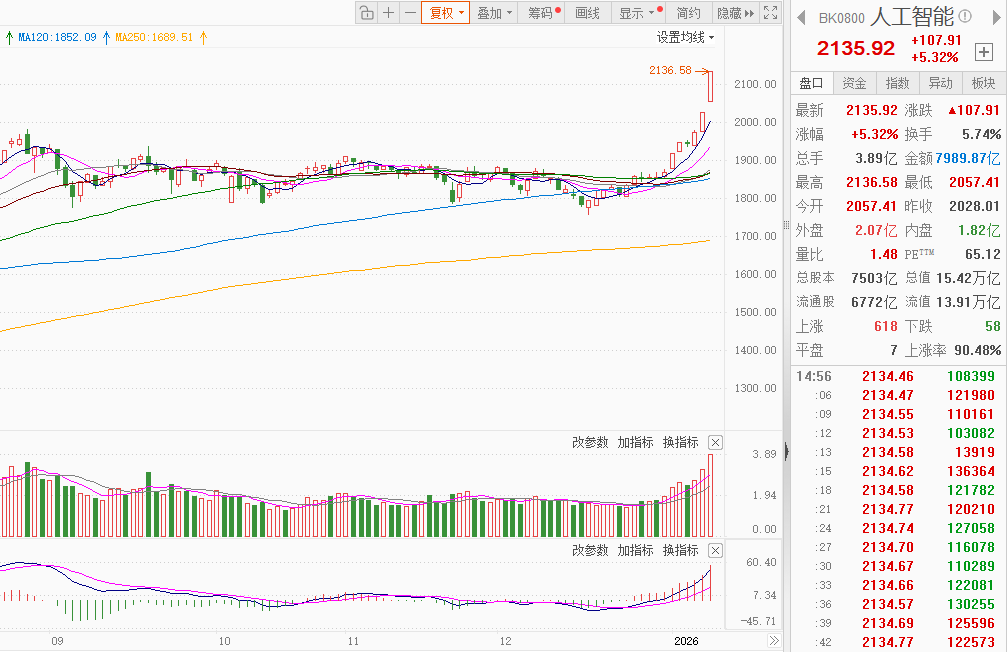
Core Insights - The AI sector is experiencing significant growth, with various subfields such as AI marketing, Sora concept, and AIGC seeing stock surges, leading to over 20 stocks hitting the "20cm" limit up [1] - Retail is undergoing profound changes due to AI technology, highlighted by the partnership between Google and Walmart, which has made AI shopping stocks a market focus [1][3] AI Sector Performance - Multiple AI and commercial aerospace-related stocks, including Yidian Tianxia and Tianyin Machinery, have shown strong performance, reflecting high market enthusiasm for high-tech growth stocks [3] - AIGC concept stock LEO shares have performed exceptionally well, with LEO Digital focusing on AI since 2023 and launching its self-developed AIGC ecosystem platform "LEOAIAD" [3] Retail Industry Transformation - Walmart and Google announced a collaboration allowing consumers to use Google's AI assistant Gemini for shopping at Walmart and Sam's Club, marking a significant shift in retail towards AI-driven shopping [3] - The transition from traditional search to AI assistant-driven shopping is seen as a major transformation in the retail industry, with Walmart leading this trend [3] Future Outlook - The widespread adoption of AI-assisted shopping is anticipated, with Visa's global market president predicting 2026 as a pivotal year for mainstream AI shopping [4] - Morgan Stanley views this as the beginning of the "Agent-style e-commerce" era, forecasting a GMV of approximately $190 billion by 2030 under baseline conditions, potentially reaching $385 billion in optimistic scenarios [4] A-Share Market Trends - AI retail concept stocks in the A-share market have shown robust performance, with companies like Qingmu Technology and Shanghai Jiubai seeing cumulative increases of over 20% this year [5] - Analysts highlight that the "AIization" of retail is moving from conceptual hype to practical implementation, with a focus on companies that can effectively leverage AI for cost reduction and efficiency [5]