传统零售

Search documents
效率即护城河:AI时代,中国互联网巨头的生存新法则
美股研究社· 2026-03-27 11:29
Core Viewpoint - The article emphasizes a significant shift in the investment landscape, where the focus has transitioned from the capabilities of AI models to the efficiency and profitability derived from AI investments. Companies are now evaluated based on how effectively they can convert computational power into profits rather than just the strength of their AI models [1][2]. Group 1: AI's Impact on Profitability - Companies like Tencent and Alibaba are increasingly showcasing how AI can optimize costs and improve efficiency, with Tencent highlighting reduced customer acquisition costs and Alibaba detailing AI-driven efficiency improvements in fulfillment expenses [2][5]. - The trend indicates that AI is moving from being a storytelling tool to a genuine profit driver, as evidenced by Walmart and FedEx, which have seen unexpected profit margin improvements without significant revenue spikes [2][8]. - The article notes that a 1% cost optimization in large-scale operations can translate to billions in net profit, highlighting the non-linear growth potential of profit margins through AI efficiency [5][7]. Group 2: Shift in Competitive Dynamics - The competitive landscape in the Chinese internet sector is shifting from a focus on growth through subsidies and price wars to a focus on efficiency and cost management, as regulatory pressures have curtailed aggressive spending strategies [11][12]. - Companies are now challenged to leverage AI not just for operational improvements but to fundamentally reshape their business models to enhance profitability [13][20]. - The article posits that the ability to integrate AI deeply into cost-heavy areas of business will determine which companies can thrive in this new environment, as opposed to those that merely use AI for superficial enhancements [18][19]. Group 3: Company-Specific Strategies - Tencent is positioned to enhance monetization efficiency through AI in advertising and gaming, focusing on vertical precision rather than general intelligence [16]. - Alibaba's dual approach of optimizing fulfillment costs while leveraging AI capabilities in its cloud services creates a feedback loop of efficiency and revenue generation [17]. - JD.com benefits from its self-operated logistics system, where AI can significantly enhance delivery efficiency, while Meituan focuses on micro-optimizations in high-frequency service scenarios to improve overall profitability [14][15]. Group 4: Future Outlook - The article concludes that the future leaders in the market will not necessarily be those who tell the best stories about AI but those who can effectively manage and optimize their cost structures using AI [22]. - As the market matures, the emphasis will be on whether companies can demonstrate tangible improvements in their profit margins through AI, marking a departure from the previous growth narratives based on user acquisition and market share [20][21].


亚马逊超越沃尔玛,成全球营收最高的公司
Di Yi Cai Jing Zi Xun· 2026-02-20 05:39
Group 1 - Amazon has surpassed Walmart as the world's highest-grossing company with an annual revenue of $717 billion, ending Walmart's long-standing reign [2][3] - Walmart's Q4 revenue for fiscal year 2026 was reported at $190.66 billion, slightly above the expected $190.58 billion, but the company provided a lower-than-expected earnings guidance for fiscal year 2027 [3] - Walmart's adjusted earnings per share for Q4 were $0.74, exceeding the forecast of $0.73, but the guidance for Q1 and fiscal year 2027 was below analyst expectations [3] Group 2 - Amazon's growth is attributed to significant investments in AI technology, alongside revenue increases from its cloud computing and advertising businesses [4] - The U.S. retail landscape is shifting, with Amazon's rise indicating a potential change in consumer spending patterns and market dynamics [2][3]



黑镜律师观察 | 传统零售反舞弊警示录:拆解中百集团2.19亿职务侵占
Jing Ji Guan Cha Bao· 2026-02-05 07:42
Core Viewpoint - The case of Zhongbai Group highlights the severe consequences of internal control failures and the importance of establishing a robust anti-fraud compliance system to protect corporate assets and prevent significant financial losses [1][5][12] Group 1: Case Overview - Zhongbai Group faced a major embezzlement case involving 219 million yuan, with the main perpetrator sentenced to life imprisonment, but only 50.2249 million yuan is expected to be recovered, indicating a loss of nearly 160 million yuan [1] - The case underscores the systemic issues in corporate governance and internal controls, particularly in traditional retail companies undergoing digital transformation [2][11] Group 2: Supply Chain Vulnerabilities - The embezzlement was facilitated by exploiting vulnerabilities in the supplier settlement system, particularly in the procurement and settlement of non-standard fresh products, which are difficult to quantify and standardize [2][3] - The "non-standard" nature of fresh products creates an environment conducive to internal corruption, as it relies heavily on subjective judgment and experience [2] Group 3: Internal Control Challenges - Many companies fail to integrate compliance requirements into their digital systems, leading to a disconnect between business processes and internal control measures [3] - The lack of effective verification mechanisms for documents and approvals in traditional retail highlights a critical internal control challenge [3][12] Group 4: Anti-Fraud Strategies - A comprehensive anti-fraud strategy should encompass technology, systems, and culture, including the use of IoT and blockchain for data integrity and transparency [4] - Companies must implement strict separation of duties in procurement, acceptance, settlement, and payment processes to mitigate risks [4][6] Group 5: Prevention and Detection - Proactive prevention measures are essential, focusing on creating a culture where employees are deterred from committing fraud through clear reporting mechanisms and severe consequences [6] - Effective fraud detection relies on data-driven risk monitoring and independent investigation teams to ensure timely responses to potential fraud [7][8] Group 6: Recovery Efforts - When fraud occurs, companies must initiate recovery efforts immediately, including legal actions and asset preservation measures [9] - The case illustrates the importance of not solely relying on law enforcement for resolution but actively engaging in internal investigations to secure evidence [10] Group 7: Broader Implications for the Industry - The issues faced by Zhongbai Group reflect broader challenges in the traditional retail sector, where many companies struggle with outdated governance and compliance practices [11][12] - A cultural shift towards prioritizing compliance and transparency is necessary for long-term sustainability in a competitive market [12]

黑镜律师观察 | 传统零售反舞弊警示录:拆解中百集团2.19亿职务侵占案
Jing Ji Guan Cha Wang· 2026-02-05 07:13
Core Viewpoint - The case of Zhongbai Group highlights the severe consequences of internal control failures and the importance of establishing a robust anti-fraud compliance system to protect corporate assets and prevent significant financial losses [3][19][20] Group 1: Case Overview - Zhongbai Group has been embroiled in a major embezzlement case involving 219 million yuan over eight years, with the main perpetrator sentenced to life imprisonment [3][4] - The company estimates that only 50.2249 million yuan can be recovered, indicating a potential loss of nearly 160 million yuan that may never be recouped [3][4] Group 2: Internal Control Failures - The case reveals critical weaknesses in the supply chain management of fresh produce, particularly the non-standard nature of these products, which creates opportunities for fraud [4][5] - The internal control processes were largely ineffective, relying on trust rather than checks and balances, leading to significant vulnerabilities [5][17] Group 3: Anti-Fraud Strategies - A comprehensive anti-fraud strategy should encompass prevention, investigation, and recovery, forming a complete asset protection framework [9][10][14] - Companies must establish a culture of compliance and integrity, supported by clear reporting mechanisms and strict penalties for violations [10][18] Group 4: Broader Implications for the Industry - The issues faced by Zhongbai Group are indicative of broader challenges within the traditional retail sector, where many companies struggle with outdated governance and compliance practices [17][19] - The need for modernization in corporate governance and internal controls is critical for survival in an increasingly competitive market [18][20]

OpenClaw调用量Kimi K2.5冲上榜首;阿里开源智能体编程模型Qwen3-Coder-Next|未来商业早参
Mei Ri Jing Ji Xin Wen· 2026-02-04 23:04
Group 1 - Gao Xin Retail is currently unable to contact its Executive Director and CEO Li Weiping, but the board believes this matter is not related to the company's business and operations, and there is no significant adverse impact on the group [1] - The situation is seen as a short-term emotional impact, while the long-term effects will depend on the company's ability to stabilize management and continue its transformation strategy [1] Group 2 - The AI model Kimi K2.5 from OpenClaw has become the most popular model, surpassing others like Gemini 3 Flash and Claude Sonnet 4.5, indicating a significant rise in the competitiveness of Chinese open-source models in the global AI sector [2] - The increase in market share and download rates of Chinese open-source models reflects a shift from "technological catch-up" to "ecological competition" in the AI industry [2] Group 3 - Alibaba has launched the new open-source programming model Qwen3-Coder-Next, which demonstrates performance comparable to other models while significantly reducing inference costs to only 5% to 10% of similar performance models [3] - This development enhances the open-source ecosystem in the AI programming field in China and showcases technological breakthroughs in lightweight and cost-effective AI models [3]

沃尔玛小幅下跌 但市值稳守1万亿美元
Xin Lang Cai Jing· 2026-02-04 15:46
Core Viewpoint - Walmart (WMT) has become the first traditional retailer to reach a market capitalization of $1 trillion, driven by growth in e-commerce, advertising, and AI initiatives [1][2]. Group 1 - Walmart's stock experienced a slight decline on Wednesday morning, but its market value remains above $1 trillion [1][2]. - The company has joined an elite club of firms, primarily dominated by technology companies, that have achieved a market capitalization of $1 trillion [1][2].
拥抱AI 沃尔玛跻身“万亿美元俱乐部”
Sou Hu Cai Jing· 2026-02-04 14:35
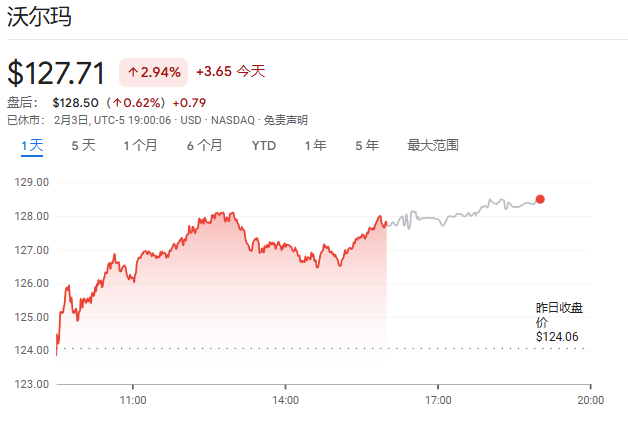
Core Insights - Walmart has become the first retailer to achieve a market capitalization of $1 trillion, marking a successful transformation over the past decade [1][4] - The company's online business became profitable for the first time last year, with projected annual e-commerce sales reaching approximately $140 billion [1][4] - Walmart is heavily investing in AI, allocating billions for supply chain automation to enhance fresh product quality, speed up delivery, and optimize inventory forecasting [1][5] Market Capitalization - On Tuesday, Walmart's stock rose by 2.9% to $127.71, resulting in a market cap of $1.018 trillion [4] - Over the past year, Walmart's stock has increased by nearly 26%, joining the exclusive club of companies with a market cap exceeding $1 trillion, previously dominated by tech giants [4] - Walmart and Berkshire Hathaway are the only non-tech companies in the U.S. with a market cap over $1 trillion, while the remaining are tech firms [4] E-commerce Growth - In the past five years, Walmart's online marketplace has expanded to over 500 million products, introduced one-hour delivery services, and launched the Walmart+ membership program to compete with Amazon Prime [5] - Walmart's U.S. e-commerce sales grew by 28% due to online orders and advertising business, with annual revenue expected to exceed $700 billion [5][6] AI Investments - Walmart has partnered with OpenAI to introduce an "instant checkout" feature and is integrating Google's Gemini AI chatbot into its shopping process [5][6] - The company is transitioning from traditional web or app searches to AI-driven shopping experiences, reflecting changing consumer behaviors [6] Leadership Transition - The recent leadership change with CEO John Furner, a strong advocate for AI investment, signifies a shift towards a decade-long transformation focused on AI and digitalization [8][9] - Walmart plans to maintain its global workforce of approximately 2.1 million employees over the next three years, despite significant changes in job roles due to AI technology [9]

市值突破1万亿美元!沃尔玛完成“传统零售公司的深刻转型”,股价两年翻倍
Hua Er Jie Jian Wen· 2026-02-04 00:40
Core Viewpoint - Walmart's market capitalization surpassed $1 trillion, making it the first traditional retailer to reach this milestone, joining a club previously dominated by tech giants [1] Group 1: Company Transformation - Walmart's stock price has more than doubled in the past two years, outperforming the S&P 500 index [1] - The achievement reflects the success of Walmart's ten-year transformation, which involved investing billions in e-commerce, positioning it as a strong competitor to Amazon [1] - The company's e-commerce sales are expected to reach approximately $140 billion for the year, marking its first profitable year in this segment [1][3] Group 2: E-commerce Growth - Analysts predict Walmart's annual revenue will exceed $700 billion, although Amazon's revenue is expected to surpass Walmart's for the first time [3] - Walmart can now offer same-day delivery services to 95% of U.S. households, showcasing significant progress in its e-commerce operations [3] - The profitability of Walmart's e-commerce division is seen as a pivotal moment for investors [3] Group 3: Technological Investments - Walmart is embracing AI and automation technologies, which have attracted investor interest in tech stocks [4] - The company has partnered with OpenAI and Google to integrate online shopping into their search chatbots, enhancing customer experience [4] Group 4: Competitive Positioning - Walmart's combination of workforce, procurement, and technology has been crucial to its success, allowing it to compete effectively against strong rivals like Amazon and Costco [5] - Despite revenue growth, Walmart has maintained a global workforce of approximately 2.1 million employees [5] Group 5: Historical Context - Ten years ago, Walmart's future was uncertain as Amazon was rapidly growing, leading to significant investments in employee wages and online business development [6] - In late 2016, Walmart's market value was only $212 billion, and major investors like Berkshire Hathaway sold off their shares due to concerns about retail industry changes [6] Group 6: Valuation Comparison - Walmart's market capitalization is still significantly lower than Amazon's $2.6 trillion, and it remains below other tech giants like Nvidia and Apple [7] - Walmart has absorbed a significant portion of tariffs imposed during the previous administration, impacting its pricing strategy [7] - The increase in Walmart's valuation has significantly boosted the wealth of the Walton family, who hold 44% of the company's shares, now valued at over $440 billion [7]
中国连锁经营协会释放信号:AI 驱动渠道服务全面升级
Sou Hu Cai Jing· 2026-02-02 07:20
Core Insights - The article emphasizes the transformative impact of AI on customer service and user experience, shifting the focus from traffic and efficiency to service experience and deepening user relationships [1][10]. Group 1: Large Enterprises Leading Service Chain Reconstruction - Leading companies are deeply integrating AI into their core business channels, significantly enhancing operational efficiency and creating unprecedented service scenarios that build user loyalty and competitive barriers [3]. Group 2: Alibaba's Tmall - Tmall is upgrading its engine for the 2025 Double 11 event, transforming its AI system into a "smart retail hub" that enables precise matching of 20 billion products with hundreds of millions of consumers and coordinates offline inventory from millions of stores [4]. - The AI system addresses efficiency bottlenecks by constructing a decision-making hub that comprehensively understands products and users [4]. - The platform's recommendation click-through rate increased by 10%, and merchant advertising ROI improved by 12%, with some brands experiencing order growth of several times in stores integrated with flash purchase [4]. - This practice marks the entry of e-commerce competition into the "computing power dividend" era, where AI becomes a foundational infrastructure for retail [4]. Group 3: Carrefour - Carrefour collaborates with Google Cloud to create a digital expert and chief content officer using generative AI, achieving a conversion rate of up to 70% [5]. - The AI-driven "wine steward" interacts with customers to understand their needs and recommends wine from a database, while the "personalized showcase" generates content based on user behavior [6]. - The AI wine steward's conversion rate is remarkably high at 70%, and the automated content generation significantly enhances team productivity [6]. Group 4: L'Oréal - L'Oréal's AI beauty advisor "Beauty Genius" on WhatsApp provides personalized services 24/7, accumulating over 480,000 conversations [7]. - This tool integrates L'Oréal's research database and product catalog to offer personalized consultations, virtual try-ons, and product recommendations [7]. - Consumers who interacted with the AI advisor showed significantly higher conversion rates and average order values compared to those who did not [7]. Group 5: Ctrip - Ctrip's "AI Trip Planner" simplifies complex travel planning into a one-stop, personalized smart service [8]. - The assistant uses Ctrip's vertical model and real-time data to predict user interests and optimize routes, significantly enhancing decision-making efficiency by 40% [8]. - This service integrates various resources into a unified smart interface, reinforcing Ctrip's core value as a one-stop platform [8]. Group 6: Small and Medium Enterprises Innovating with AI - Many small and medium enterprises are leveraging deep insights into vertical markets to achieve innovative breakthroughs in user service through agile AI applications [10]. Group 7: Tingmei Xiaowu - Tingmei Xiaowu transforms thousands of stores into personalized skincare service centers using an AI skin detection device, creating a closed-loop service model [11]. - The transformation leads to a repurchase rate exceeding 60% and a conversion rate over 30%, with some stores experiencing several times growth in performance [11]. - This practice establishes a new standard for "human-centered service" in physical retail by applying AI deeply in service processes [11]. Group 8: Bottle Planet - Bottle Planet employs an AI-based user analysis and co-creation mechanism to enhance traditional tasting channels and upgrade user service experiences [12]. - This mechanism allows AI to analyze user feedback and generate optimized strategies, creating a sustainable feedback loop for product refinement [12]. - The practice expands the channel's function from a transaction point to a relationship maintenance and value co-creation interface, providing a lightweight path for deepening channel value [12]. Conclusion - As algorithms begin to understand needs and data flows can anticipate expectations, service becomes a starting point for building trust, transforming cold efficiency into perceivable care, and shifting the value focus from scale and speed to depth and relationships [13].

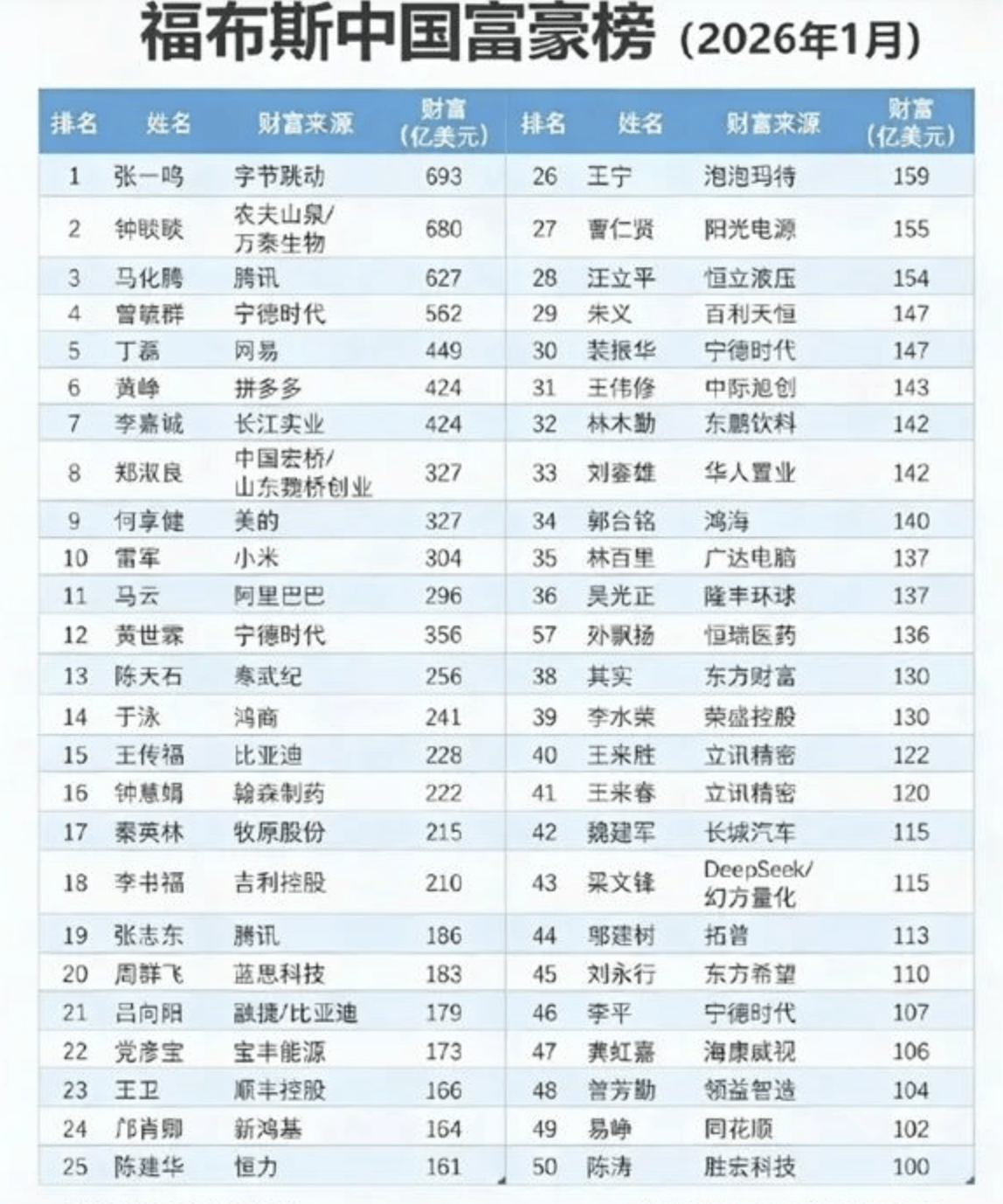
福布斯中国富豪榜出炉,马云跌出前十,李嘉诚排名第七,第一是?
Sou Hu Cai Jing· 2026-01-31 04:43
Group 1: Wealth Rankings - Zhang Yiming is now the richest person in China with a wealth of 680 million USD, followed by Zhong Shanshan at 627 million USD and Ma Huateng at 562 million USD [1][2] - Notable changes include Huang Zheng ranking sixth with 424 million USD and Lei Jun at tenth with 304 million USD [1][2] - Chen Tian Shi of Cambrian has seen rapid wealth growth, reaching 256 million USD and ranking thirteenth, just one position behind Ma Yun [1][2] Group 2: Industry Trends - The rise of AI and chip companies, exemplified by Zhang Yiming's ByteDance and Chen Tian Shi's Cambrian, indicates a rapid accumulation of value in this sector [3] - The new energy and hard technology sectors are being revalued, with companies like Ningde Times and BYD representing the comprehensive rise of the electric vehicle industry [5] - The internet ecosystem is evolving, with leaders like Zhang Yiming, Ma Huateng, and Ding Lei reflecting a shift from consumer internet to industrial internet driven by technology [7] Group 3: Traditional Industries - Traditional retail and manufacturing sectors are experiencing relative decline, with figures like Li Ka-shing being surpassed by tech newcomers [8] - This shift is not indicative of a complete loss of value in traditional industries but highlights the need for integration with cutting-edge technology to find new growth avenues [8][10] - The overall change in wealth distribution is seen as a positive for the Chinese economy, promoting resource allocation towards innovation and enhancing productivity and competitiveness [11]