
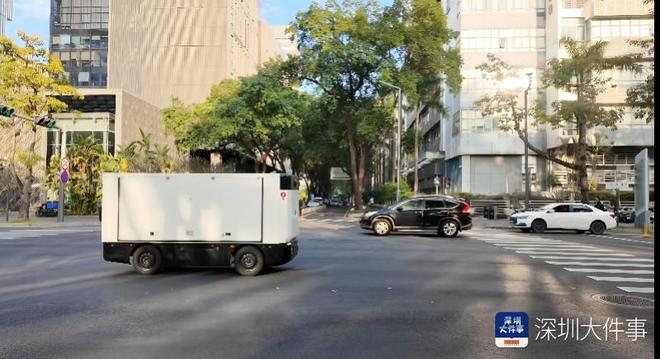
无人小车

Search documents
不止于实验室,深圳独角兽第一街如何跑赢AI转化新赛程
Nan Fang Du Shi Bao· 2026-01-16 02:14
Core Insights - The article highlights the integration of AI technologies in urban management and logistics in Shenzhen's Meilin area, showcasing a future where autonomous vehicles and drones enhance community services and governance [1][3][4]. Group 1: AI Applications and Innovations - Meilin has developed 65 AI application scenarios across urban governance, public health, and community services, with 15 functional autonomous vehicle routes covering over 50 kilometers [3][4]. - The area has seen the establishment of 82 AI-related companies, creating a complete industrial chain from chip development to scene application [8][9]. - The deployment of drones and autonomous vehicles has transformed traditional logistics and urban management, improving efficiency and reducing costs [3][4][6]. Group 2: Corporate Developments - Yuhua Group has established a new headquarters in Meilin, focusing on smart city operations and AI-driven solutions for urban services [4][6]. - Puzhou Technology has developed advanced drones with unique features for various applications, including power inspection and emergency rescue [6][8]. - The establishment of a robot data collection center by Yuhua Group aims to address labor shortages and improve operational efficiency in the sanitation industry [4][12]. Group 3: Policy and Ecosystem Support - Shenzhen is experiencing a "policy and scene" resonance period, facilitating the growth of AI industries through systematic support and market validation [9][10]. - The creation of public service platforms and incubators in Meilin has attracted numerous enterprises, fostering a collaborative environment for innovation [10][11]. - The district's focus on a "platform empowerment + scene opening + carrier incubation" strategy has led to the successful implementation of over 30 benchmark projects [12][14]. Group 4: Economic Impact - The Shenzhen New Generation Industrial Park has achieved an annual output value exceeding 200 billion yuan, making it one of the highest in Shenzhen [14]. - Meilin is home to four unicorn companies with a total valuation of 45.6 billion USD, representing 29% of Shenzhen's total, establishing it as a leading area for innovation and economic growth [14][15]. - The region's advancements in AI and technology are not only enhancing economic density but also improving quality of life and urban governance [14][15].


德赛西威20251225
2025-12-26 02:12
Summary of Desay SV's Conference Call Company Overview - **Company**: Desay SV - **Industry**: Automotive Technology and Smart Driving Solutions Key Points and Arguments Financial Performance and Projections - Desay SV expects a stable long-term gross margin around 20%, benefiting from increased penetration of traditional joint venture brands in smart driving and premium revenue from overseas operations [2][3] - The company’s contract manufacturing business currently accounts for 10% to 15% of total revenue, with expectations that this proportion will not significantly increase in the long term due to rising contributions from traditional brands' smart driving systems [3] Market Dynamics and Product Development - The cockpit sector has potential for increased per-vehicle value, driven by the demand for higher performance chips as L3 autonomous driving progresses [2][6] - Desay SV anticipates new customers in the smart driving sector primarily from traditional brands and sub-brands that did not launch this year, with a shift towards higher-margin projects expected [7] - The company is collaborating closely with domestic autonomous driving chip manufacturers, maintaining the ability to transition from OV platforms to others [9] Overseas Market Strategy - As of Q3, overseas revenue accounted for 7.5%, with expectations of remaining below 10% for the year. The goal is to increase this to 20% by 2030, starting with mass production of integrated cockpit solutions in Q4 next year [8] Supply Chain and Cost Management - Desay SV has a strong supply chain management capability, particularly in procurement and logistics, providing a significant cost advantage over competitors [11] - The company is addressing rising material costs, especially memory prices, by negotiating cost-sharing with clients and ensuring stable supply for automakers [4] Product Innovation and Competitive Edge - The company’s autonomous vehicles adhere to automotive-grade standards and are fully self-developed, which enhances reliability and quality, allowing Desay SV to capture market share without engaging in price wars [10] - The introduction of L3 autonomous driving standards is expected to significantly enhance vehicle value and increase the demand for high-performance chips [6][12] Customer Structure and Market Trends - The customer base is becoming more diversified, with revenue from any single customer now below 20%. The company expects stable demand from core clients despite competitive pressures [13] - Future market demand is anticipated to be influenced by tax incentives and trade-in policies, with core customers maintaining a strong demand for autonomous configurations [15][16] Research and Development - A decrease in R&D expenses in Q3 is viewed as a temporary phenomenon, with plans to maintain a stable R&D investment ratio to support ongoing innovation [15] Additional Important Insights - Desay SV is exploring opportunities in the instant retail market and potential collaborations in the Robotaxi sector, which is expected to yield higher margins compared to traditional passenger vehicles [12] - The company is positioned to benefit from the growing Robotaxi market, which has a significantly higher value than traditional vehicles, contributing to improved gross margins [12]
德赛西威20251030
2025-10-30 15:21
Summary of Desay SV's Conference Call Company Overview - **Company**: Desay SV - **Industry**: Automotive Electronics and Intelligent Driving Solutions Key Points Financial Performance - **Q3 Revenue Decline**: Desay SV experienced a quarter-on-quarter revenue decline primarily due to changes in sales volume and vehicle value fluctuations. The adjustment in the OEM model and the revenue settlement cycle for R&D expenses also contributed to this decline. However, net profit did not significantly decrease, indicating that these changes are short-term fluctuations and do not affect the long-term business nature [2][3][13]. Customer Structure Optimization - **Risk Diversification**: The company has optimized its customer structure, ensuring that no single core customer accounts for more than 20% of total revenue. This strategy helps to mitigate risks while promoting new business developments in autonomous driving, cockpit integration, and other areas. Collaborations with Nvidia, Qualcomm, and domestic chip manufacturers are also underway, showing positive development trends [2][5]. Growth in Autonomous Delivery Vehicles - **Delivery Vehicle Orders**: The autonomous delivery vehicle business is rapidly developing, with a significant increase in intended orders. Desay SV is in discussions with major clients like Meituan, JD.com, and the postal service, expecting to deliver thousands of units by 2026, marking it as a crucial growth area for the future [2][6]. International Market Expansion - **Overseas Market Strategy**: Desay SV's international market strategy focuses on Europe, Japan, and Southeast Asia. The company is collaborating with Toyota on the Qualcomm 8,650 project and developing high-performance domain control systems for European luxury brands. The stability and production planning in overseas markets are considered stronger compared to domestic markets [2][9]. Future Profitability Outlook - **Profitability Influencers**: Future profitability will be influenced by the proportion of OEM business, sales scale of new force brands, and the development speed of traditional self-owned brands. A rapid increase in orders from traditional brands is expected in Q4, which will positively impact profitability due to higher demand for high-value products [2][11][12]. R&D Investment and Trends - **R&D Focus**: The company is expanding its R&D team, particularly in software and algorithms. The increase in R&D expense ratio in Q3 was partly due to stock incentive plans affecting core personnel. Overall, R&D levels are expected to remain stable [2][10]. Sensor and Cockpit Product Developments - **Product Upgrades**: Upgrades in cockpit products have significantly improved average selling prices (ASP) and gross margins. The demand for new configurations in collaboration with Toyota has doubled, and the next-generation AI cockpit chip's computing power has increased significantly [2][15]. Market Competition and Strategy - **Competitive Landscape**: The market is becoming increasingly competitive, with third-party manufacturers developing comprehensive solutions. Desay SV's strategy involves maintaining quality and supply assurance to navigate this competitive environment [2][32]. Future Market Trends - **Growth in Autonomous Driving Technology**: The demand for advanced autonomous driving technology is expected to grow, with traditional brands showing a rising need for high-value solutions. Desay SV has secured numerous orders from brands like Great Wall, Chery, and Changan, indicating a positive outlook for future growth [2][19]. Cost Management and Profit Margins - **Cost Structure**: The company aims to maintain a gross margin of around 20% in the future, with potential for improvement if competitive pressures ease. The actual gross margin in Q3 was similar to Q2, and adjustments for R&D and patent fees could lead to better margins [2][21][24]. Conclusion - Desay SV is strategically positioned to leverage its diversified customer base, innovative product offerings, and international market expansion to drive future growth and profitability in the automotive electronics sector. The focus on R&D and collaboration with key industry players will further enhance its competitive edge in the rapidly evolving landscape of intelligent driving solutions [2][34].
无人车产业趋势解读
2025-06-06 02:37
Summary of Conference Call on Autonomous Vehicle Industry Trends Industry Overview - The conference call discusses the trends in the L4 autonomous driving technology industry, highlighting its broad application prospects across various sectors, particularly in robotaxi and unmanned delivery vehicles [1][2][3]. Key Points and Arguments L4 Autonomous Driving Technology - L4 autonomous driving technology is experiencing significant advancements due to breakthroughs in algorithms, supply chain standardization, and a decrease in the cost of laser radar [1][5]. - The market for unmanned delivery vehicles is expected to grow, driven by cost reductions and the opening of road rights, particularly in logistics where time sensitivity is lower [1][8]. Economic Viability - Specific scenarios have already demonstrated significant economic benefits, with unmanned delivery vehicles showing potential for cost savings in logistics, reducing delivery costs to as low as 0.08 CNY per package [3][21][22]. - The logistics industry is beginning to adopt unmanned vehicles, with major express companies like SF Express planning to increase their procurement significantly in 2025 [17]. Future Trends - The future of the unmanned delivery vehicle industry is characterized by two main trends: companies with sufficient funding engaging in price wars through internet models, and operational entities benefiting from reduced labor costs [9][24]. - The potential market for unmanned vehicles in logistics could reach hundreds of thousands of units, contingent on the suitability of various delivery scenarios [18]. Policy Support - There is a growing trend of policy support for unmanned delivery technology, with various regions opening up road rights and the Ministry of Transport promoting AI integration in transportation [23]. Additional Important Insights - The shift in thinking from a research-driven approach to one focused on applicability has allowed many unmanned vehicle companies to gain traction in recent years [5][8]. - The logistics sector's characteristics, such as large volumes and lower time sensitivity, make it particularly suitable for the development of unmanned delivery vehicles [7][9]. - The integration of unmanned vehicles into logistics could lead to a transformation in business models, allowing for more efficient use of human resources [24]. Investment Opportunities - Recommended investment targets include direct logistics companies like SF Express and Debon, as well as leading franchise logistics companies such as Shentong, Zhongtong, and YTO Express, which are expected to benefit from the changes in the industry [25][26].
