
无人环卫机器人

Search documents
汉嘉数智:引领无人环卫机器人赛道
Zheng Quan Shi Bao Wang· 2026-01-16 10:22
Group 1 - The company has officially changed its name to "Hanjia Smart Technology Group Co., Ltd." and is transitioning from a traditional engineering design firm to a focus on "big data + artificial intelligence" [1] - In 2024, the company will acquire 51% of Suzhou Futai Information Technology Co., Ltd., targeting the smart city governance sector, with consolidation expected by the end of 2024 [1] - The market for unmanned sanitation robots is expected to grow significantly, driven by the "AI+" policy and advancements in AI computing power, providing a favorable market opportunity for the company's transformation [1] Group 2 - The company has developed a full-stack self-research capability from data, models, computing power to robots and platforms, focusing on the "operation-management" field for robot applications [2] - The unmanned sanitation robot product line includes three models: 3 tons, 1 ton, and 0.5 tons, designed for various operational scenarios, achieving "regional cluster scheduling" for collaborative operations [2] - Currently, unmanned cleaning robots are operational in over 30 regions across East, Central, South, and Southwest China, with an international expansion plan, covering an area of over 25 million square meters [2]


跟环卫工抢饭碗?拆解COWA无人环卫车商业逻辑
Guan Cha Zhe Wang· 2025-11-29 03:05
Core Insights - The article highlights the rapid commercialization of low-speed unmanned cleaning vehicles, which are becoming increasingly important in urban governance, despite facing fewer regulatory hurdles compared to unmanned logistics and taxi services [1][3]. Industry Overview - In 2023, the sales scale of unmanned cleaning vehicles in China reached approximately 2.41 billion yuan, with over 14,000 units sold [3]. - The potential market size for unmanned cleaning services in China could reach 280 billion yuan by 2025, with a market of 105 billion yuan specifically for unmanned cleaning vehicles [3]. Company Spotlight - COWA Technology is identified as a leading player in the unmanned cleaning vehicle sector, operating successfully in over 50 cities domestically and internationally [3]. Market Differentiation - Unmanned cleaning robots differ fundamentally from logistics vehicles due to their complex operational requirements in dynamic urban environments, which include navigating various types of roads and obstacles [4]. - The operational logic of unmanned cleaning robots is more intricate than that of unmanned logistics vehicles, requiring real-time garbage type recognition and adaptive cleaning strategies [4]. Technical Complexity - Unmanned cleaning robots integrate advanced cleaning functionalities with autonomous driving, resulting in significantly higher technical complexity compared to traditional unmanned vehicles [5]. - COWA's unmanned cleaning robots feature a compact design that incorporates multiple cleaning components, necessitating sophisticated algorithms for coordinated control of up to 38 internal motors [5]. Customization and Adaptation - Unmanned cleaning vehicles must meet specific urban management requirements, including customizable designs to align with city branding and operational adjustments to avoid peak traffic times [5].


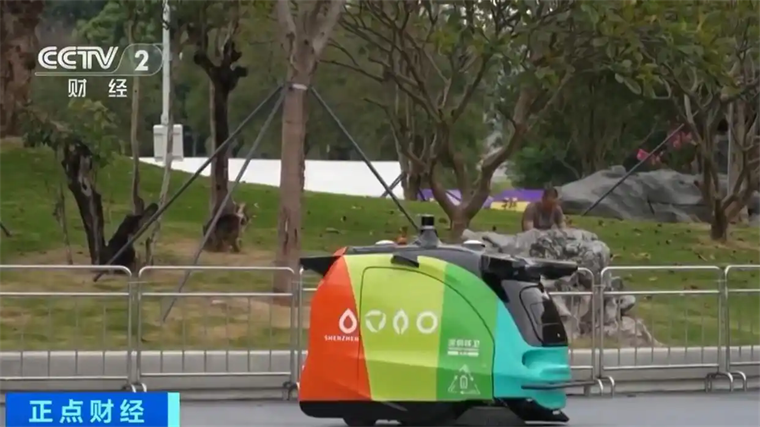
无人环卫机器人开始大规模投用:4人半天工作量,机器人2.5小时完成【附机器人行业市场分析】
Qian Zhan Wang· 2025-09-17 09:09
Core Insights - The sanitation industry is undergoing a transformation due to technological advancements, particularly with the introduction of autonomous cleaning robots in cities like Shenzhen and Guangzhou [1][3]. Group 1: Industry Transformation - Autonomous cleaning robots are being deployed in Shenzhen, significantly improving efficiency; a task that previously required four workers for half a day can now be completed in two and a half hours [1]. - Guangzhou plans to increase the number of autonomous cleaning devices to 1,000 by 2026, while other cities are also incorporating such technology to address labor shortages and efficiency issues in the sanitation sector [3]. Group 2: Market Dynamics - The robot industry is one of the most dynamic and promising high-tech sectors, integrating various advanced technologies such as mechanical engineering, electronics, computer science, artificial intelligence, and control theory [3]. - The market for robots in China surpassed 130 billion yuan in 2023, with a compound annual growth rate of 19.46% over the past five years [3]. Group 3: Service Robot Segment - Service robots account for 45% of the total robot market, emerging as a key growth driver within the industry [5]. Group 4: Operational Benefits and Challenges - The rise of autonomous cleaning robots represents not just a labor replacement but an upgrade in urban service models, allowing workers to focus on higher-value tasks such as equipment maintenance and quality supervision [7]. - Despite the promising market outlook, the commercialization of autonomous cleaning robots faces challenges, including high deployment costs and long setup times due to reliance on specialized technical personnel [7].
AI与机器人盘前速递丨宇树开源 UnifoLM-WMA-0 世界模型架构;Meta新款AI眼镜将于本周发布!
Mei Ri Jing Ji Xin Wen· 2025-09-16 01:34
Market Overview - On September 15, the Shanghai Composite Index fell by 0.26% after a brief rise. The Huaxia Sci-Tech AI ETF (589010) decreased by 1.16% following three consecutive days of gains, indicating a normal pullback in a market that is currently stabilizing and rebounding. The index remains above all moving averages, maintaining a long-term positive trend [1] - The total trading volume for the day reached 1.528 billion yuan, indicating active market participation with significant capital inflow. The Robot ETF (562500) attracted 245 million yuan in a single day, with a net inflow of 964 million yuan over the past five trading days [1] Key Developments - On September 15, Yushu Technology announced the open-source UnifoLM-WMA-0, a world model-action framework designed for general robotics learning, featuring a simulation engine and strategy enhancement capabilities [2] - The Meta Connect 2025 conference is scheduled for September 17-18, focusing on the integration of AI glasses and the metaverse. Mark Zuckerberg is expected to present the latest developments in AI glasses and Meta's vision in this domain [2] - The commercial operation of unmanned sanitation robots has begun in multiple cities across China, achieving nearly ten times the efficiency of human workers. Cities like Guangzhou plan to increase the number of unmanned cleaning devices to 1,000 by 2026 [2] Institutional Insights - According to Open Source Securities, China is one of the largest semiconductor markets globally. The ongoing expansion of AI infrastructure in the country is expected to drive growth in the domestic enterprise storage market. With increasing storage demands from data centers, domestic internet companies may face a demand gap, benefiting local enterprise storage manufacturers [2] Popular ETFs - The Robot ETF (562500) is the only ETF in the market with a scale exceeding 10 billion yuan, offering the best liquidity and comprehensive coverage of the Chinese robotics industry [3] - The Huaxia Sci-Tech AI ETF (589010) is positioned as the "brain" of robotics, capturing the "singularity moment" in the AI industry with a 20% price fluctuation and flexibility in small and mid-cap stocks [3]
无人环卫机器人爆单 ,无人环卫服务市场订单迎爆发期
Xin Lang Cai Jing· 2025-09-15 11:42
Core Insights - The sanitation industry is undergoing a significant transformation driven by automation, particularly with the large-scale deployment of unmanned sanitation robots in Shenzhen, Guangdong [1] - The use of unmanned cleaning robots has drastically reduced the time required for cleaning tasks, with a specific example showing a reduction from four workers over half a day to just two and a half hours [1] - The manufacturing companies involved in this sector are experiencing a surge in production orders, with one company reporting an order value exceeding 35 million yuan, representing over 100% growth compared to the previous year's sales [1] - The "Low-speed Unmanned Cleaning Vehicle Industry Development Blue Book" predicts that the market size for unmanned sanitation services in China will reach 280 billion yuan by 2025 [1]