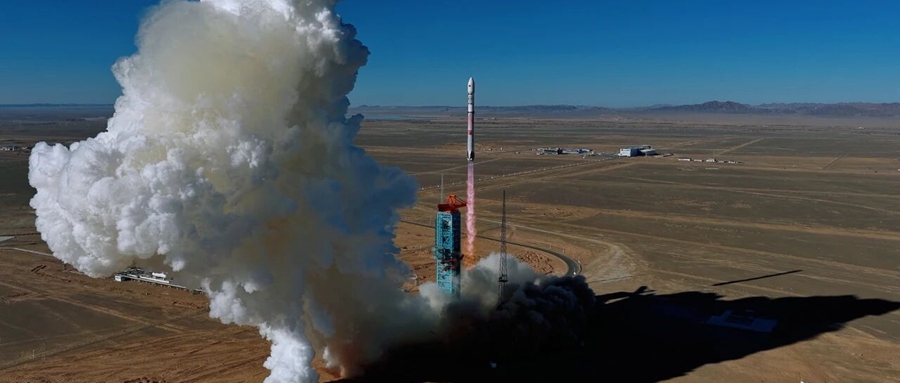
星云二号运载火箭

Search documents
深蓝航天创始人霍亮:打造常态化、低成本的“太空货运班车”|2026商业新愿景
Jing Ji Guan Cha Bao· 2026-02-12 16:10
Core Viewpoint - The company Deep Blue Aerospace is set to execute the first orbital flight mission of its "Yunxing-1" rocket after the 2026 Spring Festival, combining high-risk tasks of launch and recovery to complete a technical closed loop [2][3]. Group 1: Technical Objectives and Achievements - The mission aims to validate the rocket's launch and the vertical recovery of its first stage, which is considered a necessary step in engineering despite being perceived as aggressive [3]. - Prior to this mission, the company conducted several vertical takeoff and landing (VTVL) flight tests, accumulating hundreds of seconds of flight data to verify the deep throttling capability of its liquid oxygen-kerosene engine and the navigation accuracy of its control algorithms during landing [3]. - The company has developed a 130-ton liquid oxygen-kerosene engine, "Thunder-RS," which features over 85% of its core components manufactured using metal 3D printing technology [4]. Group 2: Manufacturing Innovations - The adoption of 3D printing technology aims to address manufacturing consistency issues and significantly reduce costs, enhancing the engine's structural reliability under high-frequency reuse conditions [5]. - The "Thunder-RS" engine is designed with a thrust adjustment capability of 50% to 110%, which is crucial for precise control of descent speed and achieving soft landings [5]. - The core value of reusable rockets lies in reducing the cost of space access, with estimates suggesting that reusing the first stage could lower the cost per launch by 60% to 70% compared to single-use models [5]. Group 3: Strategic Focus and Market Positioning - In 2026, the company's focus will shift from technical breakthroughs to system operations, aiming for high-frequency, reliable launches and establishing standardized, rapid reuse processes [6]. - The company has a tiered product strategy, with "Yunxing-1" targeting the customized launch market for small and medium-sized satellites, while the upcoming "Yunxing-2" aims to serve the 18-ton market for large-scale satellite constellations [6]. - The company recognizes the critical transition period for China's commercial space sector, emphasizing the need to enhance engineering integration capabilities and gain experience in high-frequency flight iterations to compete with global leaders like SpaceX [6]. Group 4: Long-term Goals - The long-term objective of Deep Blue Aerospace is to become a provider of regular, low-cost space transportation services, focusing on practical engineering innovations rather than conceptual innovations [7].


深蓝航天创始人霍亮:打造常态化、低成本的“太空货运班车”
Jing Ji Guan Cha Wang· 2026-02-12 16:09
Core Viewpoint - Deep Blue Aerospace is set to execute the first orbital flight mission of its "Yun-1" rocket after the 2026 Spring Festival, marking a significant milestone for the company in the commercial space sector [1] Group 1: Technical Objectives and Innovations - The mission aims to simultaneously validate the rocket's orbital launch and the vertical recovery of its first stage, a decision that follows strict engineering logic despite being perceived as aggressive [2] - The company has upgraded its manufacturing processes for the propulsion system, with the "Thunder-RS" engine, which is crucial for the future reusable rocket "Yun-2," completing its first full system test in September 2025 [3] - The use of 3D printing technology in manufacturing aims to solve consistency issues and significantly reduce costs, enhancing the engine's reliability and production cycle [4] Group 2: Cost Reduction and Market Strategy - The core value of reusable rockets lies in reducing the cost of space access, with estimates suggesting that stable recovery and reuse of the first stage could lower launch costs by 60% to 70% compared to single-use models [4] - In 2026, the focus will shift from technical breakthroughs to system operations, emphasizing high-frequency, reliable launches and establishing a standardized, rapid reuse process [5] - Deep Blue Aerospace has established a tiered product layout, with "Yun-1" targeting the customized launch market for small and medium-sized satellites, while "Yun-2" aims for the SSO market for larger satellite constellations [6] Group 3: Industry Context and Competitive Landscape - 2026 is viewed as a pivotal year for China's commercial space sector, with multiple new private liquid rockets planned for their first flights [7] - The company recognizes that the gap with global leaders like SpaceX lies not in specific technical principles but in the lack of engineering system integration capabilities and experience in large-scale, high-frequency flight iterations [7] - The long-term goal is to become a provider of regular, low-cost space transportation services, focusing on solid engineering innovations rather than conceptual innovations [8]
朱雀升空背后,谁在改写中国商业航天版图?
Mei Ri Jing Ji Xin Wen· 2025-12-03 14:02
Core Viewpoint - The successful first flight of the Zhuque-3 rocket marks a significant step in China's commercial space industry, despite not achieving the recovery verification task. This event highlights the dual breakthrough of "technological advancement" and "scale explosion" in the commercial space sector since its inception in 2015 [1][2]. Industry Overview - The commercial space sector is becoming a focal point for major powers, with China integrating it into its national space development strategy through the establishment of a dedicated Commercial Space Administration [1][2]. - The industry is experiencing rapid expansion, with at least 20 provinces in China implementing supportive policies to enhance their commercial space capabilities [1][2]. Technological Developments - The Zhuque-3 mission achieved five domestic firsts in technology, indicating progress in the development of reusable rockets [6][7]. - The development of reusable rockets is expected to reduce launch costs and increase launch frequency, addressing the current bottleneck of insufficient launch capacity [2][6]. Market Dynamics - The commercial space market in China is projected to grow from approximately 0.38 trillion yuan in 2015 to 2.3 trillion yuan by 2024, with an annual growth rate of about 22%. By 2030, the market could approach 10 trillion yuan [14][15]. - The competition among local governments to develop commercial space industries is intensifying, with regions like Hubei aiming to establish significant commercial space hubs by 2028 [16][18]. Company Landscape - Various private companies are focusing on developing large reusable rockets, with Blue Arrow Aerospace being one of the closest to achieving this goal [6][7]. - A list of companies and their respective rocket projects indicates a diverse landscape, with firms like Star River Power and Tianbing Technology also targeting reusable rocket technologies [9][10]. Financing Trends - In 2024, the commercial space sector in China saw 52 financing events totaling 15 billion yuan, with significant investments in satellite operations and rocket manufacturing [20][19]. - The financing landscape is concentrated in regions like Beijing and Shanghai, reflecting their potential for commercial space development [20][19].