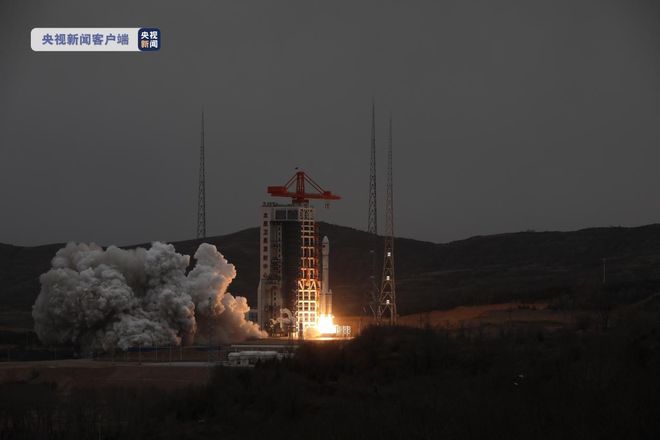
长征十二号

Search documents
ETF盘中资讯 | 军工领跑全市场,512810再创阶段新高!商业航天题材火爆,多股涨超10%,行业重磅大会今日召开
Jin Rong Jie· 2025-12-23 17:59
Core Viewpoint - The commercial aerospace sector is experiencing a strong resurgence, significantly boosting the defense and military industry, which is leading the market with the highest gains and net inflows [1] Group 1: Market Performance - As of the morning of December 18, the defense and military industry has the highest increase and net inflow among all sectors [1] - The National Defense and Military ETF (512810) opened lower but rose nearly 2%, reaching a two-month high with a trading volume exceeding 56 million yuan [1] - Key stocks in the commercial aerospace sector, such as Platinum and Zhongke Xingtong, surged by 12%, while China Satellite hit the daily limit [1] Group 2: Industry Developments - The 2025 Third China Commercial Aerospace Development Conference and the Fourth Zhongguancun Commercial Aerospace Conference were held in Beijing, indicating ongoing positive developments in the commercial aerospace sector [2] - Recent advancements include the successful launch of the Zhuque-3 rocket and the completion of multiple missions by Long March 12, accelerating the deployment of low-orbit satellite constellations [3] - The spillover of advanced military technology into civilian applications is creating new industries worth trillions, such as commercial aerospace, low-altitude economy, and deep-sea technology [3] Group 3: Investment Opportunities - The National Defense and Military ETF (512810) covers various hot themes, including commercial aerospace, controlled nuclear fusion, low-altitude economy, and military AI, serving as an efficient tool for investing in core military assets [3]


大运载时代:百箭争流,共绘天疆新图景
HUAXI Securities· 2025-12-14 11:16
Investment Rating - Industry Rating: Recommended [4] Core Insights - The successful launches of the Li Jian No.1 and Long March 12 rockets validate China's heavy-lift capabilities in commercial space [1][14] - Li Jian No.1 achieved a "one rocket, nine satellites" launch, marking its entry into large-scale operations with a payload capacity of 1.5 tons to a 500 km sun-synchronous orbit, outperforming similar Indian rockets by over four times [1][15] - Long March 12, China's strongest single-core rocket, demonstrated its capability to launch large satellite constellations with a near-Earth orbit capacity of at least 12 tons [1][16] Summary by Sections Section 1: Li Jian No.1 and Long March 12 Launches - Li Jian No.1 successfully launched nine satellites, including three for international clients, establishing a strong market presence in the commercial launch sector [14][25] - The rocket's innovative avionics system enhances reliability and supports remote one-click launches, transitioning from custom to generalized systems [25][33] - Long March 12's successful mission included launching 16 low-Earth orbit satellites, showcasing its adaptability and efficiency with a record short turnaround time [16][34] Section 2: Global Commercial Space Development - SpaceX is redefining launch capacity standards with its Starship system, achieving near-Earth orbit capacity of 150 tons and a single-use capacity of 250 tons [3][20] - The commercial space market is projected to exceed $500 billion by 2025, driven by low-cost reusable rockets and satellite constellations [20][54] - The emergence of differentiated technologies, such as Rocket Lab's Neutron rocket, indicates a competitive landscape where second-tier companies seek to carve out market niches [21][22] Section 3: Investment Recommendations - Beneficial stocks include aerospace companies like Aerospace Power, Superjet, and West Materials, as well as space computing firms like Shunhao and Putian Technology [7][23]
商业航天专家交流系列电话
2025-12-01 16:03
Summary of the Conference Call on China's Commercial Space Industry Industry Overview - The conference call focused on the **Chinese commercial space industry**, highlighting the competition among various companies developing **reusable rockets** such as **Zhuque-3**, **Tianlong-3**, **Shuangqiuxian-3**, **Xingyun-1**, and **Long March 12** [1][2][4] - The industry is at a critical juncture of **technological breakthroughs** and **industrialization** [2] Key Points and Arguments - **Zhuque-3** has faced delays not only due to environmental factors but also due to strategic adjustments by the **National Space Administration** and technical reviews, with **Long March 12** set to undertake the initial launch [1][4] - The **fuel choice** for Chinese reusable rockets is leaning towards **liquid oxygen and methane**, which is cheaper compared to **liquid oxygen and kerosene** used by SpaceX [4][18] - Current launch costs for the **Long March series** are approximately **70,000-100,000 RMB/kg** (around **10,000-14,000 USD/kg**), while the goal for new reusable rockets is to reduce this to **20,000-30,000 RMB/kg** (approximately **2,800-4,200 USD/kg**) [4][5] - The **expected increase** in launch numbers for 2026 is projected to be **2-3 times** that of 2025, with a **5-fold increase** in capacity, driven by various satellite projects and advancements in reusable rocket technology [3][21] Technical Differences and Challenges - Reusable rockets differ significantly from traditional rockets in terms of **structural design**, **engine capabilities**, and **control systems** [6][8] - The **engine** of reusable rockets must support **variable thrust**, multiple ignitions, and precise landing controls, which presents higher technical demands [6][11] - The **fairing**, a critical component, requires materials that are **lightweight** and can withstand high temperatures, typically made from **carbon fiber composites** and **aluminum honeycomb structures** [3][9][10] Market Competitiveness - The **Chinese commercial space sector** aims to enhance its global competitiveness by narrowing the cost gap with international players like SpaceX, which has significantly lower launch costs [5][22] - Companies like **Nanjing Aerospace** and **Deep Blue Aerospace** are leading in the development of **3D printing technologies** for rocket engines, which can reduce costs by about **40%** and improve production efficiency [13][14] Future Outlook - The establishment of the **Commercial Space Administration** by the National Space Administration indicates a strategic focus on the development and launch of commercial space projects [4] - The industry faces challenges in ensuring successful multiple launches in 2026 and improving production capabilities, but ongoing collaborations between governments and commercial companies are expected to address these limitations [22]
华西证券:低轨卫星拐点已至 国内组网加速
智通财经网· 2025-11-07 08:39
Core Insights - The low Earth orbit (LEO) satellite market is becoming a strategic focus in the US-China competition, with the principle of "first come, first served" governing orbital and frequency resources [1][2] - SpaceX has launched over 10,000 satellites, with more than 8,600 currently operational, while China has only about 300 LEO satellites in orbit, indicating a significant gap that necessitates accelerated deployment [1][2] Group 1: Market Dynamics - The LEO orbit can accommodate approximately 60,000 satellites, and strict international regulations require timely launches to retain frequency and orbital rights [2] - SpaceX has applied for resources for 42,000 satellites, while Amazon's Kuiper plans to deploy 3,236 satellites; China's China Star Network and Shanghai Yuanxin plans to deploy around 13,000 and 15,000 satellites, respectively [2] Group 2: Launch Capacity and Technology - Rocket launch capacity is a critical metric, with SpaceX's Falcon 9 capable of 22.8 tons to LEO, while China's Long March 8 has a capacity of only 7 tons, highlighting a significant disparity [3] - The development of commercial rockets and reusable technology is progressing rapidly in China, with several private companies achieving successful launches and narrowing the gap with international standards [3] Group 3: Cost Reduction Strategies - SpaceX has reduced the cost of individual satellites to below $500,000 through mass production, while China's satellite manufacturing is also lowering costs via modular design and batch production [4] Group 4: Market Opportunities - LEO satellites are expected to integrate deeply with terrestrial 5G networks, enabling global seamless coverage, with significant advancements anticipated by 2025 [5] - The combination of artificial intelligence (AI) and LEO satellites is leading to the development of next-generation intelligent satellite systems, with major tech companies like NVIDIA and Google planning to deploy AI-capable satellites [5] Group 5: Future Developments - China's LEO satellite deployment is entering a rapid networking phase, with recent successful launches indicating an acceleration in the pace of deployment [6][7] - The domestic market is moving towards a "constellation deployment" phase, transitioning from "single satellite customization" [7] Group 6: Investment Opportunities - Companies to watch include Fudan Microelectronics (688385.SH) and Unisoc (002249.SZ) as potential investment targets in the LEO satellite sector [8]

21天5次发射,中国星网为什么这么急?
Guan Cha Zhe Wang· 2025-08-20 00:20
Core Viewpoint - China's Starlink program is racing against time to deploy a massive constellation of satellites, with a goal of launching approximately 13,000 satellites by 2034, driven by international regulatory deadlines set by the International Telecommunication Union (ITU) [1][3][5] Group 1: Launch Strategy and Goals - China has executed five satellite launches in just 21 days, marking an unprecedented pace in its satellite deployment efforts [1][10] - The ITU has established strict timelines for satellite deployment, requiring at least one satellite in orbit within seven years, 10% of the total by the ninth year, 50% by the twelfth year, and 100% by the fourteenth year [3][5][6] - By 2029, China needs to have approximately 1,300 satellites in orbit, with a significant ramp-up in launch frequency required to meet these targets [11][12] Group 2: Competitive Landscape - SpaceX's Starlink has set a high bar with its rapid deployment of thousands of satellites, creating pressure on other competitors like China's Starlink and Amazon's Project Kuiper [6][9] - Amazon's Kuiper project, aiming to deploy 3,200 satellites, is also under time constraints, having launched over 100 satellites recently [7][9] - The competitive environment is characterized by a race to secure frequency and orbital resources, with the potential for significant consequences for those who fail to meet deployment milestones [6][18] Group 3: Challenges and Solutions - China's current strategy involves multiple rocket types being launched in parallel to meet immediate deployment needs, but this approach may not be sustainable long-term due to complexity and cost pressures [11][15] - To meet future demands, China must increase the payload capacity of its rockets and establish a more efficient launch cadence, potentially moving towards reusable rocket technology [12][14][15] - The development of the Long March 12 rocket, which may evolve into a reusable platform, is seen as a critical step in enhancing China's launch capabilities [14][15] Group 4: Regulatory Environment and Implications - The ITU's deadlines are not just formalities; failure to meet them could result in reduced frequency allocations or even project termination [18][19] - The case of Rivada, which received a waiver despite not launching any satellites, illustrates that demonstrating credible progress can provide some leeway in regulatory compliance [18][19] - For China, the focus must be on consistent satellite launches and production capabilities to avoid reliance on potential regulatory leniency [19]