
智慧电网

Search documents
从十万亿度电看中国经济“新能量”
2 1 Shi Ji Jing Ji Bao Dao· 2026-01-19 11:17
Core Insights - The milestone of 1 trillion kilowatt-hours in electricity consumption by 2025 signifies a transformative shift in China's economy from high energy consumption to high efficiency [2][5] - This growth reflects a deeper change in economic structure, emphasizing innovation-driven growth over resource dependency [2][5] Group 1: Electricity Consumption Trends - By 2025, China's total electricity consumption is projected to reach 1,036.82 billion kilowatt-hours, representing a 5% year-on-year increase [2] - The proportion of electricity consumption from manufacturing is decreasing, while high-tech manufacturing, modern services, and residential consumption are on the rise [2][3] Group 2: Economic Transformation - The transition from factor-driven growth to innovation-driven growth is evident, with emerging sectors like digital economy, smart manufacturing, and green energy gaining momentum [2][3] - The rise of data centers, cloud computing, and AI is leading to a rapid increase in electricity consumption in the information technology sector [3] Group 3: Clean Energy and Sustainability - Clean energy generation now accounts for over one-third of total electricity production, with wind and solar power capacities leading globally [4] - The development of carbon trading markets and advancements in energy storage technology are expected to enhance the connection between economic growth and carbon neutrality [4] Group 4: Smart Energy Management - The integration of big data and AI in energy management allows for real-time data collection and analysis, improving the efficiency of electricity supply [4] - Technologies such as smart grids and virtual power plants enable flexible energy supply, reducing waste and enhancing economic resilience [4]
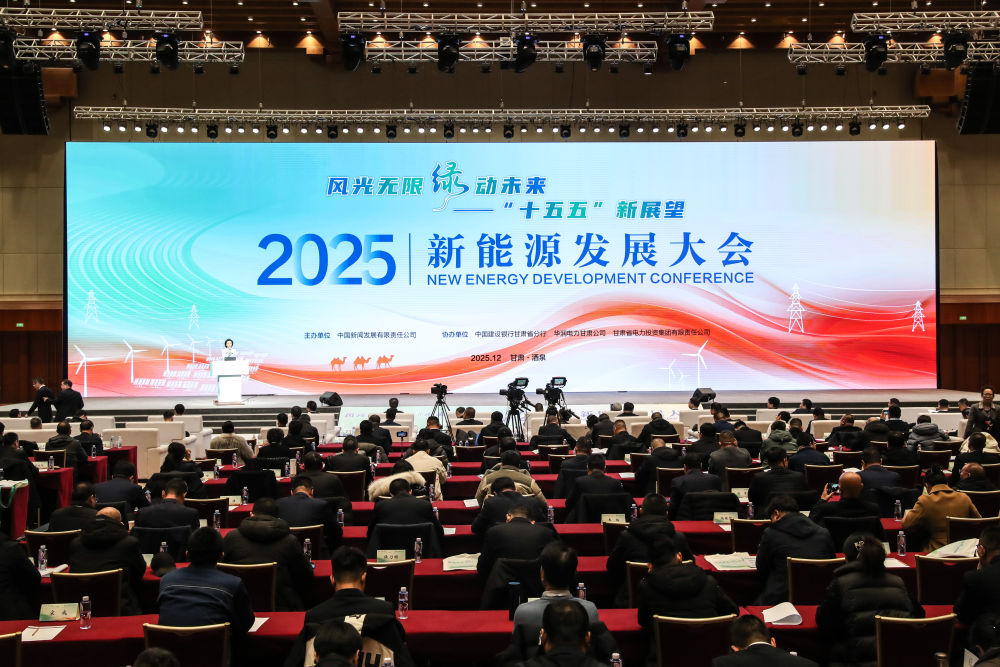
新能源发展大会|风光无限 “绿”动未来:2025新能源发展大会隆重开幕
Xin Hua She· 2025-12-18 06:50
Group 1 - The 2025 New Energy Development Conference opened in Dunhuang, Gansu Province, focusing on the theme "Wind and Solar Unlimited 'Green' Movement Future - New Outlook for the 14th Five-Year Plan" [1] - The conference gathered government departments, enterprises, universities, and research institutions from eight provinces to discuss experiences and future opportunities in new energy development [1] - Gansu's Vice Governor Lei Siwei highlighted the province's achievements in traditional industry upgrades and the growth of new industries, with the new materials industry expected to reach a value of 130.5 billion yuan and the new energy sector at 83 billion yuan in 2024 [2] Group 2 - Gansu's installed capacity of new energy reached 77.62 million kilowatts, accounting for 64.1% of the province's total power capacity, surpassing the 14th Five-Year Plan targets [2] - The province aims to create a trillion-yuan new energy industry chain and establish a national new energy industry demonstration zone [2] - China Resources Power's Chairman emphasized the importance of green development and collaboration with Gansu, with the company’s installed capacity nearing 100 million kilowatts [4] Group 3 - The conference featured discussions on the integration of AI in energy systems, with experts suggesting that AI will drive the next phase of the energy revolution [4][5] - The release of the "2025 China New Energy and New Energy Equipment Manufacturing Industry Map" indicated that China leads the world in wind and solar power installations for 15 and 10 consecutive years, respectively [8] - Gansu's energy bureau reported that by the end of 2025, the province's new energy installed capacity is expected to exceed 80 million kilowatts, a 3.4-fold increase from the end of the 13th Five-Year Plan [8]

COP30召开,气候治理亟待创新动力
Guo Ji Jin Rong Bao· 2025-11-19 08:17
Core Insights - The 30th UN Climate Change Conference (COP30) in Belem, Brazil, focuses on climate financing, emissions reduction, adaptation capacity, and climate resilience, marking a critical moment for global climate action [1] - Despite increasing global net-zero commitments, significant gaps remain in funding, transition speed, and the implementation of technology and policies [1][3] - The conference coincides with the 10th anniversary of the Paris Agreement, highlighting the disparity between corporate commitments to net-zero targets and their actual implementation [3] Group 1: Challenges in Achieving Net-Zero Goals - Many companies have set net-zero targets for 2040 or 2050 but lack clear mid-term roadmaps and actionable emission reduction strategies, leading to insufficient execution [3][5] - The mismatch between technology, business models, and policies results in companies being in experimental or early stages regarding decarbonization technologies and low-carbon business models [3][5] - Complex value chains and unclear responsibility boundaries complicate emission reduction efforts, particularly for multinational companies with layered supply chains [3][5] Group 2: Pathways to Achievable Net-Zero Strategies - Companies need to establish systematic execution mechanisms that cover governance, investment, technology, and supply chains to transition from commitment to implementation [5] - Key actions include strengthening governance systems, setting mid-term goals, and integrating decarbonization into operational and capital decisions [5] - Developing technology and investment roadmaps, identifying key emission reduction levers, and extending reduction requirements to supply chains are essential steps [5] Group 3: The Rise of Natural Capital - Increasing global regulatory and investor focus on natural capital has led many multinational companies to incorporate "Taskforce on Nature-related Financial Disclosures" (TNFD) into their sustainability reporting [6] - Over 700 institutions managing approximately $22 trillion in assets have expressed alignment with or intention to adopt TNFD, indicating its growing importance in mainstream disclosure frameworks [6] - TNFD helps companies identify potential risks related to ecological degradation and water resource scarcity while supporting opportunities in ecological restoration and resource efficiency [6] Group 4: Innovation as a Necessity - Innovation is deemed essential for global climate action, encompassing technological, business model, and policy innovations [8][9] - Key technological innovations include renewable energy, hydrogen, carbon capture, utilization and storage (CCUS), smart grids, and digital carbon management [9] - Artificial intelligence (AI) is increasingly recognized as a critical driver for climate action, aiding in carbon emission calculations, energy efficiency optimization, and supply chain carbon tracking [10] Group 5: AI and Green Energy Transition - AI applications in carbon emission measurement and energy management can enhance emission identification and energy consumption efficiency [10] - However, the rapid increase in AI's energy consumption poses a risk of new carbon emissions if the growth of computational power outpaces clean energy supply [10] - Companies are urged to develop "green computing" strategies to align AI development with energy transition efforts [10]

“新质生产力正为中国高质量发展提供澎湃动力”(人民日报)
Ren Min Ri Bao· 2025-11-18 03:19
Group 1 - The core viewpoint emphasizes the importance of developing new quality productivity as an intrinsic requirement and key focus for promoting high-quality development in China [1] - The "14th Five-Year Plan" highlights significant achievements in both quantitative and qualitative aspects of the economy, with innovation being a primary engine for high-quality development [2] - International observers note that China's advancements in technology and innovation are impressive, particularly in areas like green development, electric vehicles, artificial intelligence, and robotics [2][3] Group 2 - China is transitioning from a manufacturing powerhouse to a world-class innovation center, showcasing advanced technologies such as "water-solar complementary" systems and smart grids [3] - The "14th Five-Year Plan" aims to enhance the overall effectiveness of the national innovation system and strengthen independent innovation capabilities [4] - China's commitment to sustainable development and innovation is seen as a significant contributor to global economic stability [5] Group 3 - The development of new quality productivity in China is creating tangible opportunities for ASEAN countries, including Cambodia, and serves as a valuable reference for developing nations [6] - China's approach combines innovation-driven growth with open cooperation, which is viewed as a key to high-quality development and a source of hope for the global economy [6]