
智能代理(Agent)

Search documents
AI会计会是下一个“杀手级”应用吗?
Hua Er Jie Jian Wen· 2026-01-27 13:13
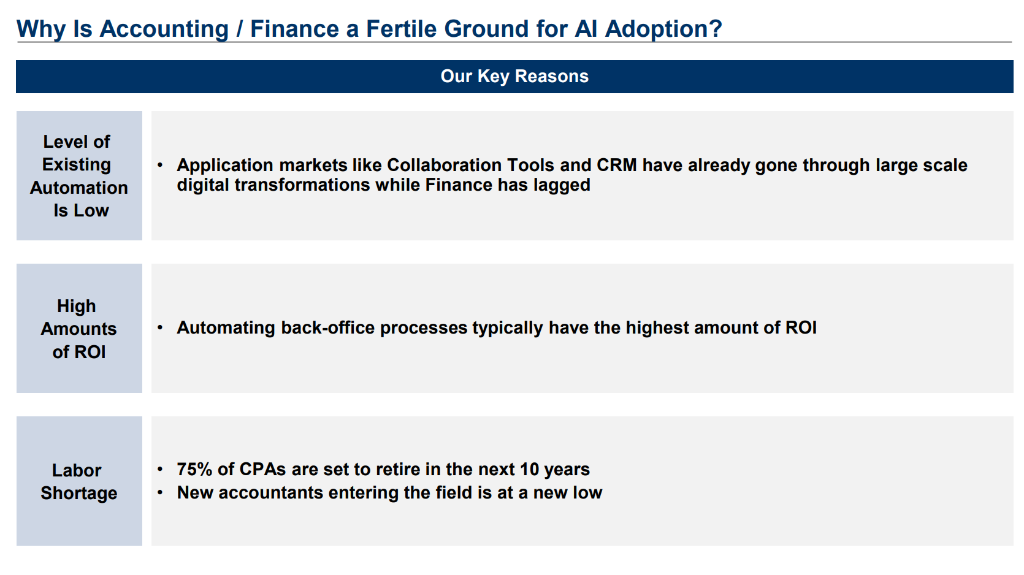
Core Insights - The financial accounting process is identified as a fertile ground for AI monetization potential, which is largely underestimated by investors [1] - Leading software providers like Intuit and Workday are expected to significantly enhance customer ROI and tap into new market spaces through AI [1] Group 1: Automation in Accounting - Accounting work is ideal for AI automation due to its clear rules, large data volumes, and high repetition, with accountants currently spending 50%-65% of their time on data processing and account classification [2] - AI can reduce tasks that typically take about 3 hours to approximately 8 minutes, allowing accountants to focus on higher-value consulting and strategic work [3] - Each significant improvement in AI application can save about 20% of processing time per client task, potentially doubling the number of clients an accountant can serve [3] Group 2: Labor Market Dynamics - Concerns about AI leading to job losses in accounting are overstated, as the industry faces a labor shortage with 75% of CPAs set to retire in the next decade and new entrants at a historical low [4][7] - AI is expected to enhance the capabilities of existing accountants rather than replace them, enabling teams to handle more business and clients without increasing headcount [7] Group 3: Monetization Pathways for Software Giants - The significant ROI from AI indicates that software providers should capture a portion of this value, with Intuit expected to monetize through upgrades to higher-tier QuickBooks plans and increased adoption of online services [8] - Workday may monetize through additional purchases of its intelligent agent products and accelerated use of Flex Credits [8] Group 4: Adoption Speed and Market Readiness - The adoption speed of AI varies, with small and medium-sized businesses (SMBs) likely to adopt faster due to simpler infrastructure and higher risk tolerance compared to larger enterprises [11] - Initial AI use cases are expected to target low-risk tasks, with acceleration towards more complex tasks as data readiness and governance improve [11] Group 5: Structural Opportunities in Financial Accounting - The financial accounting sector is seen as a fertile ground for AI due to high ROI from back-office process automation, low existing automation levels, and increasing labor shortages [12] - Evidence suggests that AI applications in financial accounting are driving quantifiable efficiency revolutions, reshaping software vendors' business models and revenue growth trajectories [14]

宏道投资董事长卫保川:AI产业的发展有四个“先后”关系
Xin Lang Cai Jing· 2026-01-15 07:36
专题:2026全球与中国资本市场展望论坛 炒股就看金麒麟分析师研报,权威,专业,及时,全面,助您挖掘潜力主题机会! 1月15日,2026全球与中国资本市场展望论坛在京召开。北京宏道投资董事长卫保川出席论坛并发表 《2026年投资展望》主旨演讲。 卫保川在发言中指出,当前权益市场具备较好的货币条件,而人工智能是全球最确定的发展方向。他认 为,AI产业目前仍处于基础设施建设的"修路"阶段,真正具有爆发性增长机会的将是未来的应用层,投 资者应把握产业演进节奏。 其次,是"先基建、后应用"。他比喻称,美国已投入近两万亿美元"修路",但应用端的"收费路口"尚未 大规模出现。目前应用仍集中在对话、编程辅助等领域,未来智能代理(Agent)等深度工具化应用将 是孕育行业巨头的土壤。 卫保川表示,从宏观视角看,市场流动性环境对权益投资较为有利。他进而提出,资金是否投入股市, 关键在于产业能否提供回报。他赞同"AI是当前时代最确定趋势"的判断,并指出经过近三年发展,AI技 术路线已基本走通,不同环节和行业将分阶段呈现投资机会。 针对AI产业的中短期路径,卫保川阐述了四个"先后"关系: 首先,是"先国外、后国内"。他认为AI技术 ...

人工智能的四大潜在风险
Di Yi Cai Jing· 2025-05-06 12:00
Group 1: Core Risks of AI Development - The primary risk associated with AI is the potential threat to employment, as AI can replace both manual and cognitive labor across various sectors, including healthcare, law, and finance [2][3] - AI's rapid advancement poses a challenge for the labor market to adapt, with estimates suggesting that by 2030, 400 million to 800 million workers globally may need to find new jobs due to automation [3] - The reliability and ethical alignment of AI systems present significant risks, particularly in ensuring that AI's goals align with human values, as demonstrated by incidents involving AI systems making harmful suggestions [4][5] Group 2: Societal and Existential Threats - The proliferation of misinformation and fake news is exacerbated by AI, which can generate realistic content, making it difficult for society to reach a consensus on truth and thus impairing rational decision-making [7][8] - AI's ability to democratize access to knowledge can also empower malicious actors, potentially leading to increased risks for society, similar to the proliferation of nuclear capabilities [8] - The ultimate risk lies in the development of Artificial General Intelligence (AGI), which could surpass human intelligence and lead to scenarios where humans lose control over AI systems, posing existential threats [10][12] Group 3: Challenges in Risk Mitigation - Addressing technical risks related to AI, such as stability and value alignment, is more manageable through advancements in algorithms and human oversight [13] - The economic implications of job displacement due to AI require societal collaboration, including potential taxation of beneficiaries to support those affected by job losses [13] - The challenge of defining truth in the context of misinformation complicates efforts to mitigate the societal risks posed by AI, as the nature of truth often exists in gray areas [13]