
智能安睡仪

Search documents
马斯克放出“量产时间表”,脑机接口集体涨停,商业化拐点来了?
华尔街见闻· 2026-01-05 11:10
Core Viewpoint - The brain-computer interface (BCI) industry is transitioning from experimental medical devices to consumer products, driven by Elon Musk's announcement of mass production timelines for Neuralink devices by 2026 [1][2]. Market Performance - On the first trading day of 2026, the BCI sector showed strong performance, with multiple stocks, including Beiyikang and Sanbo Neuroscience, hitting the upper limit of their trading ranges, indicating high market expectations for BCI commercialization [1]. Technological Developments - Neuralink's announcement of automated surgical procedures and mass production plans marks a significant milestone, indicating a shift from medical trial tools to widely available products [7][9]. - The technology roadmap for Neuralink includes plans to increase electrode channels from 3,000 in 2026 to over 25,000 by 2028, aiming for comprehensive brain connectivity [9]. Market Potential - The potential market size for BCI devices in the U.S. is projected to reach $80 billion by 2035, primarily targeting treatments for neurological diseases such as ALS and stroke [9]. - The global BCI market is expected to grow to approximately $12.4 billion by 2034, with a compound annual growth rate (CAGR) of 17% from 2025 to 2034 [16]. Competitive Landscape - The BCI field is characterized by intense competition, with the U.S. advancing in semi-invasive technologies while China shows progress in non-invasive methods [11]. - Chinese companies have made significant strides, with Brain Tiger Technology achieving world-leading status in invasive BCI technology [12]. Policy Support - The Chinese government has included BCI in its "14th Five-Year Plan," setting ambitious goals for technological breakthroughs and industry strength by 2030 [21]. - Recent policy measures aim to facilitate the integration of BCI products into healthcare systems, addressing regulatory challenges [21]. Future Outlook - The BCI industry is expected to expand beyond medical applications into AI and robotics, with the potential to create a trillion-dollar market space if human capabilities can be enhanced through these technologies [19][14].

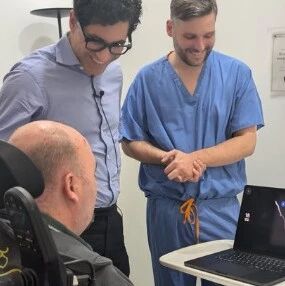
脑机接口板块,掀涨停潮
财联社· 2026-01-05 03:14
Core Viewpoint - The brain-computer interface (BCI) sector is experiencing significant activity and potential growth, driven by technological advancements and policy support, with expectations for commercialization by 2026 [1][4]. Group 1: Market Activity - On the first trading day of 2026, BCI-related stocks showed strong performance, with companies like Beiyikang and Sanbo Brain Science reaching their daily price limits [1]. - The market is expected to benefit from Neuralink's anticipated large-scale production and automated surgical solutions, which could enhance efficiency and reduce costs [1][3]. Group 2: Technological Developments - Neuralink plans to begin large-scale production of BCI devices in 2026, utilizing a new surgical method that avoids traditional invasive techniques [1][3]. - Merge Labs, co-founded by OpenAI's CEO, is focusing on non-invasive ultrasound technology to interpret brain signals without implanting electrodes [3]. Group 3: Industry Growth Projections - The global BCI market is projected to grow to approximately $12.4 billion by 2034, with a compound annual growth rate (CAGR) of 17% from 2025 to 2034 [4]. - The BCI industry is positioned for rapid expansion due to technological breakthroughs, supportive policies, and the integration of robotics [4][5]. Group 4: Competitive Landscape - The BCI field is highly competitive, with various companies engaged in clinical trials and product development across invasive, semi-invasive, and non-invasive categories [5][6]. - Domestic companies like Brain Tiger Technology are making significant advancements, while others are developing products for medical monitoring and rehabilitation [6]. Group 5: Policy and Regulatory Environment - Recent policies are clarifying standards for BCI technologies, facilitating quicker integration into healthcare systems once approved [6]. - The establishment of industry standards by the National Medical Products Administration is expected to enhance regulatory compliance and market entry for BCI products [6]. Group 6: Long-term Outlook - There is a positive long-term outlook for leading companies that possess technological and regulatory advantages, as well as those that can leverage existing resources to accelerate BCI development [7].
VC开抢深圳硬件项目
投资界· 2025-12-09 08:40
Core Viewpoint - The article highlights the resurgence of hardware startups in Shenzhen, particularly in the context of "hardware + going global," showcasing a vibrant investment scene and innovative products in various sectors such as robotics, sleep health, and smart wearables [2][10]. Group 1: Event Overview - The "X-Day" event held on February 4 in Shenzhen attracted significant attention, with six startups presenting their innovations to a packed audience of investors [2]. - The participating companies included Benmo Technology, Subrain Technology, Dream Innovation, Natural AI, Laimu Technology, and Ruiman Intelligent, covering cutting-edge fields like intelligent robotics and smart apparel [2]. Group 2: Company Highlights - Benmo Technology, founded in 2020, has completed Series C financing and launched the world's first detachable dual-person robot, gaining substantial media attention [4]. - Subrain Technology, established in October 2023, focuses on an intelligent sleep aid device that reduces average sleep onset time by 20 to 30 minutes, having completed three rounds of financing in under two months [4]. - Dream Innovation's core product, the smart sleep lamp "SunflowerX," aims to facilitate effortless sleep and natural awakening, and has secured seed funding from Xbot Park in Chongqing [5]. - Natural AI introduced a full-domain AI temperature control garment, aiming to integrate AI into wearable technology, and is set to deliver its first batch of B-end products [6]. - Laimu Technology, which has completed several rounds of financing totaling hundreds of millions, focuses on the overseas market potential for its lawn mowing robots [6]. - Ruiman Intelligent, established in 2017, specializes in ultra-lightweight humanoid robotic arms and emphasizes the necessity of international expansion for Chinese intelligent companies [7]. Group 3: Investment Landscape - The event showcased a strong presence of venture capital firms, indicating a booming interest in hardware projects [9]. - The trend of hardware companies going global is driven by successful examples like DJI and others, which have provided impressive returns to investors [10]. - The article notes that new-generation hardware products are inherently designed for international markets, leveraging Shenzhen's supply chain advantages [10]. Group 4: Future Prospects - The "X-Day" event is set to continue, with a focus on innovative early-stage projects in frontier sectors, aiming to identify potential new unicorns [13]. - The article emphasizes a shift in perception of Chinese products from "Made in China" to "Created by China," reflecting advancements in technology and innovation [13].

脑机接口研究报告及观点更新:打破人机界限,意念操控走进现实
2025-09-28 14:57
Summary of Brain-Computer Interface (BCI) Industry Research Report Industry Overview - The brain-computer interface (BCI) industry in China is benefiting from multi-faceted support, including technological innovations from various enterprises and research institutions, as well as policy support from government bodies such as the Ministry of Industry and Information Technology, the National Healthcare Security Administration, and the National Medical Products Administration, which is expected to accelerate clinical trials and approval processes [1][2][11]. Key Points and Arguments - **Classification of BCI Technologies**: BCI technologies are categorized into four types based on hardware access methods: invasive, semi-invasive, non-invasive, and interventional, each suitable for different levels of neurological disorders and rehabilitation [1][4]. - **Market Growth**: The domestic BCI market is projected to have a compound annual growth rate (CAGR) of 13.5% over the next five years, although challenges such as unclear product forms, clinical risks, and ethical issues may hinder market scaling [1][6]. - **Medical Applications**: BCI technology is primarily applied in healthcare, focusing on the rehabilitation of motor, language, visual, and cognitive impairments, with motor function rehabilitation being the most clinically advanced area [1][8]. - **Technological Innovations**: Key advancements include the shift from rigid to flexible electrodes, which enhance biocompatibility and reduce trauma to brain tissue, as well as breakthroughs in chip throughput and decoding algorithms [9][10]. Company Insights - **Meihua Medical Company**: The company has rapidly expanded its business from supplying home respiratory device components to entering the implanted BCI device market, leveraging its expertise in cochlear implants and CGM insulin pens. It is expected to see accelerated revenue growth in the upcoming quarters [5][19]. - **Notable Companies in the BCI Industry**: Key players include JieTi Medical, Tiger Technology, New Intelligence, and BoRuiKang, each involved in various aspects of the BCI supply chain, from electrode chip production to clinical trials [12]. Challenges and Risks - **Market Penetration Issues**: The penetration rate of BCI products is affected by high costs and the risks associated with surgical procedures, leading to cautious attitudes among patients and families [7]. - **Regulatory and Ethical Concerns**: The approval timeline for invasive and semi-invasive products may be delayed due to clinical risks and ethical considerations, impacting market growth [6]. Policy Environment - **Government Support**: A series of policies have been introduced to support the BCI industry, including healthcare reimbursement for innovative medical consumables and the establishment of industry standards, which are expected to catalyze market growth [11][18]. Future Outlook - The BCI industry is poised for significant growth, driven by technological advancements, supportive policies, and increasing applications in both medical and non-medical fields, including gaming and robotics [2][3].
脑机接口医疗应用前景广阔,医保前瞻性立项助力行业发展
Tai Ping Yang· 2025-03-13 05:50
Investment Rating - The industry is rated as "Positive," with expectations that the overall return will exceed the CSI 300 Index by more than 5% in the next six months [8] Core Insights - The medical application of brain-computer interface (BCI) technology has a promising future, with the National Healthcare Security Administration (NHSA) establishing pricing projects for BCI technologies, paving the way for clinical applications once the technology matures [1][7] - The global potential market size for BCI in the medical field is estimated to reach between $40 billion and $145 billion by 2030-2040, with serious medical applications projected to be between $15 billion and $85 billion, and consumer medical applications between $25 billion and $60 billion [2] - Regulatory frameworks for BCI in China are maturing, with significant government support and initiatives, including the inclusion of "brain science and brain-like research" in the national key technology projects [3] Summary by Sections Industry Overview - BCI technology has made significant advancements, transitioning from laboratory research to market applications, indicating a broad development outlook [2] - The NHSA's recent guidelines for BCI pricing signify a structured approach to integrating BCI technologies into healthcare [1] Product Development - Invasive BCI products are currently in clinical stages, with companies like Neuralink conducting long-term clinical trials aimed at restoring motor functions in paralyzed patients [4] - Non-invasive BCI products are already available in the market, with applications in consumer and rehabilitation settings, such as smart sleep devices and anesthesia monitoring [4] Related Companies - Key companies in the BCI sector include Chengyitong, Xiangyu Medical, Innovation Medical, and Aipeng Medical, which are actively developing and applying BCI technologies in various medical fields [5]