智能投顾服务

Search documents
2025全球资管深研报告:全球智能投顾全景图
Sou Hu Cai Jing· 2026-01-04 13:39
Core Insights - The rise of robo-advisors is driven by the integration of financial technology and traditional wealth management, offering low-cost, accessible, and user-friendly investment services, thereby democratizing finance [1][7] - The global robo-advisory market is expected to grow significantly, reaching over $100 billion by 2033, with the U.S. holding a dominant position [2][18] - The business model of robo-advisors has evolved from serving individual clients to a platform-based and ecosystem-oriented approach, diversifying revenue streams [3][4] Market Overview - The global robo-advisory market is projected to grow from $7.7 billion in 2023 to approximately $116.4 billion by 2033, with a compound annual growth rate (CAGR) of 31.2% from 2024 to 2033 [18] - The U.S. accounts for 81% of the global robo-advisory assets under management (AUM), with major players including Vanguard, Schwab, and Betterment [23][24] - The European market is smaller but shows potential, particularly in Germany, which has over 2 million robo-advisory users due to its unique ETF savings plan culture [25][28] Business Model Evolution - Robo-advisors have transitioned from a simple individual client model to a multi-faceted platform approach, including B2B services and diverse revenue models [3][4] - Revenue models have diversified from asset management fees to tiered subscription fees and technology-enabled service fees, reflecting a shift from scale expansion to value extraction [3][4] - Key competitive advantages for leading platforms include strong overall performance, superior digital experiences, and user-friendly interfaces [3][4] Investment Strategies - The industry is witnessing a nuanced debate between "active" and "passive" investment philosophies, with different platforms adopting varied strategies based on market understanding and client needs [3][4] - Some platforms adhere strictly to modern portfolio theory, while others incorporate active management elements or innovative techniques like smart beta to achieve excess returns [3][4] Future Outlook - The robo-advisory industry is moving away from rapid growth towards deeper integration and iteration, with ongoing consolidation expected [4] - The application of artificial intelligence, particularly large language models, is anticipated to enhance the personalization of robo-advisory services, transforming them into intelligent financial partners [4][7] - The industry is likely to see a shift from mere algorithmic recommendations to more human-like, personalized financial advisory interactions [4][7]


全球资管深研系列(四):全球智能投顾全景图
Guoxin Securities· 2025-12-25 15:25
Core Insights - The rise of robo-advisors is driven by the integration of financial technology and traditional wealth management, offering low costs, high accessibility, and convenience. Post-global financial crisis, stricter regulations and technological advancements have facilitated the emergence of non-bank fintech companies, with robo-advisors serving as a cost-effective alternative to human advisors. They utilize algorithms to automatically construct investment portfolios, significantly reducing advisory fees and breaking geographical barriers, allowing investors to access professional services anytime and anywhere. Robo-advisors particularly attract low-income groups and younger users by minimizing trading costs through passive investment strategies, enhancing capital market participation for long-term goals like retirement and emergency savings. The evolution of robo-advisors has progressed through four stages: early online questionnaires and static advice, full automation and passive management, establishment of hybrid models, and AI-driven hyper-personalization and intelligent agents [2][9][10]. - The global robo-advisory market is experiencing rapid expansion, with the U.S. maintaining a dominant position while emerging markets like China show significant potential for growth. The market size is projected to increase from $7.7 billion in 2023 to approximately $116.4 billion by 2033, with the U.S. accounting for 81% of global assets under management (AUM). The competitive landscape in the U.S. has formed a "three giants and many strong" scenario, with Vanguard, Schwab, and Fidelity as the major players, while independent unicorns like Betterment and Wealthfront continue to thrive. In Europe, the market share remains relatively small, with key players categorized into pan-European super platforms, market consolidators, and regional champions. China's robo-advisory market is expected to exceed $2 billion by 2028 and $4 billion by 2030, contributing to the development of passive investment strategies and long-term capital market participation [2][15][21][25][30]. - The business model of robo-advisors is evolving towards platformization and ecosystem integration, with revenue models shifting from single asset management fees to layered charging and technology empowerment. Robo-advisors have expanded from B2C to B2B and ecosystem models, exemplified by Ant Wealth's scenario collaboration for traffic conversion. Revenue diversification includes pure digital models relying on AUM management fees, tiered subscription models offering premium services, B2B tool empowerment models generating profits through technology output, and ecosystem platform models depending on product distribution commissions. This evolution highlights the industry's transition from scale expansion to value extraction [2][35][39]. - The core competitive advantages of leading robo-advisors include comprehensive strength, digital experience, and user-friendliness for beginners. Platforms with strong comprehensive capabilities often excel in long-term performance and service quality, while the best digital planning platforms possess robust personal asset aggregation tools that create automated financial management loops. User-friendly platforms may excel in brand trust or community ecosystem development. In the competitive landscape, Betterment and Wealthfront not only survive but thrive, embodying the pure fintech spirit by creating value through technological innovation and exceptional user experience [2][39][50]. - The development trend of robo-advisors is characterized by a philosophical debate between "active" and "passive" investment strategies. Analyzing the portfolio data of various robo-advisors reveals a shift in the industry towards this philosophical contention, categorized into MPT believers (Vanguard & Betterment), potential active managers (SoFi & Axos), and tech-driven alpha harvesters (Wealthfront) [2][11]. - Looking ahead, the industry is poised for significant restructuring and a new journey. By 2025, the robo-advisory sector will have transitioned from rapid growth to a phase of integration and iteration. Three major trends are expected to continue: industry consolidation, a shift from scale to sustainable profitability, and AI reshaping robo-advisory services. The complete withdrawal of bank-affiliated robo-advisors reflects ongoing industry consolidation, as the mismatch between customer acquisition costs and lifetime value necessitates substantial new scale to cover technology and compliance costs. Independent platforms are now focusing on sustainable profitability rather than blind scale expansion, as exemplified by Robinhood's acquisition of AI financial planning company Pluto and the launch of its own robo-advisory service, which aims to provide genuinely personalized financial consulting through large language models [2][15][30].

中国智能投顾产业:现状、问题与对策|财富与资管
清华金融评论· 2025-11-15 04:45
Core Viewpoint - The development of China's smart investment advisory industry is essential for better meeting residents' wealth management needs and facilitating long-term capital market investments, highlighting the necessity of addressing current obstacles to its growth [2][3]. Group 1: Necessity for Development - The application of AI large model technology in the financial services industry has accelerated, with smart investment advisory services becoming a key focus area [3]. - The demand for professional wealth management services among Chinese residents is rapidly increasing, with smart investment advisory serving as a crucial vehicle for this [5][6]. - China's economic context, including slowing growth, aging population, and urbanization challenges, is shifting wealth growth drivers from real estate to financial assets [6][7]. Group 2: Challenges and Obstacles - The current legal framework in China restricts full discretionary authority in investment advisory services, primarily to protect investors, which reflects concerns about the implementation of fiduciary duties [3][16]. - There is a lack of clarity regarding responsibility among key stakeholders in the smart investment advisory process, leading to potential gaps in investor protection [16][17]. - The confidentiality requirements and limitations in algorithm design pose significant challenges, as the subjective nature of algorithm optimization and lack of transparency can undermine investor trust [17]. Group 3: Market Growth and Trends - The global smart investment advisory market has seen rapid growth in assets under management (AUM), revenue, and client base, indicating a strong trend towards digital investment solutions [6]. - By 2024, the proportion of financial assets held by Chinese residents is projected to reach 47.6%, reflecting a growing inclination towards financial products [7]. - The diversification of financial products available to residents has increased, complicating the investment landscape and intensifying the demand for specialized wealth management services [8][10].

九方智投控股携手EX.IO、方德证券,共筑香港数字金融新生态
Zhi Tong Cai Jing· 2025-09-23 09:39
Core Insights - The strategic investment by JF SmartTrade, a wholly-owned subsidiary of Jiufang Zhitu Holdings, in EX.IO marks a significant step in enhancing the company's overseas digital asset business and establishing a comprehensive on-chain financial service system [3] - The collaboration between Jiufang Zhitu Holdings, EX.IO, and Fangde Securities aims to leverage their respective strengths in the digital finance sector, creating an integrated service loop covering digital asset issuance, trading, custody, and advisory [3][4] Group 1: Strategic Investment and Collaboration - Jiufang Zhitu Holdings has completed a strategic investment in EX.IO, a leading global Web3 innovation group, to deepen its overseas digital asset business [3] - EX.IO operates a compliant digital asset trading platform that received an operational license from the Hong Kong Securities and Futures Commission (SFC) in December 2024 [3] - Fangde Securities has signed a strategic cooperation agreement with EX.IO to jointly explore opportunities in the Hong Kong digital asset market, leveraging their licensing resources and market experience [4][6] Group 2: Market Context and Future Prospects - The collaboration comes in the context of Hong Kong's accelerating development of a robust digital asset ecosystem, as highlighted by the recent release of the "Hong Kong Digital Asset Development Policy Declaration 2.0" [7] - In the first half of 2025, the total trading volume of bank-related digital asset products and tokenized assets in Hong Kong reached HKD 26.1 billion, a 233% increase compared to the same period last year [7] - The partnership is expected to create a strong ecological complementarity among the three parties, enhancing their capabilities in providing comprehensive and diverse investment experiences for clients [6][7]

九方智投控股(09636)携手EX.IO、方德证券,共筑香港数字金融新生态
智通财经网· 2025-09-23 09:32
Core Insights - The strategic investment by JF SmartTrade in EX.IO marks a significant step for 九方智投控股 in enhancing its overseas digital asset business and establishing a comprehensive on-chain financial service system [3] - The collaboration between 九方智投控股, EX.IO, and 方德证券 aims to leverage their respective strengths to create an integrated service ecosystem in the digital finance sector [4][8] Group 1: Strategic Investment and Collaboration - 九方智投控股's full acquisition of JF SmartTrade for strategic investment in EX.IO is a key move to deepen its international digital asset operations [3] - EX.IO is recognized as a leading entity connecting traditional finance (Web2) with the Web3 ecosystem, providing compliant and secure financial solutions [3] - The partnership will enable 九方智投控股 to quickly enter the compliant digital asset market in Hong Kong and abroad, supported by necessary licenses and compliance [3] Group 2: Market Opportunities and Growth - 方德证券 and EX.IO have signed a strategic cooperation agreement to capitalize on the growth opportunities in the Hong Kong digital asset market [4] - 方德证券 plans to upgrade its licenses to offer digital asset trading and investment consulting services, transitioning from an internet broker to a tokenized investment bank [7] - The collaboration is expected to create a robust ecosystem combining exchange, brokerage, and advisory services, enhancing comprehensive on-chain financial service capabilities [7][8] Group 3: Industry Context and Future Outlook - The recent release of the "Hong Kong Digital Asset Development Policy Declaration 2.0" indicates a rapid development of a regulated and diverse digital asset ecosystem in Hong Kong [8] - In the first half of 2025, the total trading volume of bank-related digital asset products and tokenized assets reached HKD 26.1 billion, a 233% increase compared to the same period last year [8] - The collaboration among the three companies is seen as a model for industry high-quality development, driving the sector towards a more professional and integrated future [8]

研判2025!中国智能投顾行业产业链、行业现状及发展趋势分析:金融科技赋能普惠新生态,行业乘技术东风进入爆发期[图]
Chan Ye Xin Xi Wang· 2025-08-20 01:27
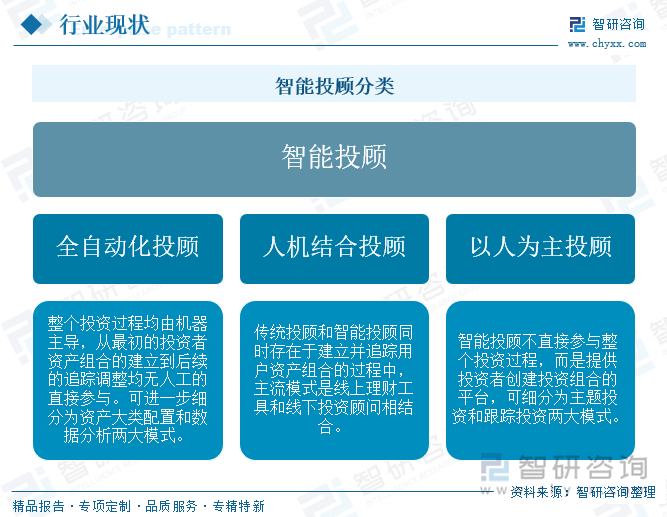
Core Insights - The rapid development of financial technology has led to the rise of robo-advisors, with global assets under management reaching $1.80 trillion in 2024, a year-on-year increase of 31.16% [1][8] - Traditional advisory models are costly and rely heavily on individual advisors' expertise, making them less accessible to small and medium investors, while robo-advisors leverage AI and big data to provide automated, personalized investment strategies [1][8] - The Chinese market for robo-advisors is also growing, with assets under management projected to reach 190.29 billion yuan in 2024, reflecting a year-on-year growth of 35.09% [10] Industry Overview - Robo-advisors utilize big data analysis, quantitative models, and algorithms to provide tailored asset allocation suggestions based on individual risk and return preferences, automating the investment process [2] - The industry is categorized into three service models: fully automated, hybrid (human-machine), and human-led advisory [2] Industry Value Chain - The upstream of the robo-advisory industry includes resources such as chips, financial data, user data, computational power, storage, and machine learning algorithms [4] - The midstream focuses on the development and operation of robo-advisory platforms, while the downstream involves direct applications for individual and institutional investors [4] Market Dynamics - In 2024, the number of new individual investors in China reached 12.72 million, a growth of 7.04%, with total investors reaching 236 million, up 5.69% [6] - The Chinese capital market is enhancing its attractiveness through reforms and expanding cross-border investment channels, leading to a record net purchase of U.S. stocks exceeding 500 billion yuan [6] - Platforms like Ant Wealth and Tencent's investment services are leveraging technology to attract users, with Ant Wealth's "Help You Invest" service reaching over 50 million users and a 65% reinvestment rate [6] Key Companies - Ant Group's "Help You Invest" service has over 50 million users, with a 65% reinvestment rate, and a significant R&D investment of 234.5 billion yuan in 2024 [16] - Huatai Securities reported an asset management scale of 556.3 billion yuan in 2024, with a 17% year-on-year growth [16] - Traditional financial institutions are also entering the robo-advisory space, with platforms like "Mojo Smart Investment" from China Merchants Bank providing comprehensive wealth management services [14] Industry Trends - The industry is expected to undergo deeper intelligent upgrades driven by advancements in AI, big data, and blockchain technologies, enhancing the precision and personalization of investment advice [20] - Service models are becoming more diversified and personalized, catering to individual investor profiles and preferences [21][22] - Regulatory frameworks are anticipated to tighten, ensuring compliance and protecting investor interests, with a focus on risk control and data security [23]


中金:百万亿级规模赛道是如何形成的?——美国买方投顾行业发展实践
中金点睛· 2025-07-01 23:49
Core Viewpoint - The article emphasizes the importance of enhancing the investor experience in public funds as a key goal in the regulatory framework, highlighting the buyer advisory business as a crucial element for the development of China's asset management industry, drawing lessons from the mature U.S. advisory market [1][2]. Industry Market - The U.S. advisory industry has seen robust growth driven by increasing household assets, rising pension management needs, and a growing number of public fund products, leading to a strong demand for advisory services [2][10]. - The number of advisory firms has increased from over 6,500 in 2000 to more than 21,000 by 2024, with SEC-registered advisory firms reaching 15,906 by the end of 2024 [10][11]. Business Development - The client base has expanded significantly, with individual clients growing from fewer than 4.54 million in 2000 to over 58 million by 2024, reflecting a compound annual growth rate of 11.2%, compared to 3.0% for institutional clients [3][24]. - The primary business models include portfolio management and financial planning, with a growing trend towards advisory recommendations and pension consulting [3][29]. - Fee structures are predominantly based on assets under management, performance-based fees, hourly charges, and fixed service fees, with commission-based fees declining due to competitive pressures [3][32]. Investment Behavior - Equity investments (listed stocks and ETFs) are the most significant asset class in advisory portfolios, followed by fund assets, which have been increasing in proportion [4][35]. - The rise of robo-advisors has gained attention, with a mixed model of "human + technology" being favored over purely automated approaches [4][37]. Competitive Landscape - The competitive landscape has evolved, with a clear establishment of leading firms, while competition remains fierce among mid-tier firms [4][43]. - The top 10 advisory firms have increased their market share from 16% in 2003 to 24.2% by 2024, indicating a consolidation trend in the industry [43][45]. Case Studies of Leading Advisory Firms - Vanguard Advisers focuses on individual clients, combining traditional and digital advisory services, managing over $300 billion by the end of 2024 [51]. - Betterment, established in 2009, has become a leading robo-advisor with a management scale of $56.4 billion, emphasizing low investment thresholds and a diverse service offering [53][54].