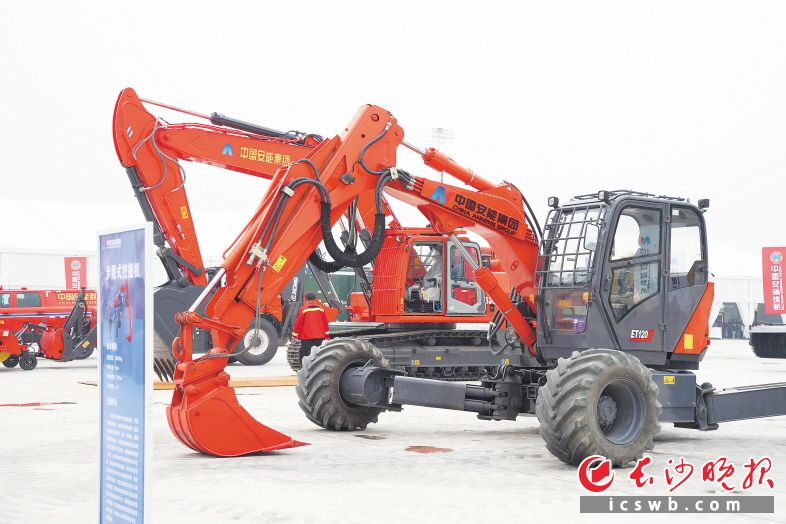
智能挖掘机

Search documents
从基础设施到应用场景,湖南“人工智能+”如何发力?
Xin Lang Cai Jing· 2026-01-11 13:08
Group 1 - The core focus of the "Artificial Intelligence +" initiative in Hunan is to strengthen the computing power infrastructure, which is essential for the growth of the AI industry [1][2] - The National Supercomputing Center in Changsha plays a pivotal role in providing computing power and integrated solutions for AI applications, boasting a high-performance computing capability of 20 exaflops [1][2] - Hunan's advantages in AI development include a strong computing foundation, a large population, and rich application scenarios in sectors like healthcare, agriculture, and autonomous driving [2] Group 2 - The "embodied intelligence" sector is gaining traction, with Hunan positioned to leverage its historical strengths in AI, including the establishment of the first AI society in China and the development of the first humanoid robot [5][6] - Companies like Super Robot are rapidly growing in the smart healthcare and intelligent operation sectors, with projected revenues exceeding 100 million yuan by 2025 and potentially doubling in 2026 [5][6] - The focus on technological research and innovation in smart perception, precise control, and collective intelligence is crucial for the future of the AI industry in Hunan [6] Group 3 - The "Artificial Intelligence +" action plan emphasizes advanced manufacturing as a key area for development, promoting AI-enabled industrial applications and the establishment of smart factories [9] - Companies like Zoomlion are leading the way in smart manufacturing, utilizing nearly 3,000 intelligent robots and 10,000 algorithms to achieve a high level of AI application in their operations [9] - The integration of AI with manufacturing is expected to create new productive forces and drive the transformation and upgrading of the manufacturing industry [10] Group 4 - The overall landscape of "Artificial Intelligence +" in Hunan is characterized by a comprehensive approach that spans from foundational support to top-level applications, showcasing a robust industrial base and continuous talent investment [13] - Hunan is poised to harness strong momentum towards a future driven by intelligent development, aiming for high-quality growth through AI integration [13]


2025全国新一线城市排名:南京第3,天津第7,厦门入围
Sou Hu Cai Jing· 2025-05-30 05:38
Core Insights - China's economic development has undergone significant transformations over the decades, evolving from early reform policies to becoming a global manufacturing hub and now focusing on innovation and dual circulation strategies [1] Group 1: New First-Tier Cities - The latest "National New First-Tier Cities Comprehensive Strength Ranking" for 2025 highlights cities like Hangzhou, Chengdu, Nanjing, and Wuhan as leaders, with Nanjing ranking third due to its historical and technological strengths [3][5] - Nanjing's integrated circuit industry is projected to exceed 200 billion yuan by 2025, showcasing its transformation into a hub for innovation [3] - Xiamen has made a notable entry into the new first-tier list at nineteenth place, driven by its "BRICS Innovation Base" and "Maritime Silk Road Central Legal Zone," with actual foreign investment expected to grow by 23% by 2025 [7] Group 2: Economic Shifts in Northern Cities - Tianjin maintains its seventh position by shifting its development focus from traditional heavy industry to precision services, with container throughput expected to surpass 22 million TEUs by 2025 [5][7] - The Binhai New Area is attracting financial institutions, with financing leasing business accounting for one-third of the national total, although it still faces challenges from its traditional petrochemical sector [7] - Challenges persist for cities like Qingdao and Xi'an, with Qingdao's marine economy growth slowing to 4.2% and Xi'an's semiconductor industry facing talent outflow, leading to a 7% decrease in integrated circuit design firms by 2025 [12] Group 3: Central and Southern City Strengths - Wuhan and Changsha demonstrate strong manufacturing capabilities, with Wuhan's high-tech enterprises expected to exceed 15,000 by 2025 and Changsha's construction machinery output accounting for 8% of the global market [14] - The competition between cities like Hangzhou and Chengdu reflects a broader struggle between digital economy and comprehensive hub development [9][10] Group 4: Future Economic Landscape - The 2025 rankings indicate a shift from a single-pole advancement to multi-center collaboration, emphasizing the importance of industrial depth over mere scale [15] - Future urban competition will focus on innovation density, ecological livability, and global resource allocation capabilities, determining which cities will thrive in the next economic cycle [15]

湖南应急装备创新成果集中亮相,产业全国领先
Chang Sha Wan Bao· 2025-05-15 23:21
Core Viewpoint - The fourth Changsha International Engineering Machinery Exhibition highlights the importance of emergency equipment in disaster prevention, mitigation, rescue, and recovery, showcasing advanced technologies and innovations from leading companies in the sector [1][2]. Group 1: Event Overview - The exhibition features a focus on the entire chain of natural disaster prevention and emergency rescue, with numerous leading emergency equipment companies demonstrating their capabilities in high-end equipment development and smart technology applications [1]. - A total of 80 companies, including SANY Group, Zoomlion, Shanhe Intelligent, and China Railway Construction Heavy Industry, participated, showcasing innovative products that represent cutting-edge technology and development directions in the emergency equipment field [1]. Group 2: Technological Innovations - Shanhe Xinghang's tethered drone system can maintain a precision of 20 meters at a height of 200 meters to suppress fire effectively, while China Railway Construction Heavy Industry's large-diameter horizontal rescue drilling machine addresses engineering collapse issues by quickly creating escape routes [2]. - The Changsha Tianyi Research Institute displayed commercial SAR satellite models, such as "Hai Si No. 1" and "Chao Hu No. 1," which utilize synthetic aperture radar to monitor ground deformation with millimeter-level precision, regardless of weather conditions [2]. Group 3: Industry Development - The emergency equipment industry in Hunan has rapidly developed, leveraging the province's strengths in engineering machinery, aerospace, and electronic information, positioning itself as a national leader with two national safety emergency industry demonstration bases [4]. - SANY Group has filled industry gaps with products like fire trucks and chemical detection vehicles, while Zoomlion offers a diverse range of emergency equipment across six categories, including fire rescue and geological disaster rescue [4]. - Shanhe Intelligent has developed a series of specialized intelligent emergency rescue equipment, and companies like Huaxun Emergency Equipment and Diwo Technology have emerged as leaders in the domestic mobile emergency drainage equipment sector [4].