智能营销解决方案

Search documents
众安信科连续三年荣登毕马威中国「金融科技企业双50榜单」
21世纪经济报道· 2026-03-10 10:26
Group 1 - The core viewpoint of the article highlights the recognition of ZhongAn Technology in the financial technology sector, as it has been listed in KPMG's "China Financial Technology Company Double 50 List" for the third consecutive year, indicating its sustained industry experience and technical strength [1] Group 2 - ZhongAn Technology provides two major AI solutions: intelligent marketing and intelligent operations, aimed at empowering financial enterprises to achieve business upgrades [4] - The intelligent marketing solution focuses on customer lifecycle management, integrating customer segmentation, strategy formulation, product matching, incentive operations, and multi-channel interactions into an executable end-to-end workflow [4] - The intelligent operations solution enhances decision-making, business management, research and development, and risk management efficiency through AI-driven capabilities, facilitating a transition from manual operations to intelligent management [4] Group 3 - The unique advantages of these solutions are built on ZhongAn Technology's self-developed cross-industry AI architecture, XK-Qi anAI, which integrates technology with enterprise workflows and ensures efficient operation of AI agents [5] - Qi anNexus transforms foundational AI capabilities into executable business solutions, leveraging over 800 self-developed AI agents and 40 AI super assistants to connect dispersed data and business processes within organizations [5] Group 4 - ZhongAn Technology's technical strength and commercial value have received continuous recognition from authoritative industry bodies, including being listed in various key reports and rankings related to AI technology and applications [7] - The successful implementation of AI solutions relies on a deep understanding of business logic, systematic responses to industry pain points, and ongoing service empowerment and ecosystem collaboration [7]

“老四”要上市!背后金主是它!
Sou Hu Cai Jing· 2026-01-12 13:44
Core Viewpoint - ZhongAn Xinke has submitted an IPO application to the Hong Kong Stock Exchange, with a latest valuation of 2.215 billion yuan, and has shown significant growth in gross margin [1][9]. Company Overview - ZhongAn Xinke, established in December 2021, is an enterprise-level AI solution provider focusing on intelligent marketing and operational management solutions [4]. - The company ranks fourth among enterprise-level AI solution providers in China with vertical large model capabilities, according to Frost & Sullivan [4]. Market Growth - The Chinese enterprise-level AI market has grown from 14.3 billion yuan in 2020 to an expected 47.2 billion yuan in 2024, with a compound annual growth rate (CAGR) of 34.8% [4]. - The vertical large model segment is projected to exceed 100 billion yuan by 2029 [4]. Financial Performance - Revenue for ZhongAn Xinke during the reporting period (2023, 2024, and the first nine months of 2025) was 226 million yuan, 309 million yuan, and 290 million yuan, respectively [4]. - Net profit for the same periods was 10.08 million yuan, 33.23 million yuan, and 31.65 million yuan [4]. Customer Growth - The number of customers served by ZhongAn Xinke increased from 88 at the end of 2023 to 338 by the end of September 2025, reflecting a CAGR of 63.1% [5]. - New customers are primarily concentrated in traditional industries such as agriculture and transportation [5]. Gross Margin Improvement - The gross margin of ZhongAn Xinke increased from 13.7% in 2023 to 27.2% in 2024, and further to 41% in the first three quarters of 2025 [5]. - The gross margin for intelligent marketing solutions surged from 4.6% in 2023 to 46.1% by September 2025, contributing significantly to overall performance [5]. Customer Concentration Risk - Despite customer growth, there is a concentration risk, with the top five customers contributing 74.7%, 62.7%, and 47.4% of total revenue in 2023, 2024, and September 2025, respectively [7]. - The largest customer, ZhongAn Group, accounted for 44.4%, 44.6%, and 23% of revenue during the same periods [7]. Shareholder Structure - ZhongAn Group, a major customer, is also a significant shareholder, holding 35.49% of ZhongAn Xinke, making it the second-largest shareholder [9]. - The founding team holds 38.93% of the shares through a holding platform and has signed a concerted action agreement [8]. - The company has raised a total of 492 million yuan in two rounds of financing, with the latest valuation reaching 2.215 billion yuan [9].


眾安信科(深圳)股份有限公司(H0287) - 申请版本(第一次呈交)
2026-01-04 16:00
香港聯合交易所有限公司與證券及期貨事務監察委員會對本申請版本的內容概不負責,對其準確性 或完整性亦不發表任何意見,並明確表示概不就因本申請版本全部或任何部分內容而產生或因倚賴 該等內容而引致的任何損失承擔任何責任。 Zhongan Information Technology (Shenzhen) Co., Ltd.* 眾 安 信 科( 深 圳 )股 份 有 限 公 司 (「本公司」) (於中華人民共和國境內註冊成立的股份有限公司) 的申請版本 警告 本申請版本乃根據香港聯合交易所有限公司(「聯交所」)及證券及期貨事務監察委員會(「證監會」)的 要求而刊發,僅用作提供資訊予香港公眾人士。 本申請版本為草擬本,其內所載資訊並不完整,亦可能會作出重大變動。 閣下閱覽本文件,即代 表 閣下知悉、接納並向本公司、本公司的保薦人、整體協調人、顧問或包銷團成員表示同意: 倘於適當時候向香港公眾人士提出要約或邀請,有意投資者務請僅依據與香港公司註冊處處長註冊 的本公司招股章程作出投資決定;招股章程的文本將於發售期內向公眾人士提供。 a) 本文件僅為向香港公眾人士提供有關本公司的資料,概無任何其他目的;投資者不應根據本文 件 ...
多年未披露关联方非经营性资金往来 浙文互联收监管警示函
Zheng Quan Ri Bao Wang· 2026-01-04 12:22
Core Viewpoint - Zhejiang Wen Internet Group Co., Ltd. received a warning letter from the Zhejiang Securities Regulatory Bureau for failing to disclose related party transactions involving loans to its subsidiary, Beijing Zhejiang Wen Internet Catering Co., Ltd. [1][2] Group 1: Regulatory Actions - The warning letter indicates that Zhejiang Wen Internet provided loans to its subsidiary over the years 2021 to 2024, totaling 1.6 million yuan, 3.37 million yuan, 2.19 million yuan, and 485,000 yuan respectively, without proper disclosure in annual reports [1][2] - The Zhejiang Securities Regulatory Bureau and the Shanghai Stock Exchange issued simultaneous warnings, emphasizing a "zero tolerance" policy towards information disclosure violations [2] Group 2: Corporate Governance Issues - The loans and lack of disclosure reflect weaknesses in the company's internal controls regarding related party identification and fund approval processes, indicating a need for improved governance [2][3] - The subsidiary, Zhejiang Wen Catering, was fully acquired by Zhejiang Wen Internet in January 2025 but was subsequently dissolved within ten months, raising concerns about the company's strategic decision-making [3] Group 3: Financial Performance - For the first three quarters of 2025, the company reported revenues of 5.605 billion yuan, a slight increase of 0.12%, while net profit attributable to shareholders decreased by 19.68% to 127 million yuan [3]

“人工智能+”战略加速落地慧博云通一季度营业收入17.43亿元,同比增长28.3%
Quan Jing Wang· 2025-04-28 04:19
Core Insights - The company, Huibo Yuntong, reported a strong revenue growth of 28.3% year-on-year in Q1 2024, achieving 1.743 billion yuan, continuing the high growth trend of 37.46% for the full year 2024 [1] - The company's growth is driven by its focus on software and information technology services, with all three main business segments showing double-digit growth [1] - Huibo Yuntong is actively expanding its AI and large model technology applications, particularly in the financial sector, establishing stable partnerships with major banks [2] - The company is increasing its R&D investment to maintain a technological edge, focusing on emerging technologies such as AI, AIoT, and cloud computing [3] - Despite short-term profit impacts from increased R&D spending, the strategic positioning in AI and fintech is expected to enhance profitability in the long run [4] Financial Performance - In Q1 2024, the software technology service revenue reached 1.074 billion yuan, growing by 16.70% [1] - The professional technical service revenue surged to 497 million yuan, marking a significant increase of 58.69% [1] - Revenue from products and solutions reached 148 million yuan, reflecting a growth of 32.39% [1] Strategic Initiatives - The company is implementing a "2+3" development strategy, focusing on TMT and finance sectors while enhancing capabilities in fintech, big data, and AI [1] - Huibo Yuntong aims to become an international, professional, and innovative comprehensive digital technology service provider [2] - The company has launched two stock incentive plans covering over 180 core employees, granting a total of 21.99 million shares to stabilize the core team and stimulate innovation [3] Market Positioning - The global generative AI market is projected to grow at a compound annual growth rate of 63.8%, reaching a market size of 284.2 billion USD by 2028, positioning Huibo Yuntong to benefit from this rapid growth [2] - The company has expanded its operations globally, establishing branches in over 20 domestic cities and various overseas regions, enhancing its market reach [3] - Huibo Yuntong plans to further invest in the financial sector and expand its capabilities through team acquisitions and mergers [3]
研判2025!中国银行业信息化建设与IT应用行业产业链、行业现状及重点企业分析:金融科技赋能转型,银行业IT市场蓬勃发展[图]
Chan Ye Xin Xi Wang· 2025-04-17 01:24
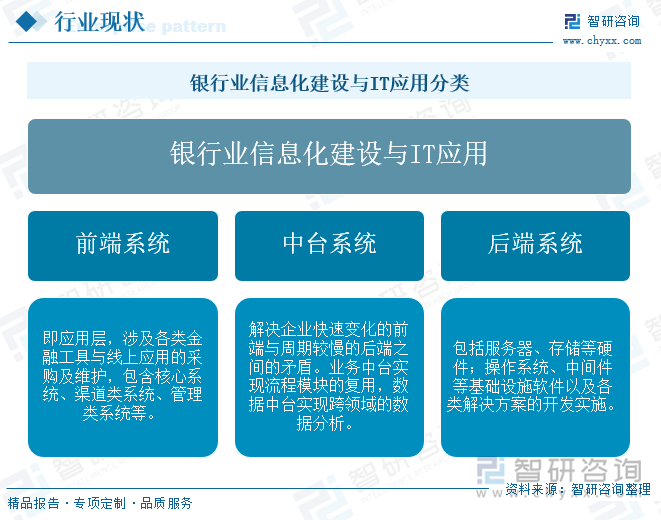
Core Viewpoint - The Chinese banking industry's information technology construction and application are rapidly developing, with a market size projected to reach 213.5 billion yuan in 2024, reflecting an 8.7% year-on-year growth [1][11]. Industry Overview - The banking information technology construction and application involve optimizing and innovating business processes, management structures, and customer services through extensive use of information technology [8]. - The market structure is primarily focused on business, channel, and management solutions, with key investment areas including core business systems, credit management systems, and risk management [11]. Industry Development History - The industry has evolved through five stages: 1. Electronic phase (1970s-1990s) where basic computer technology was introduced for simple accounting [4]. 2. Networking phase (1990s-2000s) where banks began to connect their systems for improved efficiency [4]. 3. Data centralization phase (2000-2010) focusing on unified data management across branches [5]. 4. Mature core system deployment phase (2010-2018) with the adoption of high-performance IT systems [5]. 5. Domestic system localization and digital transformation phase (2019-present) driven by national initiatives [6]. Industry Status - The industry is currently experiencing a shift towards digital and intelligent transformation, with significant growth in market size and investment in emerging solutions like data intelligence and smart marketing [11]. - The transition from centralized to distributed architecture is underway, with an accelerated pace of domestic substitution in IT systems [11]. Industry Trends - Distributed architecture and cloud-native technologies are becoming mainstream, enhancing flexibility and scalability in banking IT systems [18]. - There is a growing demand for intelligent and personalized services, driven by advancements in big data and artificial intelligence [19]. - Data sharing and privacy protection are critical issues, with privacy computing technologies gaining traction to ensure data security while enabling collaborative analysis [20]. Key Companies - Leading companies in the industry include Yuxin Technology, Shenzhou Information, and Hengsheng Electronics, which leverage their technological strengths and market positions to drive innovation [13][14]. - Yuxin Technology reported a revenue of 2.351 billion yuan in the first three quarters of 2024, a decrease of 23.05% year-on-year [14]. - Shenzhou Information achieved a revenue of 6.680 billion yuan in the same period, with a net profit decline of 235.96% [16].