
智能计算中心

Search documents
刚刚,5000亿科技巨头,终止重组!
Xin Lang Cai Jing· 2025-12-17 14:19
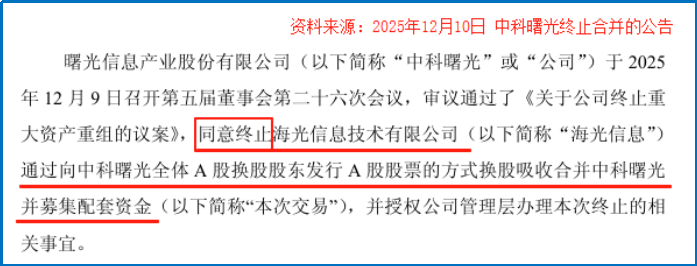
Core Viewpoint - The planned merger between Haiguang Information and Zhongke Shuguang, aimed at creating a comprehensive "chip-server-computing service" giant, has been halted due to significant changes in market conditions and the complexity of the transaction [4][21]. Group 1: Company Background - Haiguang Information, established in 2014, has Zhongke Shuguang as its largest shareholder, holding 27.96% of its shares as of September 30 [2][18]. - Haiguang focuses on CPU and DCU chip design, while Zhongke Shuguang specializes in server manufacturing and cloud computing services, with over 2 million cloud platform users [3][19]. Group 2: Business Synergy - The merger was expected to allow Haiguang's chips to be deeply integrated with Zhongke Shuguang's server systems, reducing adaptation costs and accelerating product iteration [20]. - The combination was seen as a strong partnership in the context of increasing demand for AI computing and domestic alternatives [20]. Group 3: Reasons for Termination - The termination was attributed to the large scale of the transaction, the number of parties involved, and significant market changes since the merger was proposed, making the conditions for restructuring no longer viable [4][21]. - Both companies have committed to a "cooling-off period" of at least one month before planning any major asset restructuring [6][22]. Group 4: Financial Health and Strategic Focus - Zhongke Shuguang reported a healthy cash flow, with a cumulative net inflow of 6.834 billion from 2021 to 2024, indicating strong profitability and self-sufficiency [10][25]. - The termination of the merger allows both companies to focus on their core competencies without the distraction of integration challenges, with Haiguang needing to concentrate on chip development and Zhongke Shuguang on system integration [12][27]. Group 5: Market Opportunities - The current "new infrastructure" wave in China, with a total investment of 5.75 trillion planned for key projects by mid-2025, presents significant opportunities for Zhongke Shuguang as a major supplier of computing equipment [28][29]. - The reduction in sales expense ratio from 5.88% in 2024 to 5.51% in the first three quarters of 2025 indicates improved market expansion conditions for Zhongke Shuguang [13][31]. Group 6: Future Collaboration - Despite the merger's termination, both companies will continue to deepen their collaboration in system product applications, focusing on high-end computing and AI platforms [15][32]. - This approach allows them to maintain flexibility in technology paths and market responses while avoiding potential management redundancies from a merger [32].


李连成:构建现代化基础设施体系
Bei Jing Ri Bao Ke Hu Duan· 2025-12-15 02:17
Core Viewpoint - The 20th Central Committee's Fourth Plenary Session emphasizes the construction of a modern infrastructure system as a crucial task for building a modern industrial system and strengthening the foundation of the real economy [1] Group 1: Importance of Modern Infrastructure - Infrastructure plays a strategic, foundational, and leading role in national development, significantly impacting economic and social progress [2] - The Central Committee has consistently promoted the construction of a modern infrastructure system, recognizing its importance for long-term national development [2] - Infrastructure is essential for industrial development and serves as a critical component of the modern industrial system, reflecting a country's development level and civilization [2] Group 2: New Quality Productivity - The development of a modern infrastructure system is vital for nurturing new quality productivity, as historical innovations have relied on corresponding infrastructure [3] - Modern infrastructure networks facilitate the flow of technological innovation and production factors, enhancing efficiency and reducing costs [3] Group 3: Current Challenges - There are significant gaps in China's infrastructure compared to developed countries, with issues such as insufficient coordination and resilience in key areas [4] Group 4: Characteristics of Modern Infrastructure - The modern infrastructure system must be advanced, systematic, efficient, safe, and green, aligning with the needs of a socialist modernized nation [5] - Emphasis on integrating advanced technology with economic benefits is crucial for modern infrastructure development [5] Group 5: Transition to Systematic Planning - There is a need to shift from single-domain planning to cross-domain systematic planning for infrastructure, addressing imbalances and structural issues [6][7] Group 6: Development Direction - The development of modern infrastructure should focus on intelligence, greenness, and integration, leveraging new technologies for enhanced efficiency and sustainability [8] Group 7: Key Tasks for the 14th Five-Year Plan - The 14th Five-Year Plan aims to consolidate and expand China's infrastructure advantages, focusing on modernizing transportation and energy systems while enhancing safety and resilience [9][12] Group 8: New Energy Infrastructure - The new energy infrastructure will prioritize non-fossil energy sources and develop a new power system, aiming for a significant increase in clean energy supply [12] Group 9: Modern Water Network - The construction of a modern water network is essential for national public service systems, focusing on flood control and efficient water resource management [13] Group 10: Urban Infrastructure Resilience - Enhancing urban infrastructure to support both daily functions and emergency responses is critical for improving resilience and sustainability [14]
陕西开展2025年度国家绿色数据中心推荐工作
Zhong Guo Huan Jing Bao· 2025-08-08 11:06
Group 1 - The core initiative is to promote energy-saving and carbon reduction transformations in data centers across Shaanxi Province, with a focus on green development by recommending national green data centers for 2025 [1][2] - The recommendation process involves six sectors: industry, information communication, energy, internet, finance, and public institutions, adhering to the 2025 National Green Data Center Evaluation Index System [1] - Recommended data centers must meet specific criteria, including independent legal status, clear property rights, stable operation for over one year, and compliance with national green infrastructure development plans [1] Group 2 - Data centers constructed after 2022 should ideally be located within national integrated computing network hubs and designated areas for computing and electricity coordination [1] - The minimum scale for data centers is set at 3,000 standard racks, with a rack utilization rate of no less than 60%, and computing resource usage rates should be industry-leading, aiming for at least a secondary level in the Green Data Center Evaluation [1] - The self-evaluation process for participating units includes creating a self-evaluation report based on the 2025 National Green Data Center Evaluation Index System, with local authorities responsible for reviewing and recommending submissions [2]