
联邦基金利率

Search documents
美联储观察-2026 年 3 月FOMC会议快速解读:不确定性上升-Federal Reserve Monitor-March FOMC Quick Reaction Uncertainty has risen
2026-03-19 02:36
Summary of Key Points from the March FOMC Quick Reaction Industry Overview - The document pertains to the Federal Reserve's monetary policy and economic projections, specifically focusing on the U.S. economy and its implications for financial markets. Core Insights and Arguments - The Federal Reserve maintained the target fed funds range at 3.5% to 3.75%, with only one dissenting vote, contrary to expectations of three dissenters [3][4] - The median FOMC member anticipates one rate cut this year and another next year, reflecting a "look through" approach to rising oil prices [3][6] - Economic risks are skewed towards slower growth, higher inflation, and increased unemployment, indicating a cautious outlook [7] - The Fed's Summary of Economic Projections (SEPs) shows an upward revision in GDP growth by 10 basis points for this year and 30 basis points for next year, while the unemployment rate remains unchanged for this year but is projected to rise by 10 basis points next year [5][10] - Headline PCE inflation is expected to increase by 30 basis points this year and 10 basis points next year, while core goods inflation is projected to rise by 20 basis points this year and 10 basis points next year [5][10] Additional Important Details - The Fed's statement removed previous language indicating stabilization in the unemployment rate, opting for more neutral wording [4] - The distribution of risks regarding growth, inflation, and unemployment suggests a significant concern over potential economic downturns [7][8] - The press conference is expected to address rising uncertainty, the impact of oil shocks, and the Fed's readiness to adapt monetary policy to ongoing developments [8] - The SEPs indicate that long-term growth projections have been revised upward, possibly in response to improved productivity data [3][10] Economic Projections Summary - **Real GDP Growth**: Revised to 2.4% for 2026, up from 2.3% [10] - **Unemployment Rate**: Projected at 4.4% for 2026, unchanged from previous estimates [10] - **Headline PCE Inflation**: Increased to 2.7% for 2026, up from 2.4% [10] - **Core PCE Inflation**: Revised to 2.7% for 2026, up from 2.5% [10] This summary encapsulates the key points from the Federal Reserve's recent meeting and its implications for the U.S. economy and financial markets.

FOMC维持联邦基金利率不变;2026-2027 年点阵图中位数均维持降息一次预期;经济预测摘要显示潜在 GDP 上调- Leaves Fed Funds Rate Unchanged; Median Dot Unchanged at One Cut Each in 2026 and 2027; SEP Shows Higher Potential GDP
2026-03-19 02:36
Summary of Key Points from the FOMC Meeting Industry Overview - The document pertains to the Federal Open Market Committee (FOMC) and its decisions regarding the federal funds rate, which is a critical aspect of U.S. monetary policy. Core Points and Arguments 1. **Fed Funds Rate Decision**: - The FOMC decided to keep the target range for the fed funds rate unchanged at 3.5-3.75% during its March meeting. Only Fed Governor Stephen Miran dissented, advocating for a 25 basis point cut instead [2][1]. 2. **Economic Projections**: - The median forecast in the Summary of Economic Projections (SEP) indicates one rate cut each in 2026 and 2027, which remains unchanged from the previous December forecast. Seven participants expect no cuts in 2026 [2][1]. - The longer-run fed funds rate forecast slightly increased from 3.0% to 3.125% [2][1]. 3. **Inflation Forecasts**: - The median SEP forecast shows an increase in headline PCE inflation by 0.3 percentage points to 2.7% in 2026 and by 0.1 percentage points to 2.2% in 2027. Core PCE inflation is also projected to rise by 0.2 percentage points to 2.7% in 2026 and by 0.1 percentage points to 2.2% in 2027 [3][1]. 4. **GDP Growth Projections**: - Real GDP growth forecasts have been upgraded across the board, with a small increase of 0.1 percentage points to 2.4% for Q4/Q4 growth in 2026. Larger upgrades include 0.3 percentage points to 2.3% in 2027 and 0.2 percentage points to 2.1% in 2028. The longer-run real GDP growth forecast increased by 0.2 percentage points to 2.0% [3][1]. 5. **Unemployment Rate Forecast**: - The median unemployment rate forecast remains unchanged at 4.4% for 2026, with a slight increase to 4.3% in 2027. The forecast for 2028 and the longer run remains at 4.2% [3][1]. Additional Important Information - The implications of developments in the Middle East for the U.S. economy were noted as uncertain in the post-meeting statement [2][1]. - The document includes contact information for various analysts at Goldman Sachs, indicating the involvement of multiple professionals in the analysis and reporting of the FOMC meeting outcomes [4][1]. This summary encapsulates the critical aspects of the FOMC meeting and its implications for the U.S. economy, focusing on monetary policy, inflation, GDP growth, and unemployment forecasts.
贵金属:贵金属日报2026-03-19-20260319
Wu Kuang Qi Huo· 2026-03-19 01:15
1. Report Industry Investment Rating - Not provided in the report 2. Core Viewpoints of the Report - The sharp rise in oil prices under the backdrop of the US - Iran war has pushed up market inflation expectations and prompted the market to re - evaluate the US economy's ability to withstand energy shocks [4] - The FOMC meeting on March 18 decided to keep the federal funds rate target range at 3.5%–3.75%, with Director Milan voting against and advocating a 25 - basis - point rate cut [2][4] - The possibility of a rate hike in the next move has been mentioned in this meeting, and the dot - plot maintains the expectation of one rate cut each this year and next year, but the distribution is more hawkish than before, putting short - term pressure on precious metal prices [4] - Strategically, it is recommended to be cautiously bearish. The reference operating range for the main contract of Shanghai Gold is 1,000 - 1,160 yuan/gram, and for Shanghai Silver, it is 17,200 - 20,500 yuan/kilogram [4] 3. Summary by Related Catalogs 3.1 Market Quotes - Shanghai Gold fell 2.23% to 1,088.90 yuan/gram, and Shanghai Silver fell 1.88% to 19,170.00 yuan/kilogram. COMEX Gold fell 1.39% to 4,828.00 US dollars/ounce, and COMEX Silver fell 2.63% to 75.56 US dollars/ounce. The US 10 - year Treasury yield was 4.26%, and the US dollar index was 100.25 [2] 3.2 Fed Meeting Information - The Fed's March FOMC meeting decided to keep the federal funds rate target range at 3.5%–3.75%, with Director Milan voting against and advocating a 25 - basis - point rate cut [2][4] - SEP economic forecasts show that the median expected real GDP growth rate in the US this year is 2.4%, and 2.3% next year, an increase from the December forecast. The year - end unemployment rate remains at 4.4% and will decline slightly later. The median interest rate expectation shows that the year - end interest rate is 3.4% this year and 3.1% next year, the same as in December [2] - The impact of the Middle East geopolitical events on the US economy is uncertain, and high oil prices in the short term will push up overall inflation [2] 3.3 US Government's Response to Oil Prices - US Vice - President Vance and several core officials of the Trump administration will hold a closed - door meeting with oil industry executives on Thursday. Vance revealed that the government will announce multiple countermeasures in the next 24 to 48 hours regarding the current oil price issue. The meeting will be held at the American Petroleum Institute, and the council members of this industry organization will attend [3] 3.4 Key Data of Gold and Silver | | 2026 - 03 - 18 | 2026 - 03 - 17 | Day - on - Day Change | Day - on - Day Percentage Change | One - Year Historical Quantile | | --- | --- | --- | --- | --- | --- | | **COMEX Gold** | | | | | | | Closing Price (Active Contract) | N/A | 5,011.30 USD/ounce | N/A | N/A | N/A | | Trading Volume | N/A | 11.54 million lots | N/A | N/A | N/A | | Open Interest (CFTC Latest Report Period: Weekly) | 41.40 million lots | 40.98 million lots | Increase | 1.02% | 9.43% | | Inventory | 1,000 tons | 1,003 tons | Decrease | - 0.30% | 0.79% | | **LBMA Gold** | | | | | | | Closing Price | 5,016.80 USD/ounce | 4,994.85 USD/ounce | Increase | 0.44% | 90.23% | | Closing Price (Active Contract) | 1,113.52 yuan/gram | 1,116.20 yuan/gram | Decrease | - 0.24% | 88.75% | | Trading Volume | 21.58 million lots | 23.80 million lots | Decrease | - 9.34% | 5.62% | | **SHFE Gold** | | | | | | | Open Interest | 31.17 million lots | 31.03 million lots | Increase | 0.43% | 9.23% | | Inventory | 106.85 tons | 105.32 tons | Increase | 1.45% | 99.59% | | Precipitated Funds | 55.529 billion yuan | 55.423 billion yuan | Inflow | 0.19% | 70.08% | | Closing Price (Short - pays - long) | 1,111.73 | 1,115.48 | Decrease | - 0.34% | 89.15% | | **AuT + D** | | | | | | | Trading Volume | 47.38 tons | 39.20 tons | Increase | 20.87% | 43.77% | | Open Interest | 224.12 tons | 229.93 tons | Decrease | - 2.53% | 64.65% | | **COMEX Silver** | | | | | | | Closing Price (Active Contract) | N/A | 79.46 USD/ounce | N/A | N/A | N/A | | Open Interest (CFTC Latest Report Period: Weekly) | 11.55 million lots | 11.33 million lots | Increase | 1.88% | 0.81% | | Inventory | 10,422 tons | 10,510 tons | Decrease | - 0.83% | 0.79% | | **LBMA Silver** | | | | | | | Closing Price | 80.22 USD/ounce | 78.95 USD/ounce | Increase | 1.61% | 84.76% | | Closing Price (Active Contract) | 19,980.00 yuan/kilogram | 20,308.00 yuan/kilogram | Decrease | - 1.62% | 83.93% | | Trading Volume | 88.73 million lots | 88.84 million lots | Decrease | - 0.13% | 23.29% | | **SHFE Silver** | | | | | | | Open Interest | 47.85 million lots | 47.40 million lots | Increase | 0.95% | 0.80% | | Inventory | 346.92 tons | 353.76 tons | Decrease | - 1.93% | 6.82% | | Precipitated Funds | 25.812 billion yuan | 25.988 billion yuan | Decrease | - 0.68% | 67.21% | | Closing Price (Short - pays - long) | 19,966.00 | 20,330.00 | Outflow | - 1.79% | 85.94% | | **AgT + D** | | | | | | | Trading Volume | 1,668.56 tons | 172.51 tons | Increase | 867.21% | 97.99% | | Open Interest | 2,900.004 tons | 2,887.258 tons | Increase | 0.44% | 4.01% | [6] 3.5 ETF Holdings of Gold and Silver - **Gold**: The closing price in US dollars was N/A (previous day: 459.27), the holding volume was N/A tons (previous day: 1,069.56), the precipitated funds were N/A billion US dollars (previous day: 172.482), and the trading volume was N/A million shares (previous day: 761.01). The holdings of iShare in the US, GBS in the UK, PHAU in the UK, and GOLD in the UK remained unchanged, while the holdings of SGBS in Switzerland decreased by 0.13% [64] - **Silver**: The closing price in US dollars was 68.70 (previous day: 71.66, down 4.13%), the holding volume was 15,389.75 tons (unchanged), the precipitated funds were 38.563 billion US dollars (previous day: 39.680 billion, down 2.81%), and the trading volume was 4,437.79 million shares (previous day: 3,299.18 million, up 34.51%). The holdings of ETPMAG in Australia, PSLV in Canada, and CEF in Canada remained unchanged [64]
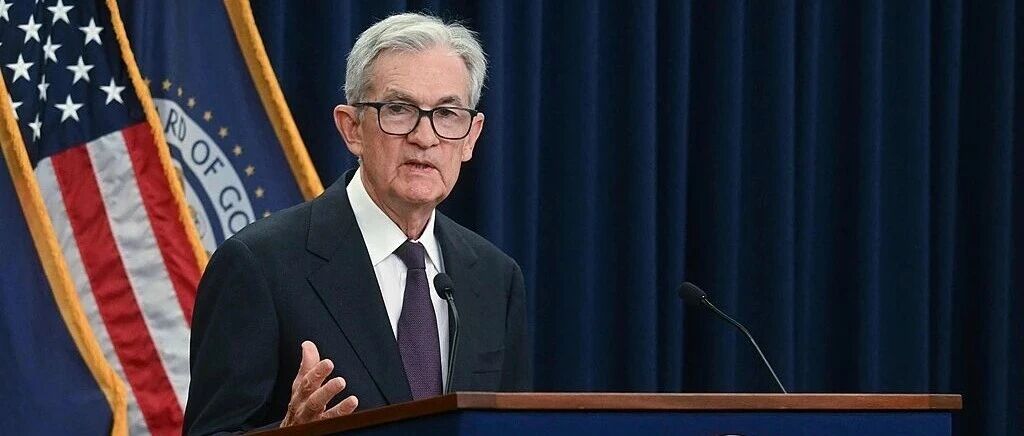
鲍威尔:无意在调查结束前离开美联储
21世纪经济报道· 2026-03-18 22:44
Group 1 - The Federal Reserve announced that it will maintain the federal funds rate target range at 3.5% to 3.75% following a two-day monetary policy meeting [1] - Powell indicated that the appropriate level for the federal funds rate is projected to reach 3.4% by the end of this year and 3.1% by the end of next year, consistent with previous forecasts [1] - Powell emphasized that these individual predictions carry uncertainty and do not represent the committee's plans or decisions, highlighting that monetary policy does not follow a fixed path [1] Group 2 - Powell stated he would continue to serve as "acting chair" if his successor is not confirmed by the end of his term in May [2] - The independence of the Federal Reserve has been a point of contention, with President Trump previously pressuring the Fed to lower interest rates and criticizing Powell's actions [2]

The Fed's Favorite Measure Of Inflation Was Hotter Than Expected at the End of 2025
Investopedia· 2026-02-20 17:00
Core Insights - The Federal Reserve's preferred inflation measure, Personal Consumption Expenditures (PCE), ended 2025 higher than its starting point, indicating persistent inflationary pressures [1] - Consumer prices rose by 2.9% year-over-year in December, up from 2.8% in November, marking the highest annual increase since March 2024 [2] - Core PCE, which excludes food and energy, increased by 3% over the same period, aligning with expectations and representing the highest annual rise since February [2] Economic Implications - High inflation continues to strain household budgets and complicates the Federal Reserve's decision-making regarding interest rate cuts, as it aims to balance inflation control with employment levels [3][5] - The increase in core prices is significant as it serves as a benchmark for the Fed's inflation target of 2%, which has not been met since 2021 due to pandemic-related disruptions [3] - The Fed's current stance on interest rates may be influenced by the persistent inflation, potentially leading to prolonged higher borrowing costs to discourage excessive borrowing and restore supply-demand balance [5][6] Market Reactions - The rise in inflation can be attributed to various factors, including tariffs imposed by the government, which have led to increased prices for consumers, although housing costs have stabilized [4] - The report on PCE was delayed due to a government shutdown, coinciding with weaker-than-expected GDP growth data for the fourth quarter, highlighting broader economic challenges [7]

纽约联储:2月17日担保隔夜融资利率(SOFR)报3.71%
Jin Rong Jie· 2026-02-18 15:09
Core Insights - The secured overnight financing rate (SOFR) increased to 3.71% on February 17, up from 3.66% the previous day [1] - The effective federal funds rate remained unchanged at 3.64% on February 17, consistent with the previous day's rate [1] Group 1 - The increase in SOFR indicates a rising cost of borrowing in the overnight market [1] - The stable effective federal funds rate suggests no immediate changes in monetary policy from the Federal Reserve [1]
一月美国CPI点评:滞后项仍在推动通胀下
Yin He Zheng Quan· 2026-02-14 06:40
Inflation Trends - The CPI year-on-year decreased to 3.0%, while the core CPI fell to 6.1%, indicating a slowdown in inflation driven by lagging factors[3] - The nominal CPI was slightly below expectations due to a significant drop in energy prices and a continued slowdown in used car prices[3] - Core services saw a slight acceleration, primarily due to increases in non-residential costs, but housing costs continued to ease, supporting the core inflation target of around 2%[3] Food and Energy Prices - Food prices adjusted seasonally decreased from 3.6% in the previous month to 3.1%, with year-on-year growth remaining at 3.0%[3] - The energy index adjusted seasonally fell by 4.5%, with a year-on-year decline of 3.1%, significantly impacting nominal inflation[3] - Energy commodities saw a month-on-month decrease of 6.6%, with gasoline prices dropping by 6.1%[3] Core Goods and Services - Core goods, excluding food and energy, showed a month-on-month increase of 0.3% and a year-on-year increase of 1.1%, indicating limited pass-through of tariff-related price increases[3] - Core services, excluding energy services, increased slightly to 3.5% month-on-month, reflecting marginal acceleration in service prices[3] Housing Costs - Housing costs decreased month-on-month by 0.3% and year-on-year by 4.3%, continuing a slow downward trend that limits service inflation[4] - The moderate increase in rent and owner-equivalent rent was consistent with leading rental indicators, supporting the easing of core inflation towards the 2% target[4] Market Expectations - The market's expectations for interest rate cuts remain stable, with CME data indicating a baseline pricing for three rate cuts throughout the year[4] - U.S. Treasury yields fell, with the 10-year yield decreasing to 3.67% and the 2-year yield down to 4.67%[4]
1月美国CPI点评:滞后项仍在推动通胀下行
Zhong Guo Yin He Zheng Quan· 2026-02-14 06:24
Inflation Trends - The CPI year-on-year decreased to 3.0%, while the core CPI fell to 6.1%, indicating a slowdown in inflation driven by lagging factors[3] - The nominal CPI was slightly below expectations due to a significant drop in energy prices and a continued slowdown in used car prices[3] - Core services saw a slight acceleration, primarily due to increases in non-residential costs, but housing costs continued to ease, supporting a move towards the inflation target of 2%[3] Food and Energy Prices - Food prices adjusted month-on-month fell significantly from 3.6% in the previous month to 3.1%, with year-on-year growth remaining at 3.0%[3] - Energy index adjusted month-on-month decreased by 1.6%, with a year-on-year decline of 3.1%, primarily driven by lower energy commodity prices[3] - The core goods index, excluding food and energy, showed a month-on-month increase of 0.3% and a year-on-year increase of 1.1%, indicating limited pass-through of tariff-related price increases[3] Housing Costs - Housing costs adjusted month-on-month increased by 3.1% and year-on-year by 4.3%, continuing a slow downward trend that limits service inflation[4] - The continued cooling of housing costs suggests a foundation for core inflation to approach the 2% target in 2024, without significantly constraining the return to a neutral federal funds rate around 3%[4] Market Expectations - The market's expectations for interest rate cuts remain stable, with CME data indicating a baseline pricing for three rate cuts throughout the year[4] - U.S. Treasury yields fell, with the 10-year yield decreasing by 6 basis points to 3.67%[4] - The U.S. dollar index slightly declined by 0.1% to 102.5, while precious metals continued to strengthen, with gold and silver prices rising by 1.66% and 1.77% respectively[4]
通胀顽固难退 两位美联储票委发声:更倾向于维持利率不变
Zhi Tong Cai Jing· 2026-02-10 22:37
Group 1 - The Federal Reserve's newly appointed voting officials express a preference to maintain current interest rates due to concerns about inflation, indicating a cautious approach to future monetary policy adjustments [1][2] - Cleveland Fed President Beth Hammack believes the current monetary policy is at an "appropriate level" and suggests patience in assessing economic data before making further changes [1] - Hammack highlights that inflation remains elevated, with risks of it staying around 3% this year, and emphasizes the need for clear evidence of sustained price declines before supporting further easing [1][2] Group 2 - Dallas Fed President Lorie Logan shares concerns about persistent high inflation, suggesting that previous rate cuts may have inadvertently increased the risk of inflation rebounding [2][3] - Logan notes that the upcoming data will be crucial in determining if inflation is moving towards the Fed's 2% target and whether the labor market remains stable [2] - Both officials acknowledge the impact of tariffs on prices, with some companies passing increased costs to consumers, while also noting rising electricity and healthcare costs contributing to inflationary pressures [2][3] Group 3 - Hammack reports that the U.S. labor market appears stable, with an unemployment rate of 4.4%, indicating a balance between job seekers and vacancies [3] - Logan observes that the downward risks in the labor market have diminished, with strong consumer spending and business investment expected to support employment [3] - Hammack anticipates that economic growth will accelerate this year due to previous rate cuts and fiscal support, potentially leading to improved employment and a gradual decrease in the unemployment rate [3]
美联储官员称政策处于有利位置 维持3.5%-3.75%联邦基金利率 通胀就业达标则无需降息
Sou Hu Cai Jing· 2026-02-10 21:13
Core Viewpoint - The Federal Reserve's policy stance is well-positioned to address risks associated with its dual mandate of inflation and employment, according to Dallas Fed President Lorie Logan [1] Group 1: Federal Reserve Policy - The Federal Reserve lowered the federal funds rate to a range of 3.5% to 3.75% last year and reaffirmed this rate level in the recent meeting [1] - Logan indicated that the current rate setting aligns with the ongoing economic environment of persistent inflation and a cooling labor market [1] - The current policy stance is close to neutral, with limited dampening effects on the economy [1] Group 2: Inflation and Labor Market - Logan expressed cautious optimism that the current policy can bring inflation back to the long-term target of 2% while maintaining labor market balance [1] - She acknowledged concerns about stubbornly high inflation levels [1] - If inflation decreases and the labor market remains stable in the coming months, the Fed may not need to lower rates further [1] Group 3: Independence of Monetary Policy - Logan emphasized that short-term political factors are not considered in the Fed's rate-setting decisions, highlighting the importance of monetary policy independence [1] - Cleveland Fed President Beth Hammack also stated that the current Fed policy stance is in a good position to remain observant of future developments [1]