服务云

Search documents
赛富时(CRM.US)FY26Q3业绩会:截至目前公司的总产能增加了约23%
智通财经网· 2025-12-04 23:15
Core Insights - Salesforce has achieved significant enhancements in its distribution organization, which is crucial for future growth, with total capacity increased by approximately 23% [1][9][10] - The company is witnessing a long-term trend towards the rise of the Agentic Enterprise, where businesses aim to leverage AI for growth and cost reduction, despite initial frustrations with DIY AI solutions [2][3] - The integration of AI into human workflows is essential, and Salesforce is uniquely positioned to provide a comprehensive solution that combines context, data, and reliable workflows [3][5] Strategic Focus - The "back to basics" strategy includes four key aspects: extensive training and empowerment of the sales team, driving core capacity with double-digit growth in multiple segments, aligning sales compensation with core objectives, and implementing rigorous management to identify and resolve sales barriers [1][9] - The sales team has increased by 20% in total capacity, with 15% of new sales representatives expected to ramp up in the current fiscal year, aligning with demand surges [3][4] Market Performance - The order pipeline for Q3 showed healthy double-digit growth, exceeding expectations, and is expected to maintain double-digit growth into the next year [4][10] - The Agentforce initiative is acting as an accelerator for core business growth, with existing customers seeing average order value (AUV) increase by 3 to 5 times after adopting Agentforce and Data Cloud [4][5] Competitive Advantage - Salesforce's data foundation, which includes Informatica, Data 360, and MuleSoft, is projected to contribute approximately $10 billion in revenue next year, enhancing the company's competitive edge [5][6] - The company emphasizes its federated capabilities, allowing integration with clients' existing data systems, which is critical for delivering accurate and reliable AI services [5][6] Pricing Strategy - The company has shifted from complex pricing models to a more straightforward commercial framework, including fixed-fee multi-year contracts and flexible pricing options to address customer concerns about potential reductions in employee numbers [7][8] - In Q3, 362 customers made additional investments in Salesforce, indicating strong demand for the Agentforce solution [7] Future Outlook - The investments in capacity and management are expected to drive future growth, with the company projecting a cRPO growth of approximately 11% in Q3, surpassing initial expectations [10]

Salesforce:AI到底是“救星”还是“丧钟”?
3 6 Ke· 2025-09-04 04:34
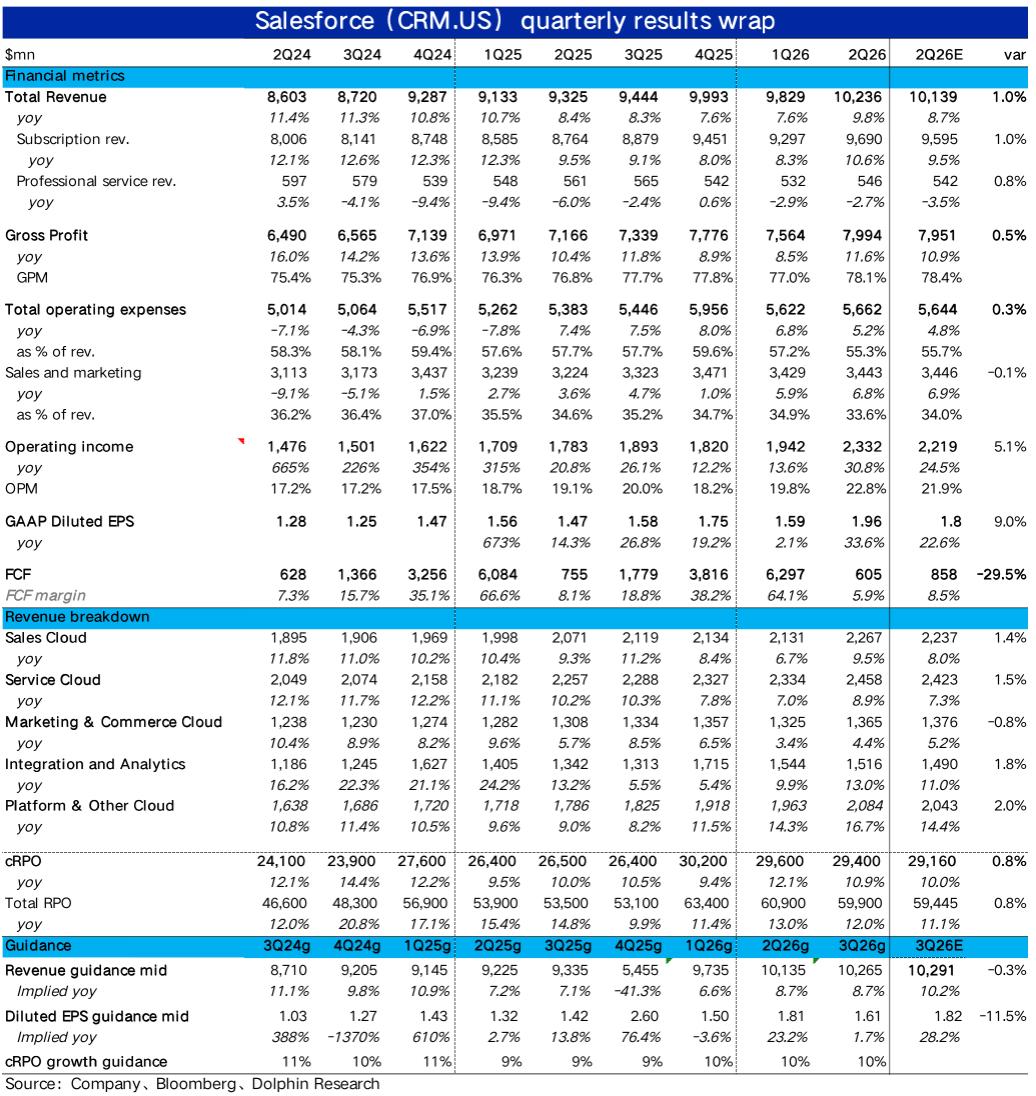
Core Viewpoint - Salesforce's Q2 FY2026 performance was stable but lacked significant growth momentum, primarily influenced by favorable exchange rates rather than organic growth [1][2][10]. Revenue and Growth - Subscription revenue grew by 10.6% year-over-year, slightly exceeding market expectations, but this growth was largely due to favorable exchange rates, with constant currency growth remaining around 9% over the past four quarters [3][17]. - All five major cloud segments experienced a 1% to 3% sequential increase in growth, but traditional IT spending areas like sales, service, and marketing showed only single-digit growth, indicating maturity in these segments [3][19]. - AI-related segments, particularly platform cloud and data analytics, showed stronger growth at 17% and 13% respectively, with annualized revenue contributions from AI and data cloud reaching $1.2 billion, up from $1 billion in the previous quarter [3][19]. Profitability and Cost Management - Gross profit for the quarter was approximately $8 billion, reflecting an 11.6% year-over-year increase, with a gross margin of 78.1%, up 1.1 percentage points from the previous quarter [6][28]. - Total operating expenses were $5.66 billion, growing by only 5.2% year-over-year, which is significantly lower than revenue growth, allowing for an increase in profit margins [8][31]. - The GAAP operating margin improved to 22.8%, marking a historical high, with operating profit increasing by nearly 31% year-over-year [36]. Forward Guidance - For the next quarter, Salesforce expects revenue growth of 8% to 9% year-over-year, with diluted EPS guidance of $1.61, indicating limited growth potential in new business areas [11][12]. - The company has raised prices for most enterprise versions by an average of 6%, but this has not translated into accelerated revenue growth, suggesting limited impact from AI initiatives [11][12]. Market Position and Challenges - Salesforce's valuation remains low within the SaaS industry, with a projected free cash flow multiple of 16x to 17x for FY2026, indicating potential for a rebound but lacking clear upward momentum [12][10]. - Concerns persist regarding the potential of AI to replace traditional software services, with Salesforce's AI agent business still in early stages and not yet demonstrating significant revenue impact [10][12].

SaaS 的下一站是 Agentforce ?Salesforce 押注 AI 工作流革命
3 6 Ke· 2025-05-23 02:28
Group 1 - Marc Benioff, CEO of Salesforce, envisions a transformative era for enterprise software driven by AI agents and unified data architecture, transitioning from Software as a Service (SaaS) to Service as Software [1][2] - The "digital workforce" revolution is expected to be more disruptive than the cloud and mobile waves of 15 years ago, fundamentally redefining application functionalities [2] - Salesforce's Agentforce and Data Cloud strategies are central to its agentic vision, positioning the company as a potential "pure software hyperscaler" [2] Group 2 - Agentforce is a new AI-driven enterprise agent platform that integrates autonomous or semi-autonomous software assistants into all Salesforce applications, aiming to enhance human productivity [3][4] - Benioff claims that embedding these agents into workflows could lead to a 50% productivity increase across departments, a significant rise from a previously stated 30% [4] - Early customer deployments, such as Disney's use of AI agents for optimizing theme park operations, demonstrate the practical viability of this vision [4] Group 3 - The concept of "agent fluidity" allows AI agents to seamlessly operate across datasets and applications, exemplifying the Service as Software model [5] - Salesforce's Data Cloud serves as a unified real-time data platform, aggregating internal and external data sources into a comprehensive business state map [8][9] - The integration of Data Cloud with core applications like Tableau enhances the effectiveness of AI agents by providing unified real-time data and metadata frameworks [10] Group 4 - Salesforce's strategy emphasizes data fluidity, allowing for federated data integration without requiring all data to be migrated to Salesforce's storage [11][12] - Collaborations with third-party data platforms like Snowflake and Databricks enhance the capabilities of Data Cloud, allowing real-time data queries and integration [12][13] - This open integration strategy positions Salesforce as a key player in modern data architecture, avoiding the pitfalls of data silos [30] Group 5 - Salesforce aims to become the first pure software hyperscaler, leveraging its SaaS platform to achieve scale without the capital-intensive model of traditional hyperscalers [19][20] - The company anticipates reaching an annual revenue of approximately $50 billion this fiscal year, with a focus on maintaining healthy free cash flow [20] - By embedding agents, workflows, and federated datasets into daily operations, Salesforce seeks to establish itself as a neutral orchestration layer in heterogeneous environments [20][21] Group 6 - The competitive landscape includes major players like Microsoft, which poses a significant challenge to Salesforce's ambitions in the AI space [23][24] - Salesforce's strategy of integrating rather than competing with data infrastructure providers like Snowflake and AWS allows it to avoid direct confrontations while enhancing its offerings [29][30] - The company is experiencing strong market response to its AI-driven agents, with over 5,000 organizations deploying the technology shortly after its launch [6][32] Group 7 - Salesforce's ambitious goal is to drive overall productivity improvements exceeding 50% through AI agents, with plans to embed AI capabilities across its entire customer base [35][36] - The next 12 to 24 months are critical for validating Salesforce's strategy and its ability to redefine the cloud economy through software alone [35][36] - If successful, Salesforce could reshape the perception of cloud leaders and establish itself as the preferred platform for enterprise-level AI [34][36]