服务器级DRAM

Search documents
韩国股市今年已上涨超30%,政府“5000点计划”奏效了?
Jing Ji Guan Cha Bao· 2026-02-16 08:07
Core Viewpoint - The South Korean stock market has risen over 30% since the beginning of 2026, driven by the government's "5000-point plan" and the surge in AI-related demand for semiconductors [1] Group 1: Market Performance - The KOSPI index has increased significantly, reaching 5507 points by February 13, 2026, marking a 30% rise since the start of the year, outperforming major global indices [1] - In 2025, the KOSPI index experienced a remarkable annual increase of approximately 75.6%, the strongest performance since the 1999 internet bubble, surpassing the S&P 500's 17% and MSCI Asia-Pacific's 25% gains [2] - As of January 27, 2026, the total market capitalization of the South Korean stock market reached $3.25 trillion, surpassing Germany's $3.22 trillion, making it the 10th largest stock market globally [3] Group 2: Key Drivers - The semiconductor sector, particularly driven by AI demand, has been a major contributor to the KOSPI's rise, with Samsung Electronics and SK Hynix seeing substantial stock price increases of 125.4% and 274.35% respectively in 2025 [2] - The government's "Company Value Enhancement Plan," initiated in 2024 and upgraded in 2025, aims to address structural undervaluation in the market and has been a significant factor in the ongoing market rally [4] Group 3: Structural Changes - Reforms aimed at alleviating the "Korean discount" have led to increased foreign investment and heightened activity among domestic retail investors, contributing to the KOSPI's accelerated growth since the second half of 2025 [5] - The MSCI Korea index saw a 48% increase by September 30, 2025, becoming the strongest performer among major Asian indices, bolstered by the government's commitment to the "KOSPI 5000" initiative [6] Group 4: Future Outlook - Morgan Stanley has raised its KOSPI target for the end of 2026 from 4500 to 5200 points, with a bullish scenario suggesting a potential rise to 6000 points, driven by strong earnings momentum and structural reforms [6]
美股异动 | 电脑硬件股盘前下跌 戴尔科技(DELL.US)跌逾4%
智通财经网· 2026-02-12 14:31
Core Viewpoint - The computer hardware sector is facing significant challenges due to rising memory and storage costs, which have increased by approximately 40% to 70% from Q1 to Q4 of 2025, impacting consumer prices and product configurations [1] Group 1: Market Impact - Dell Technologies (DELL.US) shares fell over 4%, while HP (HPQ.US) shares dropped more than 3% amid concerns over rising costs [1] - The shortage of standard DDR memory for laptops and desktops is attributed to manufacturers prioritizing higher-margin server-grade DRAM and high-bandwidth memory (HBM) for AI infrastructure [1] Group 2: Future Projections - PC manufacturers warn that 2026 may present significant challenges for consumers, not due to CPU or GPU shortages, but because of a memory shortage crisis that will increase bill of materials costs [1] - IDC research manager Jitesh Ubrani forecasts a potential 9% decline in PC shipments in 2026, bringing total shipments to approximately 260 million units, slightly below 2024's estimated 263.3 million units and close to 2023's levels, which was one of the worst years in PC history [1]


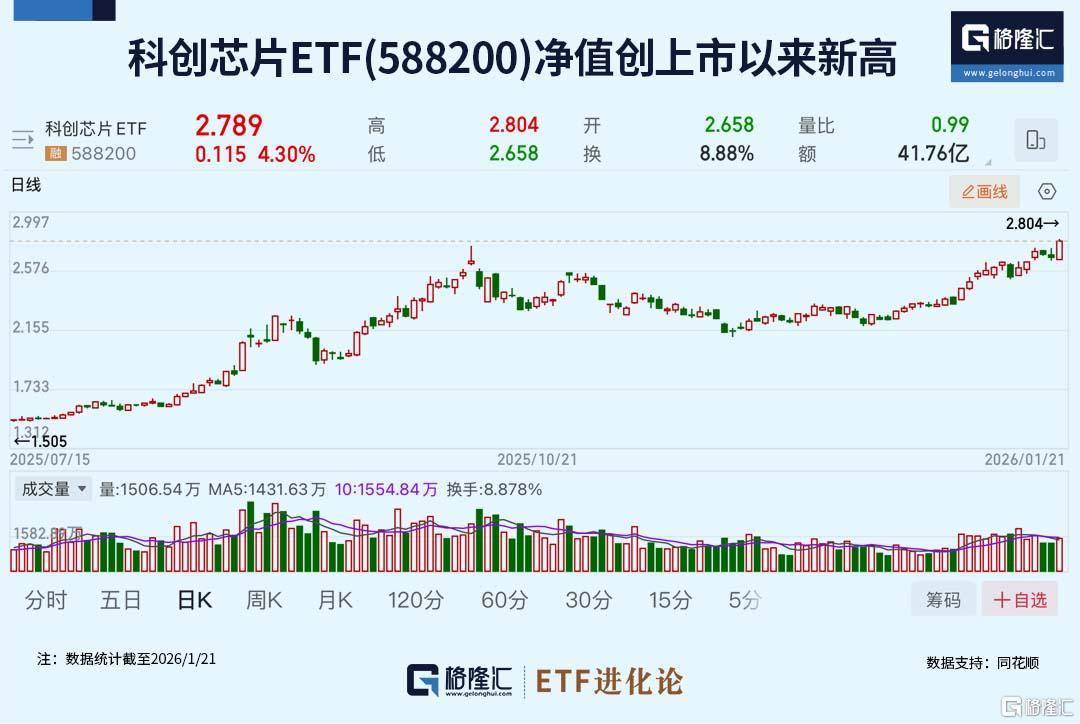
存储芯片涨价潮,十大核心ETF之科创芯片ETF(588200)净值创上市以来新高
Sou Hu Cai Jing· 2026-01-21 08:11
Core Viewpoint - The storage chip market is experiencing a significant upturn driven by strong demand from AI applications and structural supply constraints, leading to a dual growth and cyclical nature in the industry [4][6]. Group 1: Market Performance - The Kexin Chip ETF (588200) reached a new high since its listing, with a daily increase of 4.21% and a year-to-date gain of 19.07% [1]. - Over the past five trading days, the Kexin Chip ETF (588200) saw a net inflow of over 500 million yuan [3]. Group 2: Price Trends and Supply Dynamics - The core catalyst for the current market rally is the robust increase in storage chip prices, with leading semiconductor manufacturers planning to raise server-grade DRAM prices by 60%-70% in Q1 2026 [3]. - In the spot market, prices for certain DDR4 and DDR5 models have doubled, indicating strong downstream demand [3]. - The current price increases are primarily due to a "passive shortage" caused by changes in supply structure, with AI servers requiring 4-6 times more storage resources than traditional servers [3]. - Major storage manufacturers are shifting new capacity towards high-end products like HBM and DDR5, significantly reducing capacity for mature processes like DDR4 [3]. Group 3: Financial Performance and Future Outlook - The storage industry is evolving from a traditional "strong cycle" to a "growth + cycle" dual attribute, with AI driving long-term growth and supply-demand mismatches providing short-term elasticity [4]. - Financial data reflects this change, with a leading South Korean semiconductor company expected to see over 200% year-on-year growth in operating profit by Q4 2025 [4]. - The global semiconductor market is projected to reach $975 billion by 2026, nearing the trillion-dollar mark [4]. Group 4: Domestic Industry Development - The domestic storage and semiconductor industry is entering an accelerated development phase due to high market demand and geopolitical factors providing a window for domestic alternatives [5]. - The Kexin Chip ETF (588200) tracks the Shanghai Stock Exchange's chip index, covering key segments of the chip industry, including design, manufacturing, and equipment [5]. - As of January 20, 2026, the Kexin Chip ETF had a scale of 45.377 billion yuan, making it the largest among 11 ETFs tracking the same index [5].