机器人配送小哥

Search documents
CES被广东承包?超530家企业展示中国力量
Zhong Guo Jing Ying Bao· 2026-01-15 16:01
Core Insights - The CES 2023 showcased a significant presence of Chinese brands, particularly from Guangdong, highlighting a narrative of Chinese manufacturing and innovation [1][2] - Guangdong enterprises demonstrated a multi-faceted approach, focusing on both foundational technology and consumer products, indicating a shift from single-point technology displays to comprehensive industrial solutions [1][2][3] Group 1: Guangdong Enterprises at CES - Over 3302 companies participated in CES, with 837 from mainland China, 127 from Taiwan, and 98 from Hong Kong; Guangdong alone had over 530 exhibitors, with Shenzhen contributing 370, representing 44.2% of mainland China's participation [2] - Companies like SUTENG, PAXIN, Yingshi Innovation, and TCL showcased not just hardware but integrated solutions embedded in the global industrial system, marking a transition from "technically feasible" to "commercially replicable" [2][3] Group 2: Technological Advancements - Guangdong's embodied intelligent robots demonstrated operational capabilities beyond mere concept validation, with SUTENG's robot performing nearly 20 complex tasks autonomously, indicating a maturity in system capabilities [3] - The TORA-ONE humanoid robot by PAXIN showcased practical applications in new retail, reflecting a shift in focus from feasibility to value in usage [3] Group 3: Innovations in Hardware and Infrastructure - Yingshi Innovation's "Yingling A1" drone received international recognition for integrating 360-degree imaging with AI, showcasing the technological barriers being established in niche markets [4] - Daotong Technology's smart charging robot is designed to integrate into fleet operations, enhancing the efficiency and stability of autonomous vehicle charging, which is crucial for the commercial viability of autonomous fleets [4] Group 4: TCL's Strategic Positioning - TCL's participation emphasized a long-term narrative of foundational capabilities and application expansion, with a focus on technologies like printed OLED, which has been in development for 12 years and offers significant advantages in efficiency and color consistency [5] - The presence of Guangdong enterprises at CES illustrates a clear path from core technology to industrial application, reinforcing their role in global technology and industry competition [5] Group 5: Structural Changes in the Industry - The high density of Guangdong enterprises at CES reflects a structural shift in the global consumer electronics industry, moving from a supply chain role to becoming co-builders of technology and standards [2][6] - Shenzhen's transformation from a low-cost manufacturing hub to a center of innovation is evidenced by its high R&D investment, which consistently accounts for over 93% of the city's total R&D funding, and its leading position in PCT international patent applications [7] Group 6: Ecosystem Development - The emergence of a cluster of small and medium-sized "hidden champion" companies in Guangdong, driven by leaders like Huawei and BYD, is pushing the technology industry towards ecological competition [8] - The CES event highlighted the culmination of long-term efforts by Guangdong enterprises to establish a significant presence on the global stage, showcasing their advancements in various cutting-edge sectors [8]
中国科技企业闪耀CES,以创新和品牌力突围
2 1 Shi Ji Jing Ji Bao Dao· 2026-01-10 00:10
Group 1 - The core viewpoint of the articles highlights the increasing presence and competitiveness of Chinese technology companies at the CES 2026, showcasing a shift from traditional manufacturing roles to a more diversified global strategy that emphasizes technology, design, and localized operations [1][4]. - Chinese companies are exhibiting a strong focus on AI integration, with nearly all exhibitors emphasizing AI in their presentations, indicating a trend towards practical applications rather than just theoretical concepts [2][3]. - The number of Chinese humanoid robot exhibitors at CES 2026 exceeds 20, surpassing the total from the US, Japan, South Korea, and Europe combined, demonstrating a significant cluster effect in this sector [2]. Group 2 - In the first three quarters of 2025, China's export of high-tech products reached 37.5 trillion yuan, marking an 11.9% increase and contributing over 30% to the overall export growth during the same period [1]. - The global market for robotic vacuum cleaners is dominated by Chinese brands, which accounted for over 60% of the market share in terms of shipment volume in 2025 [5]. - Chinese technology companies are increasingly focusing on brand building after achieving significant sales milestones, with many adopting interactive marketing strategies to enhance brand visibility and consumer engagement [6][7]. Group 3 - The CES serves as a window into technological trends and reflects the journey of Chinese companies expanding into overseas markets, with a notable increase in brand recognition and a shift away from the "low-price label" to a "technology leader" image [4][6]. - The rapid iteration cycles of Chinese companies, averaging six months to a year for product updates, contrast with European companies that typically require two to three years, allowing for quicker market responsiveness [4][6]. - Challenges remain for Chinese companies in navigating diverse market environments, including varying consumer preferences, regulatory requirements, and external uncertainties, which necessitate comprehensive long-term strategic planning [7][8].
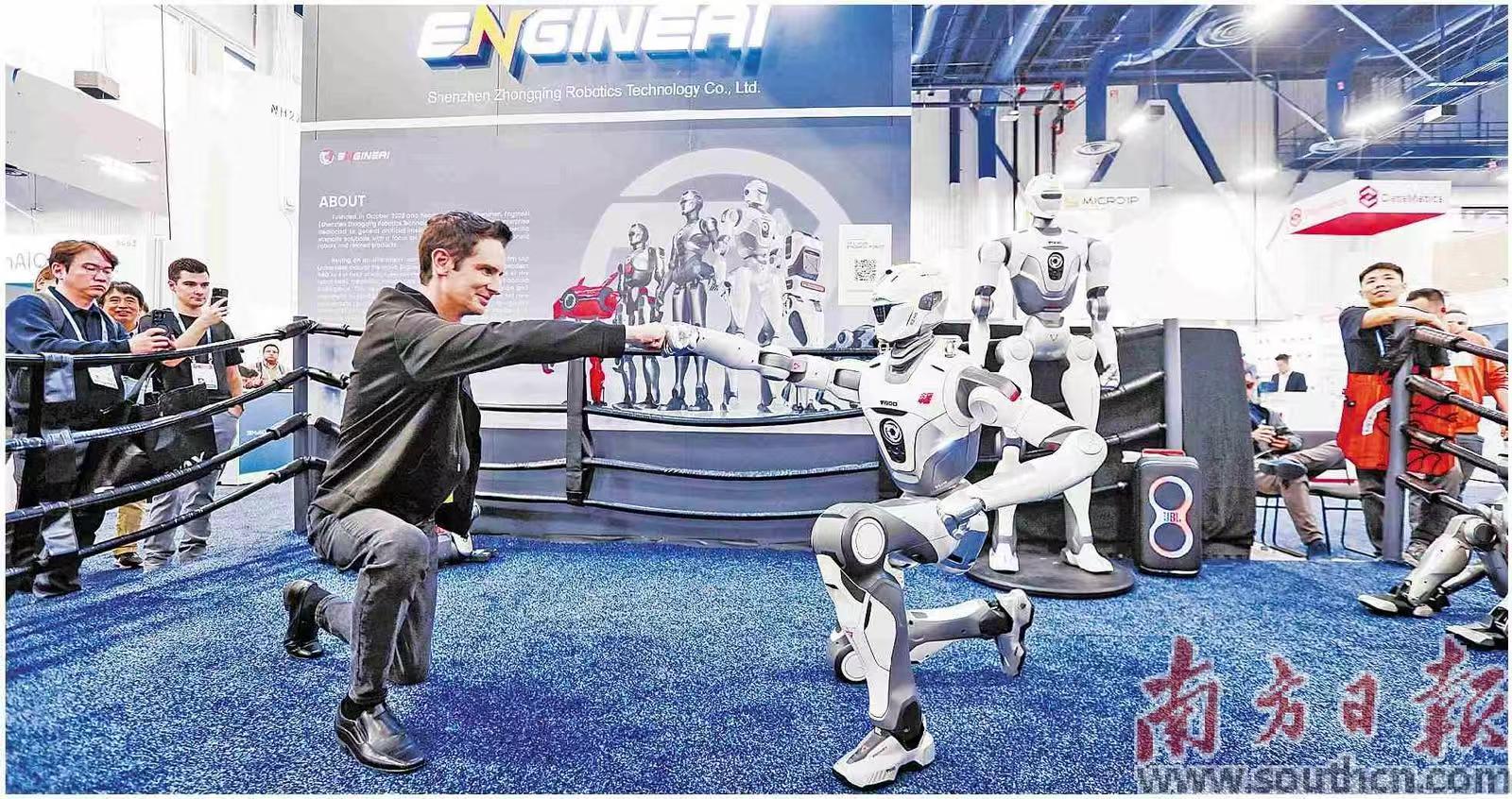
广东AI硬件全链出海 众擎机器人亮相国际消费类电子产品展
2 1 Shi Ji Jing Ji Bao Dao· 2026-01-09 03:39
Core Insights - The article highlights the emergence of AI as a foundational element in consumer electronics, with a significant growth forecast for AI technology hardware in 2026 [2][3]. Group 1: Company Highlights - Shenzhen Zhongqing Robot Technology Co., Ltd. showcased its humanoid robot T800 at CES 2026, attracting considerable attention with its interactive capabilities [2][5]. - The T800 robot features advanced technology, including a peak torque of 450N·m, equivalent to the power of a high-end car engine, and a solid-state battery with a 4-5 hour runtime [6][7]. - The company has completed multiple technical validations for the T800, anticipating sales of dozens to hundreds of units in 2026 [7]. Group 2: Industry Trends - The CES 2026 event emphasizes the integration of AI into physical products, marking a shift from conceptualization to practical applications [5][8]. - Guangdong AI hardware companies are moving towards global markets, focusing on real product offerings and collaborative solutions with international partners [4][11]. - The article notes a growing interest from international clients in Chinese robotics technology, indicating a rising global demand for these innovations [11]. Group 3: Supply Chain and Globalization - Guangdong's efficient supply chain, characterized by a "half-hour supply chain" model, allows for rapid response to global customization demands [12][15]. - Companies are not merely exporting products but are engaging in global ecosystem building, enhancing their competitive edge in the AI hardware market [16][17]. - The article mentions that AI is no longer seen as a standalone product but as a core operating system driving various devices, reshaping the competitive landscape [17][18]. Group 4: Future Outlook - The article suggests that the year 2026 will be pivotal for AI hardware, with companies aiming to optimize product matrices and align with global market needs [16][21]. - Guangdong enterprises are positioned to redefine "Chinese innovation" in the global market, leveraging their technological strengths and ecological strategies [21].