
极紫外光刻(EUV)光刻机

Search documents
6年间单片晶圆毛利润暴涨3.3倍,台积电杀疯了
Sou Hu Cai Jing· 2025-12-30 02:39
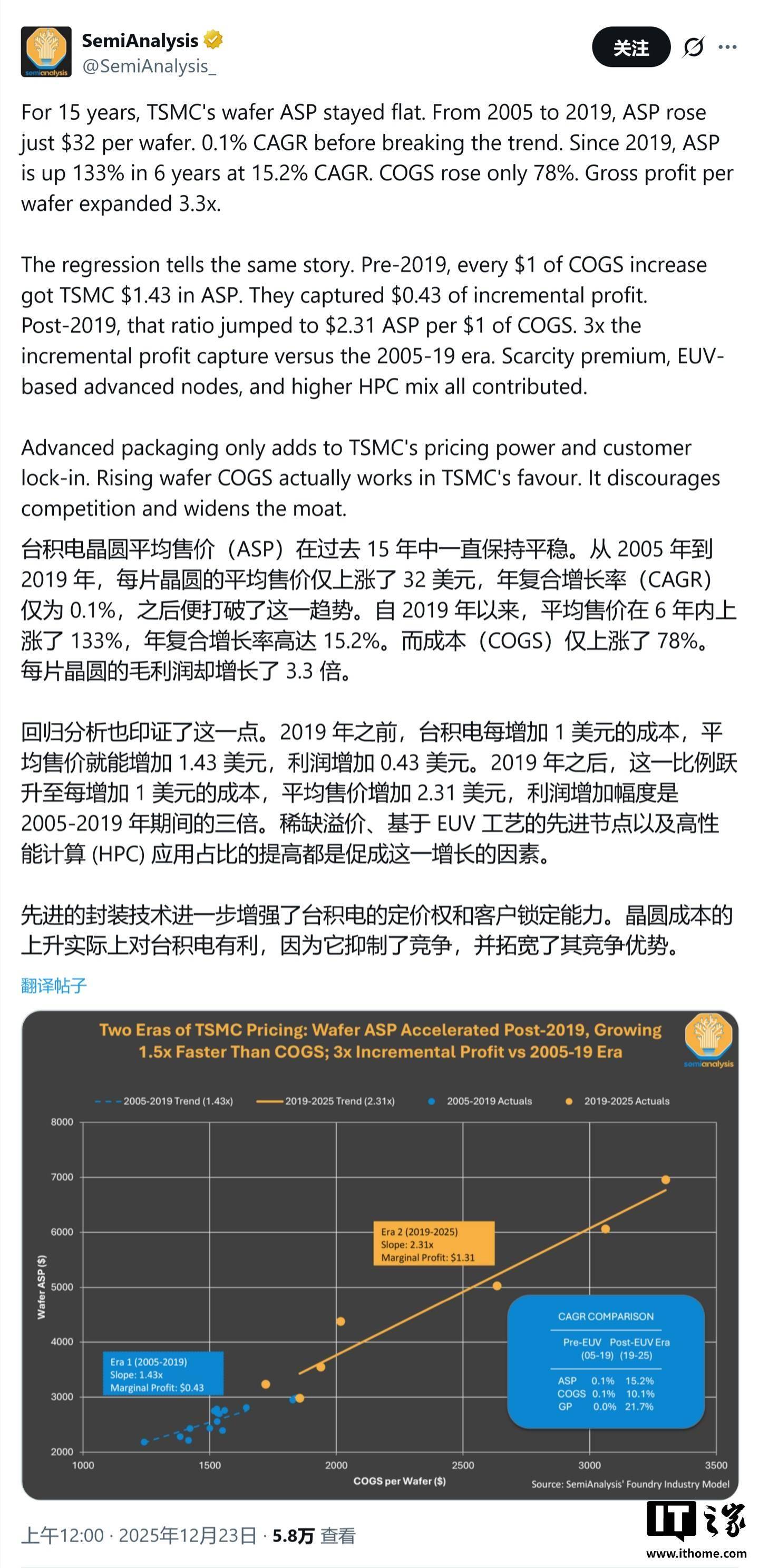
Group 1 - TSMC's pricing strategy was conservative from 2005 to 2019, with an average wafer price increase of only $32 over 15 years, reflecting a compound annual growth rate of just 0.1% [2] - In 2019, TSMC embraced EUV technology, leading to an average selling price (ASP) growth of 15.9% annually, resulting in a cumulative increase of 133% over six years [3] - TSMC's gross margin per wafer is projected to reach 3.3 times the 2019 level by 2025, indicating strong pricing power and the ability to pass increased costs to downstream customers [3] Group 2 - Prior to 2019, a $1 increase in production costs led to only a $1.43 increase in wafer price, yielding a profit increment of $0.43; post-2019, the same cost increase results in a $2.31 price rise, boosting profit increment to over $1.30 [3] - TSMC's success is attributed to strong demand from clients like NVIDIA, AMD, and Apple for AI and high-performance computing chips, which prioritize performance over price [3] - Unlike Samsung, which faces yield issues limiting its EUV capacity to in-house use, TSMC has established deep partnerships with top global chip designers through its Open Innovation Platform (OIP) [4] Group 3 - The current market structure, characterized by systemic supply shortages and high capital intensity, is expected to remain unchallenged until a true competitor emerges [5]


事关光刻技术,特朗普政府拟入股
财联社· 2025-12-02 05:53
Core Viewpoint - The Trump administration has agreed to invest up to $150 million in xLight, a startup aiming to develop advanced semiconductor manufacturing technology, marking a strategic move to support domestic industries deemed critical [2][8]. Group 1: Company Overview - xLight is focused on improving the extreme ultraviolet lithography (EUV) process, which is essential for chip manufacturing. The company aims to enhance a critical component of this process, specifically the laser used to etch complex micro-patterns onto silicon wafers [3]. - The company is led by Nicholas Kelez, with Pat Gelsinger, former CEO of Intel, serving as the executive chairman after his departure from Intel due to financial struggles [3][6]. Group 2: Investment and Technology Development - The $150 million investment will help xLight build a large "free electron laser" powered by particle accelerators, which aims to create a more powerful and precise light source for chip manufacturing. Each machine will measure approximately 100 meters by 50 meters and will be deployed outside chip factories [6]. - xLight's goal is to produce its first silicon wafers by 2028, with the investment expected to significantly enhance the efficiency of wafer processing by up to 30% to 40% [6][7]. Group 3: Implications for the Semiconductor Industry - If successful, xLight's technology could redefine the economics of current EUV processes and empower future EUV advancements, potentially allowing semiconductor manufacturers to etch smaller line widths on silicon wafers [6][8]. - The development aligns with Moore's Law, which predicts that the number of transistors on a chip—and thus its computing power—should double approximately every two years [6]. Group 4: Government Strategy - The investment in xLight is part of a broader strategy by the Trump administration to directly invest in key industries, including semiconductors, critical minerals, and rare earth elements, through various financial mechanisms [8][9]. - Some analysts have criticized this approach as a form of state capitalism, arguing that it involves the government in selecting industry winners and losers [9].
