
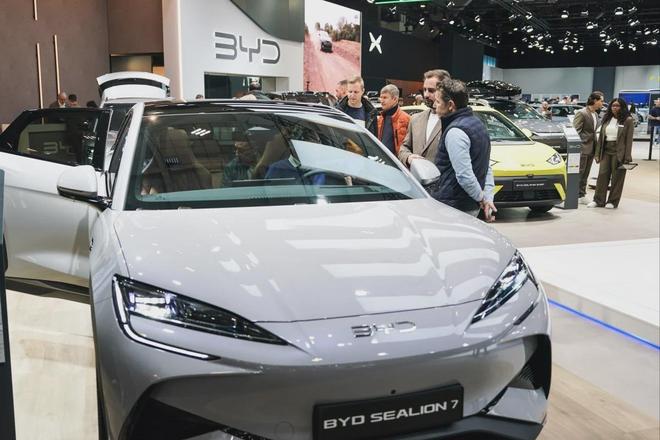
比亚迪海狮07

Search documents
油费是电费4倍!中国电车爆火
第一财经· 2026-03-23 09:25
Core Viewpoint - The rising oil prices are significantly boosting the sales of electric vehicles (EVs), particularly from Chinese brands, as consumers seek cost-effective alternatives to traditional fuel vehicles [4][5][9]. Group 1: Sales Trends and Market Dynamics - In Australia, the sales of electric vehicles have surged, with a Melbourne dealer reporting a 50% year-on-year increase in sales due to rising oil prices [3][5]. - The retail sales of new energy vehicles in China reached 285,000 units from March 1 to March 15, marking a 36% increase compared to the same period last month [10]. - In February, the growth rate of new energy vehicle sales in Australia rose to 11.8%, a historical high, with Tesla and BYD leading the market [7]. Group 2: Competitive Landscape - Chinese automotive brands are increasingly capturing market share from traditional Japanese fuel vehicles in Australia, with new energy vehicle sales surpassing those of Japanese brands for the first time [5][9]. - The cost advantage of electric vehicles is becoming more pronounced, with the cost of filling a fuel tank being four times higher than charging an electric vehicle [5][6]. - BYD's Atto 3 and other models are experiencing high demand due to competitive pricing compared to traditional models like the Tesla Model Y [5][6]. Group 3: Global Expansion and Future Outlook - Chinese brands such as BYD, Changan, and Xpeng are seeing a surge in orders across Southeast Asia, indicating a growing international demand for their electric vehicles [9]. - The penetration rate of new energy vehicles in China has exceeded 45%, with a target for significant growth in overseas markets by 2026 [9][10]. - The high oil prices are expected to enhance the competitiveness of the Chinese new energy vehicle industry in the long term, despite short-term pressures from rising costs in logistics and materials [9][10].


分析师:中国车企在欧将提升利润率,改善盈利状况和品牌声誉
Guan Cha Zhe Wang· 2026-01-15 08:32
Group 1 - The core viewpoint of the articles is that the EU's implementation of a minimum price for Chinese electric vehicles (EVs) will enhance profit margins for Chinese manufacturers, ultimately improving their profitability and brand reputation [1][3] - Deutsche Bank analyst Wang Bin noted that the minimum price policy will technically suppress sales, particularly for low-cost small EVs, but it will positively impact major Chinese EV manufacturers like BYD, which have advantages in technology and production costs [1] - UBS China automotive research head Gong Min stated that the minimum price commitment will help Chinese EV manufacturers in Europe avoid falling into vicious price competition [1] Group 2 - JPMorgan's Asia-Pacific automotive research head Lai Yizhe mentioned that the average profit for Chinese car manufacturers in mainland China is approximately 5,000 RMB, but exporting more vehicles overseas at higher prices could increase profits to around 20,000 RMB [3] - Lai Yizhe believes that under the minimum price system, Chinese EVs can maintain local customer appeal by enhancing smart features and optimizing interior designs without offering discounts, which will improve their reputation in Europe in the long run [3] - China is the largest automotive and EV market globally, with approximately 13 million EVs sold last year, accounting for about 70% of global sales. Currently, 88,000 of the cars exported to the EU are pure electric vehicles, making up 55% of the total [3]
中国特供车搁置、FSD难落地,特斯拉在华走下坡路了
Feng Huang Wang· 2025-07-07 04:34
Core Viewpoint - Tesla is facing increasing challenges in the Chinese market, which is crucial for its global operations, as local competitors gain popularity and market share, leading to a decline in Tesla's sales and market presence [1][5][6]. Group 1: Market Dynamics - Tesla's market share in China has dropped from 11% in early 2021 to 4% by May 2023, while competitors like BYD hold approximately 29% of the market [7]. - In May 2023, Tesla's sales in China were just under 40,000 units, a 30% decrease year-over-year, contrasting with a 28% growth in the overall Chinese electric vehicle market [6][7]. Group 2: Consumer Preferences - Chinese consumers find Tesla's models increasingly unappealing, citing a lack of innovative features compared to local brands, which offer advanced functionalities like large screens and integrated entertainment systems [1][3]. - A former Tesla owner switched to a Xiaomi electric vehicle, highlighting the perception that Tesla has become "boring" and lacks revolutionary features [8]. Group 3: Technological Challenges - Tesla's Full Self-Driving (FSD) system has not received full regulatory approval in China, hindering its competitive edge in the autonomous driving sector [2][9]. - Local competitors have developed advanced driver-assistance technologies at lower prices, further challenging Tesla's market position [9][10]. Group 4: Strategic Responses - Tesla plans to introduce a lower-cost version of the Model Y SUV by 2026 to boost sales, but there are concerns that without significant price reductions, these models may struggle against local competitors [5][4]. - The company has attempted to adapt by offering popular local applications, but the overall number of available applications remains limited compared to local brands [3]. Group 5: Future Outlook - Experts suggest that Tesla's path in China may become increasingly difficult as local companies rise, drawing parallels to past experiences of American firms in the Chinese market [6]. - Despite challenges, Tesla's CEO Elon Musk remains optimistic about the company's resilience and potential to lead in future technologies, including humanoid robots, although competition from local startups is intensifying [11][12].
