比亚迪秦plus

Search documents
新能源汽车景气度调研:比亚迪恢复最快
数说新能源· 2026-03-05 03:01
Core Viewpoint - The article discusses the current state of the automotive market, particularly focusing on the impact of government subsidy policies on electric vehicle sales and the recovery of various brands in the market. Group 1: Market Performance and Recovery - In January, the automotive market experienced a decline in production and sales due to the withdrawal of national policies, with a notable drop in sales of economic electric vehicles exceeding 30% [2] - By February, the implementation of subsidy policies, such as scrappage and trade-in incentives, helped to stimulate some consumer demand, although overall orders still saw a year-on-year decline of about 15% [2] - The recovery in the automotive market since February has shown improvement compared to last year, but there remains a gap compared to March sales from the previous year [3] Group 2: Brand-Specific Recovery - BYD's Dynasty and Ocean brands have shown a rapid recovery, aided by various promotional policies introduced in late February and early March [4] - Geely has supplemented its entry-level models with additional policies, but overall, BYD is recovering the fastest among competitors [5] - Leap Motor was one of the first brands to introduce significant policy changes, offering substantial discounts on its B-series models [6] Group 3: Consumer Preferences and Technology - Consumer interest in BYD's upcoming technology releases is high, which is expected to significantly impact the brand's market recovery [9] - The key competitive factors in technology are centered around electric motors, control systems, and batteries, with BYD's innovations likely to enhance consumer experience, especially for mid-range vehicles [10] - BYD plans to adopt a new battery technology that could increase energy density to over 200Wh/kg, potentially achieving a range of 1000 kilometers [11] Group 4: Market Dynamics and Pricing Strategies - The introduction of low or zero-interest financing options has had a stimulating effect on the market, particularly for vehicles priced above 200,000 yuan, although acceptance of long-term loans remains low [14] - The actual transaction prices for vehicles above 200,000 yuan have remained stable or slightly declined compared to last year, with sales of mid-range electric vehicles performing well [15] - The pricing strategies of manufacturers like SAIC and Volkswagen are shifting towards higher-priced models, encouraging dealers to focus on selling more premium products [18] Group 5: Inventory and Supply Chain - BYD's inventory levels for its Dynasty and Ocean series are relatively high, exceeding 2.5 months, while other brands like Geely have also seen significant inventory levels [13] - The overall inventory situation varies, with some electric vehicle brands experiencing low inventory levels, while traditional fuel vehicle brands have higher stock [13] Group 6: Future Outlook - Geely plans to focus on the deployment of 800V technology in lower-priced models and enhance its smart driving capabilities across its product range [12] - The automotive market is expected to continue evolving with a focus on improving product quality and avoiding price wars, emphasizing the importance of technological advancements and consumer preferences [19]



中国车企,要接受新车销量“仅微涨”的新常态
虎嗅APP· 2026-02-10 14:12
Core Viewpoint - The Chinese automotive market is experiencing a downturn in new car sales, with significant declines reported for major brands, while the used car market is thriving, indicating a shift in consumer preferences and market dynamics [2][3][24]. Group 1: New Car Market Trends - In January 2026, BYD's sales dropped by 30%, and Li Auto's sales fell by 7.55%, with Geely only seeing a slight increase of 1% due to strong overseas performance [2]. - The overall passenger car sales in China are projected to reach 24 million in 2026, with a growth rate slowing to 1% [2]. - The decline in consumer confidence, exacerbated by reduced subsidies and macroeconomic factors, is expected to keep consumer sentiment below the breakeven line [2]. Group 2: Used Car Market Dynamics - The used car market in China is booming, with a transaction volume of 20.1 million units in 2025, marking a year-on-year growth of 2.52% and a total transaction value of 1.28979 trillion yuan [3]. - The demand for used electric vehicles is expected to grow by over 50% [3]. - The trend of purchasing used cars is driven by practical needs, such as commuting and returning home during holidays, with a notable increase in cross-regional vehicle registrations [6][8]. Group 3: Consumer Preferences and Behavior - Consumers are increasingly opting for used cars due to price advantages, allowing them to afford better models compared to new cars [10]. - The introduction of new policies has increased the variety of available used car models, enhancing consumer choice [11]. - The demand for used cars is becoming more personalized, with consumers selecting vehicles based on specific needs such as fuel efficiency and durability [14]. Group 4: Implications for Automotive Companies - The rise in used car sales may negatively impact new car sales in the short term, as each additional used car sold could equate to one less new car sold [17]. - In the long term, a healthy used car market can stabilize the residual values of new cars, encouraging new car purchases [20]. - The growing interest in used cars among younger consumers may lead to future brand loyalty and new car purchases from the same manufacturers [21]. Group 5: Market Evolution and Future Outlook - The automotive market in China is maturing, with new car sales growth plateauing, while the used car market is expected to continue expanding [24]. - The automotive industry must adapt to this new normal by focusing on vehicle durability and reliability, rather than solely on sales volume [24]. - The overall automotive market is projected to exceed 10 trillion yuan in 2025, with significant implications for the aftermarket services sector [22].



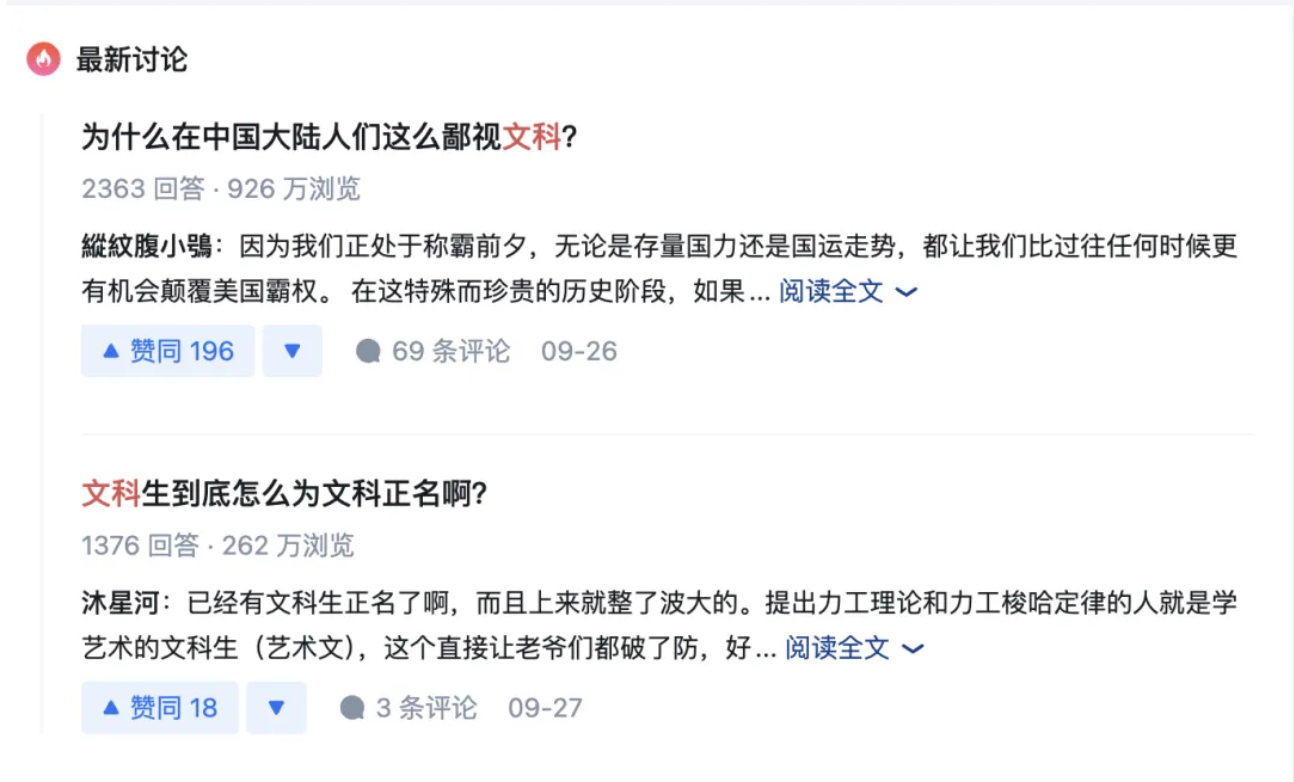
中国需要什么样的文科生?
Hu Xiu· 2025-09-30 01:53
Group 1 - The core viewpoint is that the value of liberal arts and liberal arts students in China is facing unprecedented skepticism and criticism in today's society [2][4] - The number of liberal arts programs being eliminated in universities has reached 1,422 from 2019 to 2022, indicating a systemic reduction in the field [5] - Employment and salary issues for liberal arts graduates are highlighted, with non-technical positions often being at the bottom of the pay scale and facing higher risks of layoffs [6] Group 2 - The essence of the disdain towards liberal arts is that the knowledge possessed by liberal arts students is often not convertible into tangible benefits, leading to a perception of uselessness [21][28] - The difficulty in quantifying the value of liberal arts achievements is attributed to their subjective nature, making objective evaluation challenging [29][31] - The slow iteration of liberal arts theories and the lack of innovative contributions from Chinese scholars further complicate the realization of their value [32][36] Group 3 - The current era presents a unique opportunity for liberal arts in China, as advancements in STEM fields can serve as a foundation for cultural and artistic development [41][44] - The need for liberal arts students to transform their knowledge into practical value is emphasized, suggesting that they can play a crucial role in promoting Chinese culture and brands internationally [50][72] - The importance of storytelling and cultural representation is highlighted, with examples of how cultural narratives can enhance the perceived value of products and ideas [68][70]