毛戈平彩妆产品

Search documents
美妆品牌近期渠道情况调研-反馈
2026-03-16 02:20
Summary of Conference Call Notes Industry Overview - The beauty industry is experiencing a recovery in sales and consumer behavior following a public relations crisis in 2025, with key brands showing positive trends in their performance metrics [1][5][6]. Key Companies and Their Performance 可复美 (Kefumei) - **Sales Recovery**: In March 2026, GMV (Gross Merchandise Value) reached 38%, with an order rate of 7.1% and a return rate of 21.5%, returning to pre-crisis levels [1][5]. - **2026 GMV Target**: The company aims for a GMV of 2 billion yuan in 2026, postponed from the original 2025 target due to the 2025 crisis [1][6]. - **Marketing Strategy**: The brand has normalized channel costs, eliminating extra fees for top influencers, and increased marketing investment, as indicated by a rise in the TR (advertising spending/GMV) from 15%-17% in January to 19% in March [1][4]. 毛戈平 (Mao Geping) - **Sales Growth**: Achieved a GMV growth of approximately 45% in January and February 2026, with a significant increase of 159% during the March 4-8 period compared to the previous year [7]. - **2026 GMV Target**: The target for 2026 is set at around 2.3 billion yuan, following a growth from 1.3 billion yuan in 2024 to 1.9 billion yuan in 2025 [7][8]. - **Operational Strategy**: The focus has shifted to cost-effective marketing strategies, reducing high-cost brand advertising and increasing investment in influencer-driven short videos and live streams [8][9]. 林清轩 (Lin Qingxuan) - **Strong Growth**: The brand reported a GMV increase of 54% in early 2026, with a staggering 431% growth during the March 4-8 period [9][10]. - **2026 GMV Target**: Aiming for a GMV of 2 billion yuan, with potential to reach 2.2-2.3 billion yuan if marketing strategies are effectively executed [9][10]. - **Consumer Engagement**: The brand has a high repurchase rate of nearly 30%, and employs strategies to convert online customers to VIP members, achieving a conversion rate of 50% [11]. Market Trends - **"Oil-based Skincare" Segment**: This segment is currently valued at 10-12 billion yuan, with a potential ceiling of 20 billion yuan and a CAGR exceeding 30%. Key players include Lin Qingxuan, Afu, and Lan, all working to expand the market [1][12]. - **K-shaped Market Dynamics**: The skincare market is showing a K-shaped recovery, with high-end and low-end products performing well, while mid-range products face significant pressure [2][14]. - **Ingredient Trends**: The skincare industry is evolving with new ingredient trends emerging approximately every 2-3 years, with current focus shifting from collagen and hyaluronic acid to PDRN and other innovative components [2][13]. Additional Insights - **Consumer Behavior Recovery**: Key consumer metrics for Kefumei have largely returned to pre-crisis levels, indicating a positive shift in consumer sentiment and purchasing behavior [5]. - **Marketing and Advertising**: There is a notable increase in brand marketing investments, reflecting a renewed confidence among brands to engage consumers through various channels [4][10]. This summary encapsulates the key points from the conference call, highlighting the performance of major beauty brands, market trends, and consumer behavior insights.

毛戈平夫妇等人,将至少套现14亿
盐财经· 2026-01-08 09:58
Core Viewpoint - The article discusses the share reduction announcement by Mao Geping Cosmetics Co., Ltd., highlighting the planned sale of up to 17.2 million H-shares by major shareholders, including the founders, which represents 3.51% of the company's total issued shares. The reduction is primarily for personal financial needs and is not expected to impact the company's governance or operations significantly [2][5][6]. Group 1 - The share reduction involves six major shareholders, including founders Mao Geping and Wang Liqun, as well as other executive directors, with a potential cash-out of at least 1.4 billion HKD based on the opening price of 81.75 HKD per share [5][6]. - The timing of the share reduction coincides with the first window after the lock-up period, which typically lasts for 12 months for major shareholders and executives [6]. - The company emphasizes that the reduction will not lead to a change in control and that the major shareholders remain confident in the company's future [5][7]. Group 2 - The share reduction is executed through block trades, which is expected to mitigate panic selling in the market and stabilize the stock price [8]. - Mao Geping's stock price saw a significant increase, reaching 87.95 HKD per share, with a market capitalization of 431.12 billion HKD, reflecting a 7.26% rise on the day following the announcement [8]. - The company's financial performance shows promising growth, with a revenue of 2.588 billion CNY in the first half of 2025, a 31.3% increase year-on-year, and a net profit of 670 million CNY, up 36.1% [8].


毛戈平涨超6% 机构料其双十一表现稳健奠定Q4业绩
Zhi Tong Cai Jing· 2025-11-12 02:05
Core Viewpoint - The stock of Mao Geping (01318) has increased by over 6%, currently up 6.51% at HKD 96.5, with a trading volume of HKD 69.51 million, indicating strong market interest and performance during the recent promotional period [1] Group 1: Sales Performance - The recent Double 11 promotion lasted about a month, concluding around November 11, with Mao Geping showing steady growth across both Douyin and Tmall channels [1] - Tmall's first-day sales featuring Li Jiaqi sold out, reflecting high popularity and consumer demand [1] Group 2: Market Insights - According to Shenwan Hongyuan's report, the competitive landscape during the September Double 11 pre-sale and multi-platform competition has set a solid foundation for Q4 performance [1] - Open Source Securities highlights that domestic brands are leveraging cultural roots to capture "emotional dividends," thereby increasing market share [1] Group 3: Consumer Trends - The report emphasizes the importance of emotional value and safety in product innovation, focusing on opportunities in niche markets such as "regional + technology" narratives, sensitive skin anti-aging, domestic trend cosmetics, and olfactory economy [1]
社零数据涨了,但为什么感到生意更难做了?
3 6 Ke· 2025-09-16 00:33
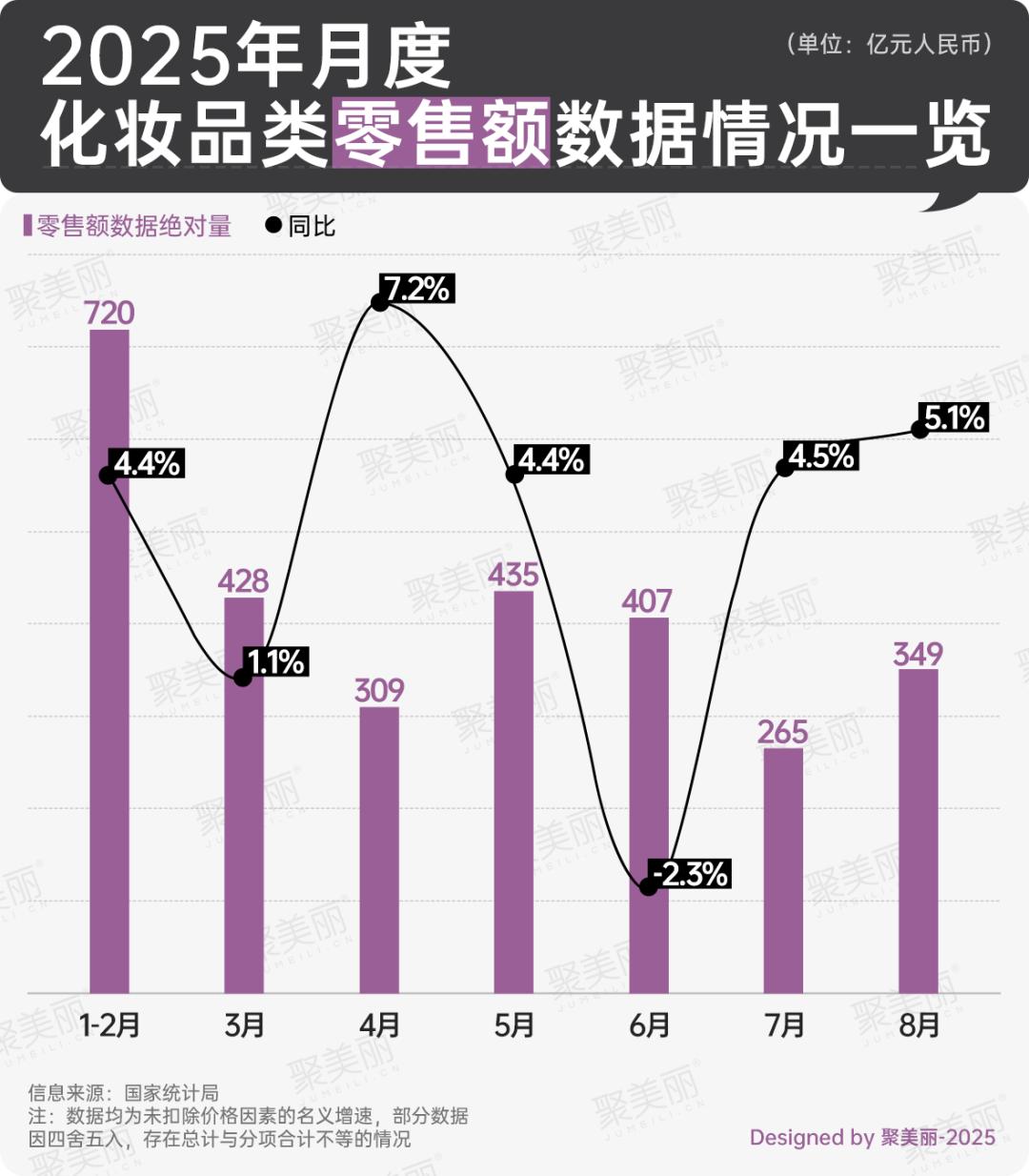
Core Insights - The cosmetics retail sector has experienced significant fluctuations in monthly sales due to macroeconomic weakness and intensified industry competition, with June marking the first negative growth of the year during the 618 shopping festival [1] - Despite a reported recovery in July and August, the actual market sentiment among industry professionals remains pessimistic, indicating a disconnect between statistical data and real-world experiences [6][12] Retail Performance Data - In August, the cosmetics retail sales reached 34.9 billion yuan, showing a year-on-year growth of 5.1%, while the cumulative sales from January to August totaled 291.5 billion yuan, with a growth of 3.3% [3][5] - The overall retail sales of consumer goods in August amounted to 396.68 billion yuan, reflecting a 3.4% year-on-year increase, with non-automotive consumer goods retail sales growing by 3.7% [5] Market Dynamics - The growth in cosmetics retail sales is primarily driven by larger retail enterprises, as smaller businesses and brands are struggling to survive amid economic downturns and increased competition [12][14] - The disparity between reported growth and the experiences of smaller players highlights the challenges faced by non-scale businesses, which are not adequately represented in national statistics [11][12] Industry Challenges - The cosmetics industry is undergoing a transition from a high-growth phase to a period of slower growth and intensified competition, with many small and innovative brands facing significant operational challenges [13][14] - A total of 64 bankruptcy cases related to cosmetics companies have been reported, indicating a troubling trend for the industry, particularly among smaller firms [14][16] Consumer Behavior - The average price of cosmetic products has decreased, with a notable decline in gross margins for brands like 毛戈平, attributed to consumer downgrading and a deteriorating economic environment [23] - A significant portion of consumers (72%) express concerns over rising daily costs, indicating that pricing remains a critical issue for both consumers and brands [23]