
汽车机器人

Search documents
理想汽车三季度财报发布,CEO李想决定回归创业公司模式
Jin Rong Jie· 2025-11-27 03:53
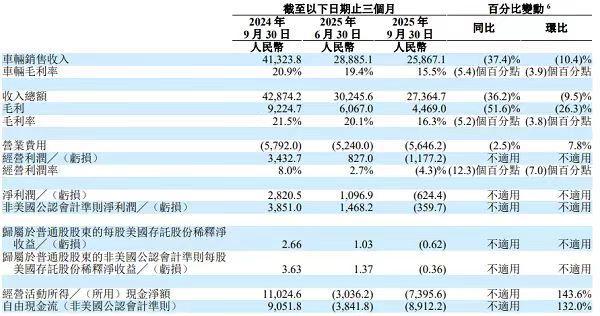
Core Viewpoint - Li Auto reported a third-quarter revenue of 27.4 billion RMB with a net loss of 624.4 million RMB, delivering 93,211 vehicles. The CEO acknowledged that the professional management model is unsuitable for the current unstable market and plans to revert to a startup model in Q4 [1][4]. Financial Performance - Vehicle sales revenue for Q3 was 41.32 billion RMB, down 37.4% year-on-year and 10.4% quarter-on-quarter [2]. - Total revenue for Q3 reached 42.87 billion RMB, reflecting a 36.2% year-on-year decline and a 9.5% quarter-on-quarter decrease [2]. - Gross profit for Q3 was 9.22 billion RMB, a decrease of 51.6% year-on-year and 26.3% quarter-on-quarter [2]. - The gross margin for Q3 was 21.5%, down 5.2 percentage points year-on-year [2]. - Operating profit for Q3 was 3.43 billion RMB, with an operating margin of 8.0%, down 4.3 percentage points year-on-year [2]. - The net cash from operating activities was 11.02 billion RMB, showing a significant improvement of 143.6% [2]. Strategic Direction - Li Auto plans to invest heavily in AI and related technologies, with R&D spending reaching 30 billion RMB in Q3 and an expected total of 120 billion RMB for the year, including over 60 billion RMB in AI [1][2]. - The company aims to transform vehicles into intelligent products, enhancing user experience through features like automated parking and charging [1][2]. - A major redesign of the L series is planned for 2026, with a strategic focus on regaining leadership in range-extended products [4]. Market Outlook - Despite the disappointing Q3 results, the market remains optimistic about Li Auto, with CICC maintaining an outperform rating for the company [4]. - Adjustments to profit forecasts for 2025 and 2026 have been made, with a 66% and 30% reduction respectively, reflecting challenges from recalls and increased competition [4].


基石资本张维,最新发声
Zhong Guo Ji Jin Bao· 2025-04-29 13:46
Group 1: Investment Direction and Strategy - The core investment direction is in hard technology industries where there is a "gap" between China and the U.S., particularly in sectors facing "bottleneck" issues [1][9] - The investment strategy of the company focuses on technological advancement as the main line, seeking benchmark enterprises led by outstanding entrepreneurs [9][10] - The company emphasizes the importance of creating a favorable social environment for innovation and entrepreneurship, rather than merely trading stocks [2][13] Group 2: Manufacturing and Export Achievements - China is recognized as the world's only manufacturing superpower, with a manufacturing output accounting for 35% of the global total, significantly surpassing the U.S., Japan, and Germany [5][6] - In 2023, China became the world's largest automobile exporter, and in 2024, integrated circuits became the largest single export product, reaching an export value of $159.5 billion [3][5] - Despite the growth in chip exports, China still faces a significant trade deficit in integrated circuits, indicating a low self-sufficiency rate in high-end chips [3][6] Group 3: New Energy Vehicle Market Outlook - The future landscape of the new energy vehicle market is summarized as "Five Giants vs. One Hero," identifying key players such as BYD, Chery, Geely, Huawei, Xiaomi, and Tesla [11][12] - Current production capacity in the domestic new energy vehicle sector exceeds demand, with a utilization rate of only 54% [11] - The company believes that as the new energy vehicle industry matures, efficiency and cost-effectiveness will become critical for survival [11][12] Group 4: Technological Innovation and Market Dynamics - The company highlights the historical opportunity for China's technology industry due to macroeconomic changes and the ongoing fourth industrial revolution [7][8] - There is a significant development space in information technology in China, with the sector's market share at 15.62% compared to the U.S. at 23.49% [10] - The company has invested in various sectors, including AI, robotics, and semiconductor industries, to capitalize on the opportunities presented by technological advancements [10]