
沐曦C600

Search documents
沐曦施淑珏:国产GPU商业化加速 软硬协同跨越“好用”门槛
2 1 Shi Ji Jing Ji Bao Dao· 2026-01-23 10:55
Core Insights - The rise of domestic GPU companies is highlighted by the recent IPOs of Moer Thread and Muxi Co., which have intensified market interest in domestic GPUs amid the global AI boom and exponential growth in computing power demand [2][3] Group 1: Market Position and Valuation - The Hurun Research Institute's "2025 Hurun China AI Enterprises Top 50" ranks Cambricon, Moer Thread, and Muxi Co. as the top three AI companies, with Cambricon valued at 630 billion yuan, Moer Thread at 310 billion yuan, and Muxi Co. at 250 billion yuan [2] - Cambricon achieved a revenue of 2.88 billion yuan in the first half of 2025, a staggering 4300% increase year-on-year, while Moer Thread reported a revenue of 780 million yuan in the first three quarters of 2025, up 182% year-on-year [2] Group 2: Industry Trends and Future Outlook - The demand for computing power is expected to double every 3.5 months, with annual growth rates of 500% to 1000%, indicating a strong market outlook for companies like Muxi, Moer, and Cambricon [3] - Muxi Co. is focusing on commercializing its products and has developed a complete self-research technology system from hardware architecture to software stack, enabling a full-stack GPU product matrix [4] Group 3: Commercialization and Product Development - Muxi Co. emphasizes the importance of transitioning from "usable" to "user-friendly" GPUs, assessing performance based on multiple dimensions such as generality, usability, stability, and scalability [4] - The company is one of the few domestic GPU suppliers to achieve large-scale commercial applications with thousands of GPU clusters and is working on the deployment of tens of thousands of GPU clusters [5] Group 4: Strategic Initiatives - Muxi Co. has proposed a "1+6+X" industry layout strategy, targeting six vertical industries including finance, healthcare, energy, education, transportation, and entertainment, while also exploring cutting-edge areas like embodied intelligence and low-altitude economy [7] - The company aims to deepen industrialization and commercialization, with plans for the next-generation C600 product to enter mass production, achieving a closed loop in the domestic supply chain [7][8] Group 5: Ecosystem Development - Muxi Co. is building an open-source ecosystem, with its MXMACA software stack being compatible with mainstream ecosystems, allowing AI applications to migrate to its platform with minimal cost [8] - The MXMACA software stack has over 150,000 users, and the company collaborates with universities to reach over 100,000 students through various activities and courses [8]

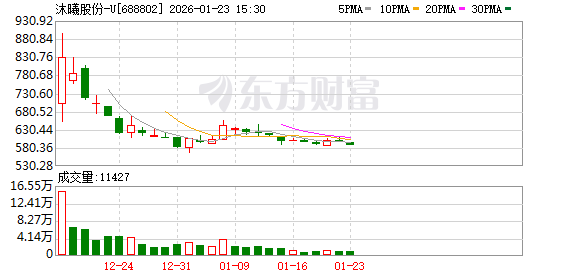
沐曦施淑珏:国产GPU商业化加速,软硬协同跨越“好用”门槛
2 1 Shi Ji Jing Ji Bao Dao· 2026-01-23 10:35
Core Insights - The rise of domestic GPU companies is highlighted by the recent listing of companies like Moer Technology and Muxi Co., which has intensified market interest in domestic GPUs [1] - The Hurun Research Institute's report ranks Cambricon, Moer Technology, and Muxi Co. as the top three AI companies in China based on their valuations, with Cambricon valued at 630 billion yuan, Moer Technology at 310 billion yuan, and Muxi Co. at 250 billion yuan [1] - Muxi Co. emphasizes the importance of transitioning from "usable" to "user-friendly" GPUs, focusing on performance in real AI application scenarios [5] Company Valuation and Market Trends - The valuation of domestic GPU companies reflects optimism about their long-term growth potential, with the global AI application output per capita estimated at $20-30 per month and computing power demand doubling every 3.5 months [2] - Muxi Co. is one of the few domestic GPU suppliers achieving large-scale commercial applications with thousands of GPU clusters, indicating strong engineering capabilities in chip design [6] Product Development and Ecosystem - Muxi Co. has developed a complete self-research technology system from hardware architecture to software stack, enabling a full-stack GPU product matrix [3] - The company aims to build an open-source ecosystem, with its MXMACA software stack being compatible with mainstream ecosystems, allowing for easy migration of AI applications [8] Strategic Industry Layout - Muxi Co. has proposed a "1+6+X" industry layout strategy, targeting six vertical industries including finance, healthcare, energy, education, transportation, and entertainment, along with emerging fields like embodied intelligence [7] - The company plans to deepen its industrialization and commercialization efforts, with its next-generation product C600 entering mass production, achieving a closed-loop domestic supply chain [7]

沐曦施淑珏:国产GPU商业化的关键在于“工程能力”与“软硬协同”
Feng Huang Wang Cai Jing· 2026-01-22 13:52
Core Insights - The article highlights the significant advancements of domestic high-performance GPU companies in China, particularly focusing on Muxi Integrated Circuit, which ranks third in the "2025 Hurun China AI Enterprises Top 50" with a valuation of 250 billion RMB [1] Group 1: Commercialization and Engineering Capabilities - Muxi emphasizes the importance of transitioning from "usable" to "highly usable" GPUs, focusing on multi-dimensional capabilities rather than just single-chip performance [2] - The company is one of the few in China to achieve large-scale commercial applications with thousands of GPU clusters, currently advancing towards ten-thousand GPU clusters [2] - Muxi's founding team has over 20 years of experience in high-end GPU development, enabling them to optimize performance across chip, framework, and model layers for distributed inference [2] Group 2: Software Ecosystem Development - Muxi has developed the MXMACA software stack, which is natively compatible with mainstream ecosystems and has been open-sourced, accumulating over 15 million API calls within a year [3] - The software ecosystem has engaged over 100,000 university student developers through collaborations, facilitating easy migration of AI applications to Muxi's platform [3] Group 3: Industry Strategy and Market Position - Muxi's "1+6+X" strategy targets six vertical industries, including finance, healthcare, and entertainment, with significant progress in the financial sector where major clients are entering the third phase of repurchase [4] - The company has achieved a closed-loop in its supply chain with the next-generation product C600, which is fully based on domestic processes and is set for commercial production [4] Group 4: Future Outlook and Market Dynamics - By 2026, computing power is expected to become as essential as water, electricity, and coal, with demand for computing power doubling every 3.5 months [5][6] - Muxi's market valuation reflects a pricing of future productivity, despite concerns about potential valuation bubbles in the GPU sector [6] - The company remains committed to continuous self-iteration and product development to gain market recognition amidst ongoing competition [6]
国产AI链的大变化
2025-12-29 15:50
Summary of Key Points from the Conference Call Industry Overview - The domestic AI chip market is expected to face a supply shortage in 2026, with the gap between domestic and foreign chip supply narrowing due to increased domestic production capacity and gradual opening of supply from Europe and the US [1][2] - The Internet Data Center (IDC) sector is showing signs of recovery, with large-scale bidding activities resuming, indicating optimism about future demand [1][2] Core Insights and Arguments - Major domestic AI models are expected to close the gap with overseas counterparts, with a projected supply-demand imbalance not only in chips but also in AI models themselves [2] - The introduction of new domestic computing products, such as Huawei's Ascend 950PR, is anticipated in Q1 2026, which may drive more orders from internet companies [1][2] - Two significant AI model companies, Zhiyu and MinMax, are expected to go public around the Spring Festival, which could enhance market confidence in domestic AI enterprises [2] Growth Projections - Domestic computing power is projected to grow by over 50% year-on-year in 2026, driven by increased capital expenditure from domestic internet companies, improved chip performance, and supportive policies [1][3] - The AIDC (AI Data Center) industry chain is experiencing significant changes, with a surge in bidding activity in the first half of 2025, although supply constraints limited growth in the second half [1][7] New Product Launches - The 690 chip is expected to be sampled in early 2026, with its performance and market feedback being crucial for its success [1][5] - Other notable products include Haiguang's DCO 4 and the upcoming C600 and C700 from Muxi, which are expected to be released in 2026 [5] Market Influencing Factors - Increased capital expenditure from domestic internet companies and the performance improvements of chips are key drivers of market growth [3][4] - Policy changes, such as the approval process for high-performance computing cards, will significantly impact market dynamics [4] Beneficiaries of AIDC Industry Changes - Companies with significant internet exposure, such as Chai Fa, are expected to benefit from potential price increases [8] - Other companies to watch include server manufacturers like Inspur and those involved in ITC bidding, such as Runze and Data Port [8] Impact of New Market Entrants - The entry of new players like Enka is not expected to negatively impact domestic cards due to the ongoing supply-demand tightness in 2026 [9] - Focus should be on companies that can continue to raise prices or those that follow volume growth logic, including supply chain players like Weichai and Ruijie [9]
怎么看华为超节点和国产卡26年的竞争格局
2025-08-05 03:20
Summary of Conference Call on Huawei's Super Node and Domestic AI Chip Market Industry Overview - The conference call discusses the domestic AI chip market, focusing on Huawei's 384 Super Node and its competitive landscape against international players like NVIDIA [1][2][8]. Key Points and Arguments - **Huawei 384 Super Node**: - Utilizes high-speed interconnect and optical module technology, enhancing cost-effectiveness and deployment certainty in inference scenarios, serving as a domestic alternative to NVIDIA's Nvlink bottleneck [1][2]. - Supports SP8, providing superior performance in inference tasks compared to many domestic cards lacking this feature [2]. - **Domestic AI Chip Companies**: - Companies like Moer, Muxi, and Suiyuan are narrowing the gap with international leaders through technological advancements, with expectations to increase market share by 2026 [1][4]. - New products from these companies, such as Moer S5000 and Muxi C600, are expected to meet the demands of major internet companies, enhancing their competitive position [4]. - **Market Demand and Supply**: - The demand for domestic computing cards is not limited to internet companies but extends to telecom operators, financial institutions, and state-owned enterprises, indicating a supply-demand imbalance [3][16]. - The market is projected to focus on 2026 valuations, with optimism surrounding the growth of domestic graphics cards [3][13]. - **High-Density Super Point Solutions**: - Companies like Haiguang are developing high-density, high-performance super point solutions, such as a silent liquid cooling solution supporting up to 660 cards, to improve overall computing efficiency [5][6]. - **GPGPU Architecture Development**: - Domestic GPGPU architecture is evolving, with companies like Huawei Ascend transitioning to GPGPU to reduce interconnect development risks [7]. - The integration of DSA functions into GPUs by manufacturers like Moer indicates a trend towards technological convergence [7]. - **Future Market Dynamics**: - The competitive landscape is expected to become more complex by 2026, with new product launches and testing processes for internet companies [10][12]. - Despite the anticipated changes, the overall market structure is expected to remain stable, with Huawei leading, followed by Cambricon and Haiguang [10]. Additional Important Insights - **Inference Demand Growth**: - The increasing demand for inference capabilities, especially in the context of the multi-modal era, is driving the need for domestic computing cards [9][12]. - **AI Application Revenue**: - Significant growth in AI application revenues is anticipated, with estimates for companies like Keling reaching $200 million in 2025 [10]. - **Comparison with U.S. Market**: - The U.S. market is dominated by a few major clients, while China's demand is diversified across numerous long-tail customers, indicating a robust growth potential for domestic computing cards [16]. This summary encapsulates the critical insights from the conference call, highlighting the competitive landscape, technological advancements, and market dynamics within the domestic AI chip industry.