海南椰子鸡

Search documents
椰子鸡:一锅清甜,品味海岛风情(跟着味蕾去旅行)
Ren Min Ri Bao· 2025-10-03 22:02
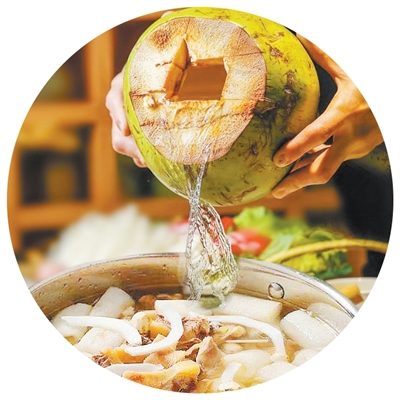
Core Insights - Hainan coconut chicken is a unique dish that emphasizes the natural flavors of its ingredients, attracting tourists to Hainan for its fresh and delicious taste [2][3] Ingredient Quality - The key to the dish's flavor lies in the use of fresh coconuts and Wenchang chicken, with the right maturity of coconuts being crucial for optimal sweetness [3] - Wenchang chicken, raised in coconut groves, is known for its tender meat and thin skin, requiring no marination before cooking [3] Culinary Experience - The dining experience of coconut chicken is ritualistic, starting with tasting the sweet broth followed by the tender chicken, enhanced by a special dipping sauce made from local ingredients [5][6] Economic Impact - The popularity of coconut chicken has led to the development of a billion-yuan industry chain, promoting a "company + farmer" model for standardized Wenchang chicken farming [7] - Thousands of local farmers have benefited from the cultivation of ingredients like sand ginger and green tangerines, contributing to their income [7] - The improvement of cold chain logistics has facilitated the expansion of coconut chicken restaurants across the country [7]

一瓶4.9元,椰子水战争刀刀见红
创业邦· 2025-06-06 03:17
Core Viewpoint - The article discusses the growing demand for coconuts in China, highlighting the "Coconut Water War" as companies rush to secure coconut supplies from Southeast Asia to meet domestic needs [3][23]. Group 1: Market Demand and Supply - In the past four years, Chinese consumers have consumed 1.2 billion cups of Luckin Coffee's coconut latte, indicating a significant market for coconut products [8]. - China’s annual coconut demand exceeds 4 billion coconuts, with 60% for fresh consumption and the remainder for processing [21]. - Hainan's coconut production meets only 10% of domestic demand, leading to a reliance on imports [3][22]. Group 2: Industry Players and Strategies - Luckin Coffee plans to procure 1 million tons of coconuts from Indonesia over five years to secure its supply chain [10]. - IMCOCO, a new company, aims to replicate the success of Thai coconut water brands in China, targeting a production of 600 million bottles annually [19]. - Established companies like Shanghai Jianong Foods are also investing in coconut water production, with significant land and processing capabilities in Thailand [38]. Group 3: Economic Impact and Trends - The coconut market is experiencing rapid growth, with the coconut water beverage market projected to expand from $101.8 million in 2019 to $1.093 billion by 2024, reflecting a compound annual growth rate of 60.8% [41]. - The influx of Chinese companies into Southeast Asia for coconut sourcing is creating economic shifts, impacting local prices and availability for residents [52][53]. - The article warns of potential market saturation, with over 50 coconut water brands expected by 2025, leading to quality concerns and price wars [46][47]. Group 4: Challenges and Future Outlook - The coconut industry faces challenges such as a lack of industry standards, leading to quality inconsistencies in coconut water products [47]. - Rising coconut prices in Southeast Asia, driven by increased demand, have outpaced inflation rates, creating economic strain on local populations [54]. - Experts predict that by 2025, China's annual coconut demand will be 10-20 times the current production capacity of Hainan, necessitating a shift from a "traffic dividend" to a "value dividend" in the industry [54].

一瓶4.9元,椰子水战争刀刀见红
3 6 Ke· 2025-06-05 04:13
Core Insights - The increasing demand for coconuts in China is evident, with significant consumption figures such as 1.2 billion cups of Luckin Coffee's coconut latte over four years and 1.1 billion yuan worth of Thai coconut water consumed in one year [1][4][12] - The domestic coconut production in Hainan can only meet 10% of the demand, leading to a heavy reliance on imports, primarily from Southeast Asia, where coconut prices have surged [1][13][14] - Major Chinese companies and entrepreneurs are actively engaging in the coconut supply chain in Southeast Asia, aiming to secure fresh coconut sources, marking the beginning of a "coconut water war" [1][14] Market Dynamics - The coconut water market in China is rapidly expanding, with projections indicating a growth from $101.8 million in 2019 to $1.0933 billion by 2024, reflecting a compound annual growth rate of 60.8% [21] - The market is characterized by two business models: the "lazy win" model, which relies on overseas raw materials and brands, and the "laborious model," which involves building local brands and managing the entire supply chain [16][20] - Companies like IMCOCO and Shanghai Jianong Foods are establishing themselves in the coconut market, with IMCOCO planning to produce 600 million bottles of coconut water annually [11][21] Competitive Landscape - The competition is intensifying, with numerous new entrants in the coconut water market, leading to a potential oversaturation of brands, which could complicate consumer choices [25] - The lack of industry standards for coconut water quality has resulted in consumer trust issues, as some products have been reported to contain additives that compromise their natural appeal [26] - Price wars are emerging, with coconut water prices dropping significantly despite rising production costs, raising concerns about product quality and sustainability [27] Economic Impact - The surge in coconut demand from China is impacting local economies in Southeast Asia, with rising prices affecting the affordability of coconuts for local consumers [28] - The coconut processing industry in Indonesia is facing challenges due to increased raw material costs, leading to reduced profit margins for small manufacturers [28] - Experts predict that China's annual coconut demand will far exceed local production capabilities, necessitating a shift towards sustainable practices and innovation in the coconut industry [28]