海味零食

Search documents
因债务逾期,良品铺子控股股东收到法院执行通知书
Shen Zhen Shang Bao· 2026-02-03 15:13
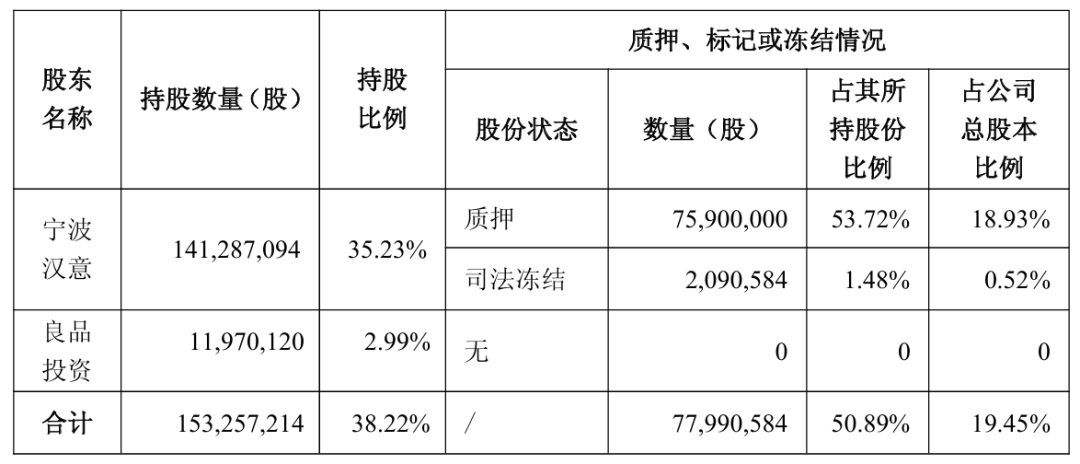
Core Viewpoint - The company faces financial challenges due to the default of its controlling shareholder, which may lead to forced execution of pledged shares, but asserts that its daily operations remain unaffected [1][2]. Group 1: Shareholder and Debt Situation - The controlling shareholder, Ningbo Hanyi, has a total debt of approximately 280 million yuan, with 53.72% of its shares pledged [1]. - As of the announcement date, Ningbo Hanyi has pledged 75.9 million shares, accounting for 18.93% of the company's total share capital [1]. - The company has a total of 153.26 million shares held by major shareholders, with 50.89% of these shares either pledged or frozen [1]. Group 2: Company Performance and Financial Outlook - The company reported a projected net loss of 120 to 160 million yuan for 2025, marking a new low since its listing [2]. - The decline in net profit is attributed to the optimization of store structure, resulting in a decrease in sales revenue [2]. - The company has also experienced a decrease in interest income and government subsidies, with declines of approximately 18 million yuan and 23 million yuan, respectively [2]. Group 3: Store Operations - As of September 30, 2025, the company operates 2,227 stores, having closed 283 and opened 65, resulting in a net decrease of 218 stores [3]. Group 4: Market Performance - As of February 3, the company's stock price decreased by 0.50% to 11.97 yuan per share, with a total market capitalization of approximately 4.8 billion yuan [4]. - Over the past year, the company's stock price has declined by nearly 20% [4].


休闲食品企业加速线下“抢滩” 全渠道融合或重塑行业格局
Zhong Guo Chan Ye Jing Ji Xin Xi Wang· 2026-01-07 01:10
Core Insights - The leisure food industry is witnessing a significant shift towards offline channel expansion, with companies like Three Squirrels and Qiaqia Foods enhancing their physical presence to meet evolving consumer demands for health, cost-effectiveness, and convenience [1][2][4] Group 1: Offline Channel Expansion - Three Squirrels is opening its first batch of seven standard stores across various cities, aiming to cover a wide range of consumer needs with a new product mix that includes fresh and prepared items, with a self-branding ratio of 90% [2] - Salted Fish's strategy focuses on returning to supermarkets to become a deeper partner in retail channels, enhancing consumer trust through flexible channel strategies [2] - Qiaqia Foods is actively expanding its snack wholesale channels by increasing SKU variety and store coverage to improve channel performance [2] Group 2: Hard Discount Retail Growth - Hard discount retailers, represented by internet and retail giants, are aggressively expanding their offline presence, with Meituan's "Happy Monkey" and Hema's "Super Box" planning to open numerous new stores in the coming years [3] - The trend of channel transformation is reshaping the industry landscape, with a notable rise in various offline formats such as convenience stores, membership warehouses, and discount stores, alongside innovations in online retail models [3] Group 3: Product Diversification and Health Trends - The leisure food sector is diversifying its product offerings, with companies like Three Squirrels introducing a range of new items to meet personalized consumer demands [4] - Good Products is also expanding its product categories to cover a wide array of consumer needs, including healthy and convenient food options [4] - Health attributes are becoming a core selling point, with consumers increasingly favoring products that are natural, simple in ingredients, and free from excessive additives, raising the bar for innovation and supply chain efficiency [4] Group 4: Market Trends and Challenges - The Chinese snack industry is maturing, with consumer demands shifting towards health, functionality, and cost-effectiveness [5] - The expansion of volume discount stores and instant retail is expected to reshape the market landscape, driven by penetration into niche scenarios and regional market expansion [5] - Key challenges facing the industry include raw material cost fluctuations, homogenization of products, and food safety risks [6]

良品铺子拟15亿卖身武汉国资,前者控股股东部分股权遭冻结
Sou Hu Cai Jing· 2025-07-18 03:32
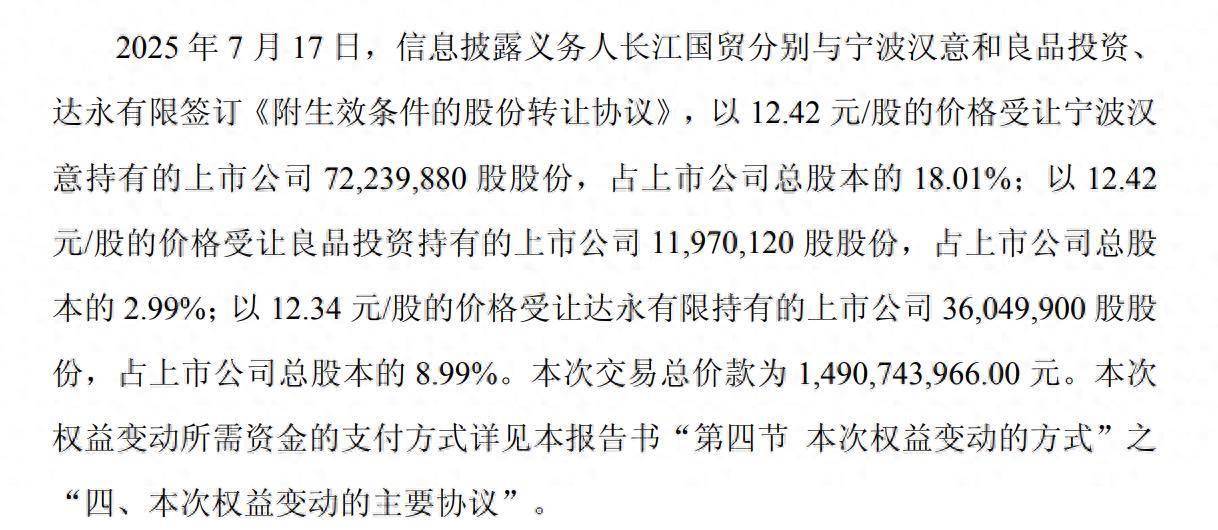
Group 1 - Wuhan Jin Kong holds 100% equity of Changjiang Guomao and is the controlling shareholder, with the actual controller being the State-owned Assets Supervision and Administration Commission of Wuhan [1] - Ningbo Hanyi, the controlling shareholder of the listed company Liangpin Shop, is involved in a contractual dispute with Guangzhou Light Industry Group regarding the transfer of shares [2] - After the completion of the equity change, Changjiang Guomao will directly hold 120 million shares of the listed company, accounting for 29.99% of the total share capital, changing the controlling shareholder from Ningbo Hanyi to Changjiang Guomao [3] Group 2 - Liangpin Shop, founded in 2006, is a multi-channel snack food enterprise with products covering various categories including meat snacks, seafood snacks, and nuts [4] - Liangpin Shop expects a net profit attributable to shareholders of the listed company to be between -75 million to -105 million yuan for the first half of 2025, indicating a loss compared to the same period last year [4]
股价提前涨停!良品铺子要易主,7月11日起停牌
Bei Jing Shang Bao· 2025-07-10 12:50
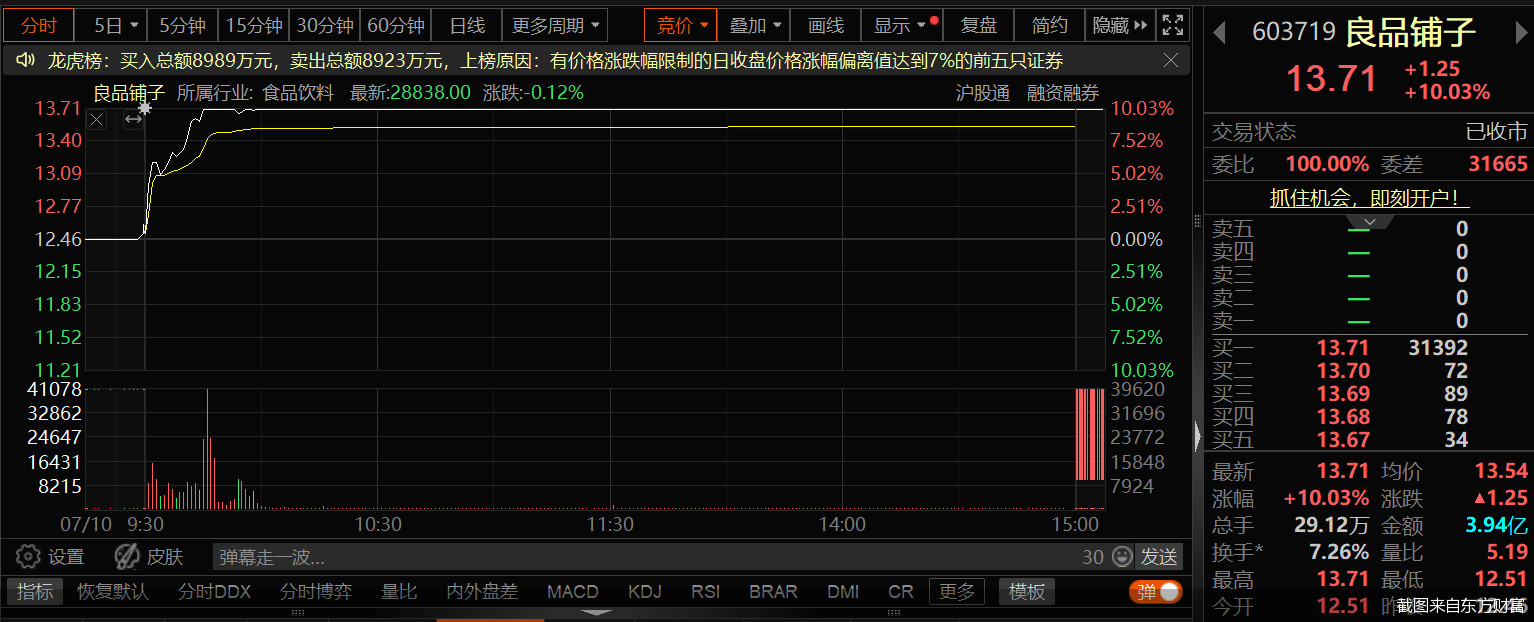
Company Overview - On July 10, the company announced that its controlling shareholder, Ningbo Hanyi Venture Capital Partnership, is planning a significant matter that may lead to a change in control of the company, resulting in the suspension of its stock from July 11 for up to two trading days [1][3] - As of the end of Q1 this year, Ningbo Hanyi directly holds 35.23% of the company's shares, making it the controlling shareholder [2] Stock Performance - On July 10, the company's stock price hit the daily limit, closing at 13.71 yuan per share, with a trading volume of 394 million yuan and a total market capitalization of approximately 5.498 billion yuan [3] Financial Performance - The company reported net profits for the years 2020 to 2024 as follows: approximately 344 million yuan, 282 million yuan, 336 million yuan, 180 million yuan, and a loss of 46.1 million yuan [5] - The company has indicated that its net profit for 2024 is expected to decline due to a strategy of lowering prices without compromising quality, which affects gross margins [5] Industry Context - The snack food industry is currently experiencing intense competition and channel transformation, with the top five brands holding less than 20% market share and frequent price wars due to severe product homogeneity [5] - The rapid expansion of snack retail stores is impacting traditional sales channels [5]