
港股投资策略

Search documents
中金公司刘刚:2026年买A股还是买港股?布局四大主线
Xin Lang Cai Jing· 2026-01-15 08:35
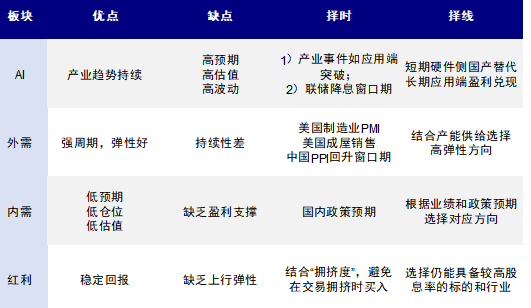
Core Insights - The 2026 Global and China Capital Market Outlook Forum was held on January 15, focusing on wealth logic in the AI era and the future of capital markets [1][6]. Market Outlook - The target index for Hong Kong stocks in 2026 is set between 28,000 and 29,000 points, with a core principle of "structure over market" and a focus on four key sectors [2][7]. - The 2025 market performance was satisfactory, with a previous target of 26,000 points for the Hang Seng Index being met [2][7]. - The expectation for 2026 is based on the assessment that Hong Kong's earnings growth may lag behind that of A-shares, but this outlook could change with significant fiscal policy support [2][7]. Sector Analysis - The four key sectors for investment in Hong Kong stocks are dividends, internet, new consumption, and innovative pharmaceuticals, which are seen as having unique advantages [2][7]. - AI remains a primary investment theme, with A-shares focusing on hardware and Hong Kong stocks on application sectors, indicating a complementary market strategy [3][8]. - The cyclical sector is highlighted as a focus for the first quarter, including copper, aluminum, chemicals, engineering machinery, and real estate-related tools, supported by U.S. demand and favorable domestic policies [3][8]. - The consumer sector lacks overall fundamental support, suggesting a selective approach to stock picking based on deep value [3][8]. Investment Strategy - The investment strategy revolves around "following credit expansion," with funds naturally gravitating towards areas of credit growth, even considering opportunities from overseas credit expansion [3][8]. - The analysis emphasizes the importance of structural investment over market timing, particularly in sectors with strong credit expansion dynamics [3][8].


港股开盘 | 恒指低开0.33% 医药股活跃
智通财经网· 2025-08-12 01:39
Market Overview - The Hang Seng Index opened down 0.33%, while the Hang Seng Tech Index fell by 0.59%. Pharmaceutical stocks were active, with Fosun Pharma rising over 7%, and lithium stocks continued their strong performance, with Tianqi Lithium increasing by over 2%. Consumer stocks weakened, with China Duty Free and Haitian Flavoring & Food both declining nearly 1% [1] Future Outlook for Hong Kong Stocks - Huatai Securities released a report indicating that the recent pullback in Hong Kong stocks is primarily due to adjustments in internal and external expectations, but the medium-term liquidity easing logic remains unchanged. The report suggests focusing on sectors with improving sentiment and low valuations, particularly emphasizing the technology sector. Short-term trading should revolve around interim report performances, with recommendations to pay attention to: 1) gaming and e-commerce leaders with cost-effective valuations and improving sentiment; 2) innovative drugs and non-bank financials with slightly higher forward 12-month valuation percentiles but high earnings realization [1] - Guotai Junan Securities forecasts that Hong Kong stocks are likely to continue their bull market trend in the second half of the year, driven by continued inflows of incremental capital and structural advantages in asset allocation. The report highlights the need to monitor both outflow and inflow factors regarding liquidity. It notes that the total financing scale for the year may approach HKD 300 billion, while the overall reduction pressure is easing after the peak of unlocks in the second quarter [2] - China International Capital Corporation (CICC) emphasizes that the behavior of dominant funds determines the structure and model of rising industries. Historically, liquidity-driven markets tend to concentrate on leading industries rather than rotating between high and low positions. The report indicates that the focus is currently on AI, innovative drugs, resources, and the STAR Market [2] Liquidity and Trading Activity - Bank of China International states that the Hong Kong Monetary Authority's sale of USD for HKD has a minimal impact on the Hong Kong stock market, as these funds primarily have a low-risk appetite and focus on high-interest deposits. The report indicates that liquidity in the Hong Kong stock market remains ample, with an average daily turnover of HKD 262.9 billion in July 2025, representing a year-on-year growth of 167%. As of August 6, the average daily turnover for August is HKD 233.5 billion, still at historical highs [3] - The report predicts that the Hang Seng Index will reach 27,500 points by the end of December this year, corresponding to a forecasted price-to-earnings ratio of 12.3 times, which is a 5% premium over the average forecasted P/E ratio over the past 20 years. Additionally, southbound trading has recorded a net inflow of RMB 833.2 billion this year, a year-on-year increase of 109.8%. The forecast for net inflows from mainland China to Hong Kong southbound trading in 2025 is expected to reach RMB 1.2 trillion, surpassing RMB 744 billion in 2024 and RMB 289.4 billion in 2023 [3]