濒海战斗舰

Search documents
美媒:大量美空中及海上军事力量在中东地区集结
Xin Lang Cai Jing· 2026-02-19 15:50
Group 1 - The core viewpoint of the article highlights the increased military presence of the US in the Middle East, with deployments of aircraft, early warning systems, and drones in countries such as Jordan, Saudi Arabia, Bahrain, and the UAE [1] - The US Navy has positioned multiple destroyers and littoral combat ships near the Red Sea, Persian Gulf, and Strait of Hormuz, with the "Abraham Lincoln" carrier strike group, including F-35C Lightning II fighters, currently in the North Arabian Sea [1] - The "Ford" carrier strike group is expected to arrive as early as the upcoming weekend, indicating a significant escalation in military readiness in the region [1] Group 2 - Analysis from the US-based Institute for Science and International Security indicates that Iran has recently reinforced its military and nuclear facilities, suggesting heightened tensions and potential threats [1] - Joint naval exercises between Iran and Russia commenced on February 19, further complicating the geopolitical landscape in the region [1] - The commander of the Iranian Islamic Revolutionary Guard Corps Navy stated that the Iranian Navy is prepared to close the Strait of Hormuz at any time upon receiving orders, emphasizing the strategic importance of this maritime chokepoint [1]

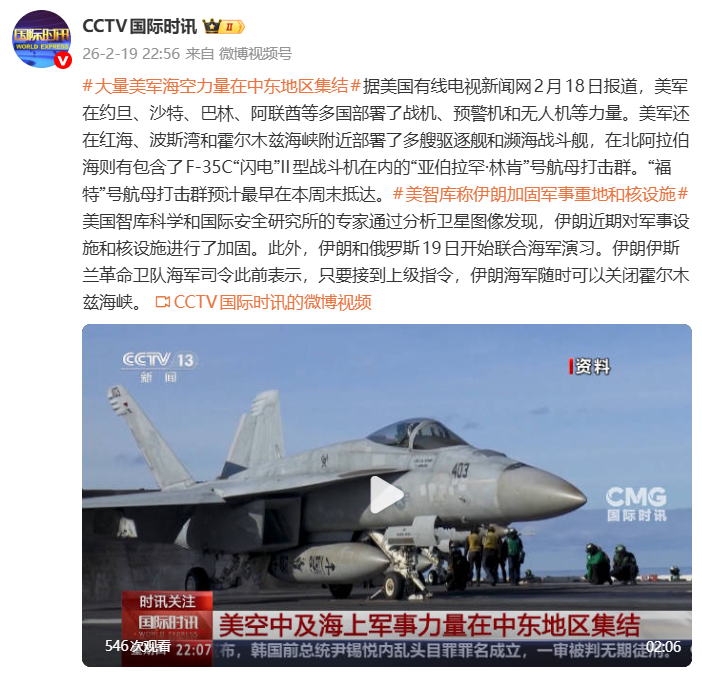
大量美军在中东地区集结
财联社· 2026-02-19 15:10
Military Deployment - The U.S. military has deployed aircraft, early warning systems, and drones in multiple countries including Jordan, Saudi Arabia, Bahrain, and the UAE [1] - Naval forces including destroyers and littoral combat ships have been positioned near the Red Sea, Persian Gulf, and Strait of Hormuz, with the "Abraham Lincoln" carrier strike group in the North Arabian Sea [1] - The "Ford" carrier strike group is expected to arrive as early as the upcoming weekend [1] Regional Tensions - Experts from the U.S. think tank, the Institute for Science and International Security, have noted that Iran has recently reinforced its military and nuclear facilities based on satellite imagery analysis [1] - Iran and Russia commenced joint naval exercises on February 19 [1] - The commander of the Iranian Islamic Revolutionary Guard Corps Navy stated that the Iranian Navy is prepared to close the Strait of Hormuz upon receiving orders [1]

特朗普要造战列舰,真能造出来吗?
Xin Lang Cai Jing· 2025-12-28 13:11
Group 1 - The U.S. President Trump announced the construction of a new battleship named "Trump-class," which he claims will be the fastest and largest warship in the U.S. Navy [1][2] - The estimated cost of the "Trump-class" battleship is over $15 billion, exceeding that of the Ford-class aircraft carrier [2] - The design and review process for the new battleship is expected to take 72 months, or 6 years, and it will replace the previous DDG(X) next-generation destroyer project [1][2] Group 2 - The "Trump-class" battleship will not be a traditional multi-turret battleship but will primarily use missiles as its main weapon, featuring advanced systems such as the MK-41 vertical launch system and hypersonic missile launchers [2] - Military experts express skepticism about the feasibility of the "Trump-class," citing challenges in integrating various advanced weapon systems that are still in development [3] - The construction of the "Trump-class" battleship raises concerns about the U.S. Navy's ability to deliver on such ambitious projects, given past difficulties with new vessel designs [3][5]
美国不兜底了!特朗普果然精明,高市早苗退路被彻底堵死
Sou Hu Cai Jing· 2025-12-17 06:15
Core Viewpoint - The U.S. is shifting its national security strategy to focus on its own hemisphere, indicating a reduction in global military commitments and a prioritization of domestic interests over international alliances [5][12][25]. Group 1: U.S. National Security Strategy - The recently released National Security Strategy report emphasizes that the U.S. will no longer act as the global police, instead concentrating on its own backyard [5][12]. - The report serves as a final warning to countries relying on U.S. protection, particularly Japan, indicating a loss of support for their security [5][12]. - The U.S. military budget for 2024 is set at $895 billion, a historical high, but the distribution of resources globally is becoming increasingly strained [7][11]. Group 2: Military Capacity and Production Issues - The U.S. military faces significant production challenges, with ammunition consumption in Ukraine exceeding annual production capabilities [7][9]. - Key naval assets, such as the Zumwalt-class destroyers, are underperforming, with only three incomplete vessels currently in port [9]. - The report highlights the need for the U.S. to control strategic locations like the Panama Canal while reducing military engagements in Europe and the Middle East [12][25]. Group 3: Japan's Strategic Dilemma - Japanese Prime Minister Kishi's hardline stance towards China has backfired, as the U.S. strategy indicates a withdrawal of support, leaving Japan vulnerable [13][20]. - The report does not mention Taiwan, signaling a reluctance from the U.S. to be drawn into conflicts that could jeopardize its interests [20][22]. - Japan's reliance on the U.S. for security is now questioned, as the report positions Japan as a tool for U.S. interests rather than an equal partner [20][22]. Group 4: Comparison with South Korea - South Korean President Lee Jae-myung adopts a more pragmatic approach, balancing relations between the U.S. and China, which allows for greater strategic flexibility [23]. - This contrasts sharply with Japan's approach, which is seen as short-sighted and overly reliant on U.S. support [23][25]. Group 5: China's Response - China maintains a clear stance of not initiating conflict but will respond strongly to challenges against its core interests, as evidenced by its recent diplomatic actions [27]. - The rapid shipbuilding capabilities of China, with a significant share of global tonnage, highlight its growing military strength compared to the U.S. [11][27].