朱姆沃尔特级驱逐舰

Search documents
特朗普要造战列舰,真能造出来吗?
Xin Lang Cai Jing· 2025-12-28 13:11
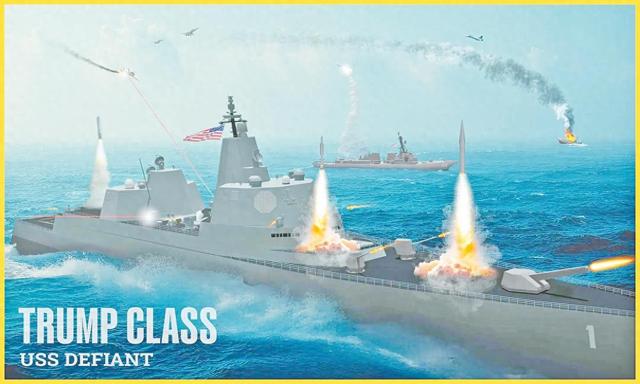
Group 1 - The U.S. President Trump announced the construction of a new battleship named "Trump-class," which he claims will be the fastest and largest warship in the U.S. Navy [1][2] - The estimated cost of the "Trump-class" battleship is over $15 billion, exceeding that of the Ford-class aircraft carrier [2] - The design and review process for the new battleship is expected to take 72 months, or 6 years, and it will replace the previous DDG(X) next-generation destroyer project [1][2] Group 2 - The "Trump-class" battleship will not be a traditional multi-turret battleship but will primarily use missiles as its main weapon, featuring advanced systems such as the MK-41 vertical launch system and hypersonic missile launchers [2] - Military experts express skepticism about the feasibility of the "Trump-class," citing challenges in integrating various advanced weapon systems that are still in development [3] - The construction of the "Trump-class" battleship raises concerns about the U.S. Navy's ability to deliver on such ambitious projects, given past difficulties with new vessel designs [3][5]
“特朗普”级战列舰计划是闹剧一场?专家辣评:永不启航的纸老虎
Jin Shi Shu Ju· 2025-12-26 09:33
Core Viewpoint - The announcement of the "Trump-class" battleship by President Trump claims it will be the "fastest, largest, and most powerful" battleship, but experts argue that battleships are outdated and the project faces significant challenges [1][2]. Group 1: Project Overview - The "Trump-class" battleship is described as a super warship that aims to maintain U.S. military dominance and intimidate adversaries [1]. - The last U.S. battleship was built over 80 years ago, and the last Iowa-class battleships were retired nearly 30 years ago, indicating that the concept of battleships is outdated [1][2]. Group 2: Expert Opinions - Mark Cancian from CSIS believes the project is impractical due to its long design cycle, high costs, and misalignment with the Navy's current distributed firepower strategy [1][5]. - Bernard Loo compares the project to Japan's Yamato and Musashi battleships, suggesting it is more about prestige than practical military utility [2]. Group 3: Design and Functionality - The proposed battleship will have a displacement of over 35,000 tons and a length exceeding 840 feet, which could make it a target for enemy forces [2]. - Bryan Clark emphasizes that the effectiveness of a vessel relies more on its weaponry than its classification, noting that the Trump-class will include advanced weapon systems like electromagnetic railguns and laser weapons [4]. Group 4: Cost and Budget Implications - The estimated cost of the Trump-class battleship could exceed $8 billion, making it 2 to 3 times more expensive than current destroyers, which could strain the Navy's budget [6]. - Historical context shows that U.S. weapon projects often exceed their budgets and timelines, as seen with the Zumwalt-class destroyer, which was reduced from 32 to 3 units due to cost overruns [6].
特朗普要建“特朗普级”战列舰,称战斗力爆棚,军事专家打出多个问号
Feng Huang Wang Cai Jing· 2025-12-24 09:21
Core Viewpoint - The new "Trump-class" battleship, as described by Trump, raises questions regarding its firepower and feasibility, particularly in comparison to existing naval vessels like the Zumwalt-class destroyer [1] Group 1: Ship Specifications - The planned "Trump-class" battleship has a displacement of 30,000 to 40,000 tons, significantly larger than the Zumwalt-class destroyer, which has a displacement of approximately 15,000 tons [1] - The battleship is expected to feature a vertical launch system with 128 cells and 12 hypersonic weapons, alongside unspecified laser and electromagnetic weapons [1] Group 2: Operational and Technical Concerns - There are contradictions in the proposed systems, such as the claim of high AI control versus the need for 650 to 850 crew members [1] - The large size and displacement of the "Trump-class" may lead to challenges regarding cost, construction time, and overall feasibility for the U.S. [1]


美国复活超级战列舰有多难
Xin Lang Cai Jing· 2025-12-24 06:28
Core Viewpoint - The U.S. Navy is set to construct a new class of battleships named the "Trump" class, which will be the first battleships built since 1944, raising questions about the U.S.'s capability to build such super warships in the modern era [1][3]. Group 1: Specifications and Features - The "Trump" class battleship will have a displacement of over 35,000 tons and will be classified as a guided missile battleship, with the first ship named "Fearless" (BBG-1) [3][4]. - It will feature modern armaments including hypersonic missiles, a 32-megajoule electromagnetic railgun, and various laser interception systems, making it heavily armed [4][5]. - The battleship will measure between 840-880 feet (approximately 256-268 meters) in length and will have a maximum speed exceeding 30 knots, with a crew of approximately 650-850 personnel [4][5]. Group 2: Historical Context and Comparison - Historically, battleships were the core vessels of naval fleets until the rise of aircraft carriers, with the last U.S. battleships being the Iowa class, which saw action in the Gulf War before being retired [3][4]. - The "Trump" class battleship will surpass the current largest surface combatant, the Zumwalt-class destroyer, which has a displacement of 15,000 tons [4][5]. Group 3: Construction and Economic Implications - The U.S. Navy plans to build 10 "Trump" class battleships, with potential for up to 25, at an estimated cost of $10 billion to $15 billion each [8][9]. - The construction of these battleships is seen as vital for revitalizing the U.S. shipbuilding industry, with jobs expected to be created across various states [10]. Group 4: Challenges and Concerns - There are significant concerns regarding the U.S. Navy's declining shipbuilding capacity, with many shipyards having transitioned or closed since World War II, limiting the ability to construct such large vessels [9][10]. - The availability of skilled labor is also a concern, as the shipbuilding industry may struggle to find enough workers to meet the demands of constructing the "Trump" class battleships [10]. Group 5: Strategic Relevance - Critics argue that in the current era of naval warfare, characterized by the use of unmanned vessels and hypersonic weapons, smaller and more agile ships may be more effective than large battleships [11]. - The "Trump" class battleship's design may contradict the U.S. Navy's recent focus on distributed maritime operations, which emphasizes a networked approach using smaller platforms [11].
美国不兜底了!特朗普果然精明,高市早苗退路被彻底堵死
Sou Hu Cai Jing· 2025-12-17 06:15
Core Viewpoint - The U.S. is shifting its national security strategy to focus on its own hemisphere, indicating a reduction in global military commitments and a prioritization of domestic interests over international alliances [5][12][25]. Group 1: U.S. National Security Strategy - The recently released National Security Strategy report emphasizes that the U.S. will no longer act as the global police, instead concentrating on its own backyard [5][12]. - The report serves as a final warning to countries relying on U.S. protection, particularly Japan, indicating a loss of support for their security [5][12]. - The U.S. military budget for 2024 is set at $895 billion, a historical high, but the distribution of resources globally is becoming increasingly strained [7][11]. Group 2: Military Capacity and Production Issues - The U.S. military faces significant production challenges, with ammunition consumption in Ukraine exceeding annual production capabilities [7][9]. - Key naval assets, such as the Zumwalt-class destroyers, are underperforming, with only three incomplete vessels currently in port [9]. - The report highlights the need for the U.S. to control strategic locations like the Panama Canal while reducing military engagements in Europe and the Middle East [12][25]. Group 3: Japan's Strategic Dilemma - Japanese Prime Minister Kishi's hardline stance towards China has backfired, as the U.S. strategy indicates a withdrawal of support, leaving Japan vulnerable [13][20]. - The report does not mention Taiwan, signaling a reluctance from the U.S. to be drawn into conflicts that could jeopardize its interests [20][22]. - Japan's reliance on the U.S. for security is now questioned, as the report positions Japan as a tool for U.S. interests rather than an equal partner [20][22]. Group 4: Comparison with South Korea - South Korean President Lee Jae-myung adopts a more pragmatic approach, balancing relations between the U.S. and China, which allows for greater strategic flexibility [23]. - This contrasts sharply with Japan's approach, which is seen as short-sighted and overly reliant on U.S. support [23][25]. Group 5: China's Response - China maintains a clear stance of not initiating conflict but will respond strongly to challenges against its core interests, as evidenced by its recent diplomatic actions [27]. - The rapid shipbuilding capabilities of China, with a significant share of global tonnage, highlight its growing military strength compared to the U.S. [11][27].

军费多不代表花得对!美国军费近9000亿,军工产业还是走进死胡同
Sou Hu Cai Jing· 2025-09-27 04:51
Core Insights - The U.S. military-industrial complex is facing significant challenges despite a record military budget of $895.2 billion for FY2025, which exceeds the combined military budgets of China, Russia, and seven other military powers [1] - The current state of U.S. military production is marked by delays and inefficiencies, with notable examples including the Ford-class aircraft carrier and the F-35 fighter jet, which has seen production halts [1] Group 1: Market Competition and Monopolization - The decline of competition in the U.S. military-industrial sector has led to a monopolistic environment, reducing innovation and increasing costs for the Pentagon [3][5] - Historical market competition during and after World War II fostered a diverse range of manufacturers, but deregulation in the 1980s led to a consolidation of firms, resulting in fewer players like Lockheed Martin and Boeing dominating the market [5] - The lack of competition has allowed companies to increase prices and reduce accountability, exemplified by Lockheed Martin's pricing strategies and Boeing's failed E-7 early warning aircraft tests [5] Group 2: Budget Allocation Issues - The U.S. military's budget allocation is heavily skewed towards ammunition and immediate operational needs, with a 24% increase in ammunition procurement budget to $30.6 billion for FY2024 [7][9] - This focus on short-term needs has led to a neglect of research and development funding, causing significant projects like the F/A-XX sixth-generation fighter and Constellation-class frigate to be delayed or canceled [9] Group 3: Supply Chain Challenges - The U.S. military-industrial complex is heavily reliant on global supply chains, with 19 out of 35 critical minerals sourced primarily from China, impacting production capabilities [10][12] - Supply chain disruptions have contributed to delays in the construction of key military assets, such as the Zumwalt-class destroyer and the F-35 fighter jet [12] Group 4: Export Market Vulnerabilities - The export market for U.S. military equipment is under threat, with 26% of Lockheed Martin's $65.9 billion revenue coming from exports, and Raytheon's export ratio at 39% [14] - Restrictions on exporting advanced equipment like the F-22 and competition from other nations developing their own military technologies further complicate the export landscape [14] Conclusion - The systemic issues within the U.S. military-industrial complex, including monopolization, budget misallocation, and supply chain vulnerabilities, suggest that merely increasing military spending will not resolve the underlying problems [15] - A sustainable military power requires a robust industrial system, effective resource allocation, and a collaborative approach, rather than a focus on arms races [15]


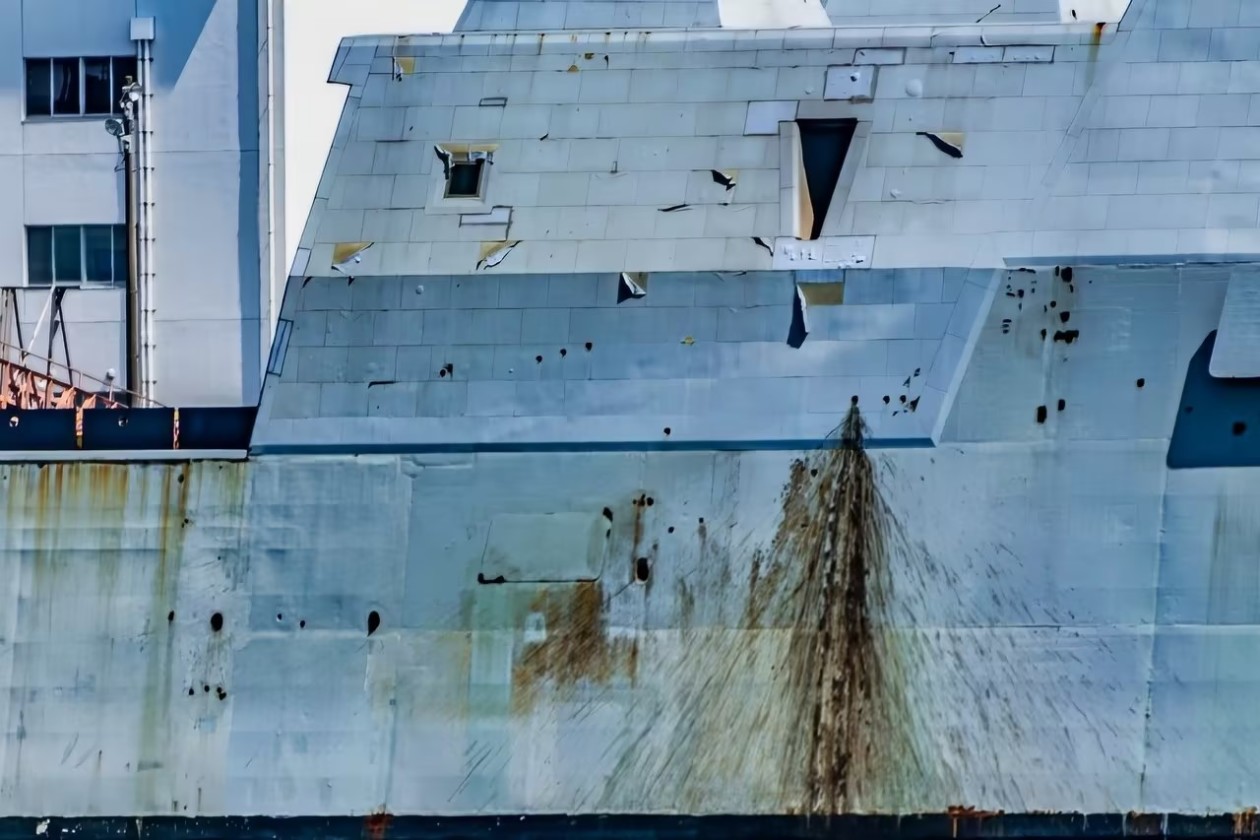
美媒:美国“最先进”驱逐舰停靠日本时被拍到锈迹斑斑涂层破损,“看起来令人尴尬”
Huan Qiu Wang· 2025-08-07 03:45
Core Viewpoint - The USS Michael Monsoor, a Zumwalt-class destroyer, has been spotted in a deteriorating condition, raising concerns about its maintenance and performance despite assurances from the U.S. Navy that the corrosion does not affect its capabilities [1][5]. Group 1: Condition and Public Perception - The USS Michael Monsoor has visible rust and damage, leading to mockery and concern among Japanese netizens, with comments suggesting that it takes courage to engage in battle aboard such a vessel [4]. - The visible corrosion has prompted questions about whether it impacts the ship's radar-evading design, with some sarcastically suggesting that shouting might be a better way to conceal its presence [4]. Group 2: U.S. Navy's Response and Challenges - The U.S. Navy claims that the corrosion and stains are normal for a ship of its size and operational time, asserting that these do not affect performance [5]. - The USS Michael Monsoor, costing $9 billion, presents a troubling visual that contradicts its intended stealth capabilities, highlighting the challenges faced by the U.S. Navy, including aging infrastructure, personnel shortages, and limited dry dock capacity leading to maintenance delays [5]. - The Zumwalt-class destroyer program, initially planned for 32 ships, has only resulted in three due to high costs, equipment fragility, and inefficiencies, with critics labeling the program a wasteful endeavor [5].