爪布奇诺

Search documents
2025年三季度广州零售市场回顾与展望
Sou Hu Cai Jing· 2025-10-09 13:50
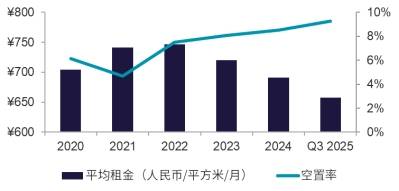
Group 1 - The core viewpoint of the articles highlights the continuous upgrade of experiential consumption and the pet economy in Guangzhou, driven by the upcoming 15th National Games and supportive policies like visa-free transit [1][8] - The retail market in Guangzhou is experiencing a multi-core development trend, with new projects like K11 Select contributing to an increase in the total stock of quality shopping centers to 6.16 million square meters [2][5] - The demand for consumption is steadily released due to the summer peak season and the influx of tourists, leading to a notable increase in family, student, and foreign visitor numbers [2][5] Group 2 - The average rent for quality shopping centers in Guangzhou has decreased by 2.3% to 657.3 yuan per square meter, as landlords adopt more favorable rental strategies to retain tenants [2] - The vacancy rate for quality shopping centers remains relatively stable, with a slight increase of 0.1 percentage points to 9.3% [2] - The rise of experiential consumption is exemplified by the opening of Miniso Land, which integrates retail, experiential zones, and cultural exhibitions, reflecting a shift towards providing emotional value in consumer experiences [7][8] Group 3 - The pet economy is expanding, with new pet-related businesses and services emerging, such as pet-friendly shopping spaces and specialized offerings from brands like Starbucks [7][8] - The upcoming National Games is expected to stimulate consumption and accommodation demand, further enhancing the business environment in Guangzhou [8] - The report indicates that 46.1% of new brands entering the market are in the food and beverage sector, while 41.8% are in retail, showcasing a strong focus on these categories [5]

当星巴克的空间“自救”野心,碰上小红书的流量赌局
Hu Xiu· 2025-09-28 02:23
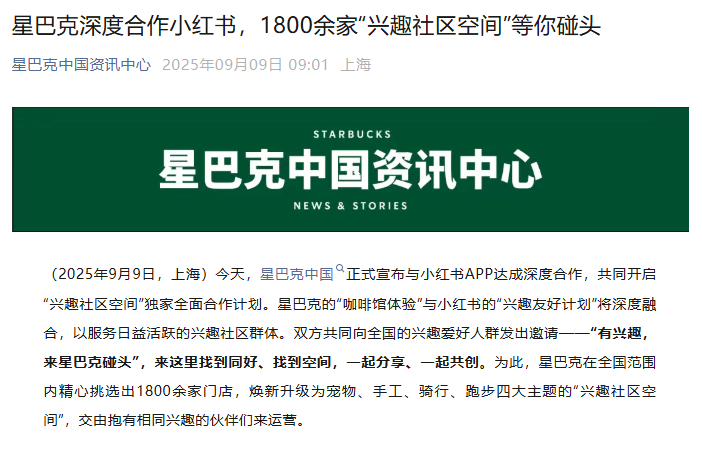
Core Insights - Starbucks China and Xiaohongshu have announced a deep collaboration to transform over 1,800 stores into themed "interest community spaces" focusing on pets, crafts, cycling, and running, indicating a strategic response to market competition pressures [1][4][19] Group 1: Collaboration Details - The partnership aims to create distinct offline social spaces catering to specific interest groups, with over 450 stores designated as pet-friendly, providing free "pawccino" treats and hosting events like pet parties [4][12] - More than 1,000 stores will offer craft-friendly spaces with experiences like unlocking craft blind boxes, while over 50 stores will provide running-friendly services such as free cup upgrades and hydration [4][12] - Cycling-friendly spaces will also be established in 50 stores, equipped with bike pumps and offering free water and limited-time cup upgrades [4][12] Group 2: Market Context - The collaboration comes as Starbucks faces declining market share in China, dropping from 42% in 2017 to 14% in 2024, largely due to competition from local brands like Luckin Coffee [19][23] - The shift in consumer behavior from a focus on the "third space" experience to a more functional, high-frequency consumption model has pressured Starbucks to redefine its market strategy [19][21] Group 3: Strategic Implications - The initiative reflects a broader trend where brands are increasingly leveraging community and interest-based marketing to build customer loyalty, as seen in other successful brands like Lululemon [25][26] - However, there are concerns that the collaboration may prioritize traffic generation over genuine community engagement, potentially leading to a perception of insincerity in the brand's efforts [38][44] - The effectiveness of this partnership will depend on Starbucks' ability to authentically connect with interest groups rather than merely using them as a marketing tool [44][52]