特定化学品

Search documents
会晤结束后,华尔街日报报道:“美高层表示,美国将立即降低关税,以换取配合。”
Sou Hu Cai Jing· 2025-10-31 23:10
Group 1 - The U.S. will immediately lower certain tariffs in exchange for cooperation from a specific Eastern country to combat the export of certain chemicals related to specific substances [1] - The U.S. Trade Representative stated that the Eastern country will relax restrictions on rare earth exports [1] - The Eastern country has agreed to make large-scale purchases of soybeans, with agricultural procurement set to start quickly [1] Group 2 - The claimed "achievements" by U.S. officials have significant limitations, with only a partial confirmation of the agreements, such as a reduction of certain tariffs from 20% to 10% after the Eastern country agreed to purchase a specific amount of agricultural products [3] - The issue of rare earth exports may require annual negotiations and could involve exchanges of rare earths for specific chips, with other aspects remaining unclear [3] - The market had previously overestimated the outcomes of the meeting, and the U.S. statements appear to be more of a self-promotional "performance" rather than a substantial breakthrough [3] Group 3 - Core interests and trade rule differences between the two parties remain unresolved, making it difficult to establish a long-term stable cooperative relationship through unilateral pressure and interest exchanges [4] - Historical experience suggests that confrontation will only exacerbate bilateral relations, while equal negotiation and mutual benefit are essential for resolution [4] - There is a hope for normal development of relations between the two parties to promote world peace and progress [4]

欧盟要购买美国能源取代俄罗斯油气,俄方回应:将导致欧洲去工业化
Sou Hu Cai Jing· 2025-07-29 07:52
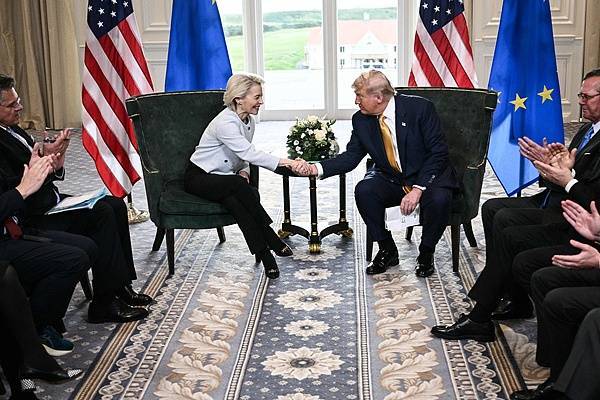
Core Points - The EU and the US have reached a new trade agreement aimed at avoiding a larger trade war, with the EU committing to stop importing Russian oil and gas in exchange for reduced US tariffs [1][3] - The EU plans to purchase $750 billion worth of energy products from the US over the next three years, diversifying its energy sources and enhancing energy security [1][4] - The agreement includes a 15% tariff on US imports from the EU, but certain categories will have zero tariffs, which has raised concerns among some European officials about the balance of the deal [4][5] Group 1 - The EU will completely abandon imports of Russian oil and gas, opting instead to purchase American energy, which is expected to contribute to European energy security [1] - The EU's energy purchases from the US will include liquefied natural gas, oil, and nuclear fuel, with a clear goal to eliminate reliance on Russian fossil fuels by 2027 [1][3] - The agreement is seen as beneficial primarily to the US, with critics arguing it could lead to deindustrialization in Europe and increased energy costs [3][4] Group 2 - The deal is expected to result in an additional $600 billion investment from the EU into the US, which some European officials view as detrimental to local employment and industry [4][5] - The agreement has faced criticism for being unbalanced, with concerns that it mirrors previous US trade tactics that pressured other nations [4][5] - European leaders have expressed dissatisfaction with the agreement, viewing it as a capitulation to US interests at the expense of European economic strength [5]